
Ресурсы
Изучайте широкий спектр ценных ресурсов ВГГ, чтобы углубить своё понимание и повысить эффективность исследований, просветительской деятельности, преподавания и обучения.
Найдено: 3,385
 Notes techniques du secteur de l'éducation: education au changement climatique Год публикации: 2013 Организация-автор: Organisation des Nations Unies pour l'éducation, la science et la culture (UNESCO) Climate change is a major challenge to sustainable development. The ten hottest years on record have occurred since 1998. Sea-levels are rising. Rainfall patterns are changing, causing droughts and floods. Extreme weather events such as storms, cyclones and heat waves are becoming more frequent and intense. Climate change poses a number of interconnected challenges, including water security, rising pressures on food production and health and disaster risks. ◗ Climate change disproportionately affects developing countries and vulnerable people within those countries, thereby seriously threatening progress towards the Millennium Development Goals (MDGs) and Education for All (EFA). It is already having a reverse impact on enrolment rates, the delivery of quality education and safe learning environments. ◗ Education has a key role to play in concerted local and global climate change mitigation and adaptation efforts. ◗ UNESCO promotes climate change education within the overall context of Education for Sustainable Development (ESD). ◗ UNESCO supports Member States in building the capacity of policy makers and educators to enhance the education sector response to climate change. ◗ Closer alignment of Climate Change Education with Disaster Risk Reduction (DRR) education contributes to safeguarding development gains and building resilience in countries vulnerable to the negative impacts of climate change. Education sector technical notes: climate change education Год публикации: 2013 Организация-автор: UNESCO Climate change is a major challenge to sustainable development. The ten hottest years on record have occurred since 1998. Sea-levels are rising. Rainfall patterns are changing, causing droughts and floods. Extreme weather events such as storms, cyclones and heat waves are becoming more frequent and intense. Climate change poses a number of interconnected challenges, including water security, rising pressures on food production and health and disaster risks. ◗ Climate change disproportionately affects developing countries and vulnerable people within those countries, thereby seriously threatening progress towards the Millennium Development Goals (MDGs) and Education for All (EFA). It is already having a reverse impact on enrolment rates, the delivery of quality education and safe learning environments. ◗ Education has a key role to play in concerted local and global climate change mitigation and adaptation efforts. ◗ UNESCO promotes climate change education within the overall context of Education for Sustainable Development (ESD). ◗ UNESCO supports Member States in building the capacity of policy makers and educators to enhance the education sector response to climate change. ◗ Closer alignment of Climate Change Education with Disaster Risk Reduction (DRR) education contributes to safeguarding development gains and building resilience in countries vulnerable to the negative impacts of climate change. Educación sobre el Cambio Climático para el Desarrollo Sostenible: Iniciativa de la UNESCO sobre el Cambio Climático Год публикации: 2010 Организация-автор: Organización de las Naciones Unidas para la Educación, la Ciencia y la Cultura (UNESCO) The UNESCO Climate Change Initiative was launched by Director-General Irina Bokova in Copenhagen during the 15th Conference of the Parties to the UN Framework Convention on Climate Change (UNFCCC COP15). It seeks to reinforce the scientific, mitigation and adaptation capacities of countries and communities that are most vulnerable to the effects of climate change. It focuses on a select number of strategic issues in line with The UN System Delivering as One on Climate Change action plan and The UNESCO Strategy for Action on Climate Change. The Initiative is based on four thematic areas: scientific, educational, environmental and ethical. Key objectives will be achieved through intersectoral and interdisciplinary cooperation, coordinated field activities, and networking. Special attention is given to UNESCO’s two global priorities, Africa and gender equality, as well as to the increased vulnerability of Small Island Developing States (SIDS). The UN System “Delivering as One” on Climate Change During the 13th session of the Conference of Parties to the UNFCCC in Bali, Indonesia, UN Secretary General Ban Ki-Moon presented an unprecedented coordination effort to bring together all the diverse perspectives, expertise and strengths of the UN system so as to deliver as one in the critical area of climate change. The initiative brings together expertise and ongoing work in diverse areas ranging from science and technology to agriculture, transport, forestry and disaster risk reduction, to address both mitigation and adaptation. It brings together the normative, standard setting and knowledge sharing capacities of the system with its operational reach in order to support the most vulnerable. The overall objective is to maximize existing synergies, eliminate duplication and overlap, and optimize the impact of the collective effort of the UN system. To ensure better coordination, convening responsibilities were assigned to UN system entities with a large volume of activities in the five focus areas and four cross-cutting areas. Focus areas ㆍAdaptation – High-Level Committee on Programmes collectively ㆍ Technology transfer – UNIDO, UN-DESA ㆍReduction of emissions from deforestation and degradation (REDD) – UNDP, FAO, UNEP ㆍ Financing mitigation and adaptation action – UNDP, World Bank Group ㆍCapacity building – UNDP, UNEP Cross-cutting areas ㆍClimate knowledge: science, assessment, monitoring and early warning – WMO, UNESCO ㆍSupporting global, regional and national action – UN-DESA, UN Regional Commissions, UNDP ㆍClimate-neutral UN – UNEP ㆍPublic awareness – UNCG, UNEP.
 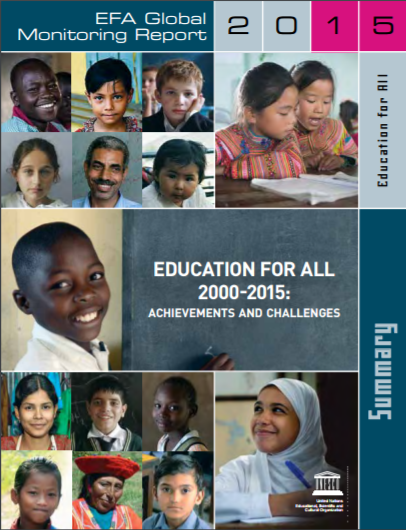 모두를 위한 교육 2000-2015: 성과와 과제; EFA 세계 현황 보고서, 2015; 요약본 Год публикации: 2015 Организация-автор: 유네스코 At the World Education Forum in Dakar, Senegal, in 2000, governments from 164 countries, together with representatives of regional groups, international organizations, donor agencies, non-government organizations (NGOs) and civil society, adopted a Framework for Action to deliver Education for All (EFA) commitments. The Dakar Framework comprised 6 goals and their associated targets to be achieved by 2015, and 12 strategies to which all stakeholders would contribute. The EFA Global Monitoring Report (GMR) has monitored progress on an almost annual basis towards the EFA goals and the two education-related Millennium Development Goals (MDGs). The 2015 GMR provides a complete assessment of progress since 2000 towards the target date for reaching the Dakar Framework’s goals. It takes stock of whether the world achieved the EFA goals and stakeholders upheld their commitments. It explains possible determinants of the pace of progress. Finally, it identifies key lessons for shaping the post-2015 global education agenda.
  Better Life, Better Future: UNESCO Global Partnership for Girl's and Women's Education Год публикации: 2015 Организация-автор: UNESCO Since its inception, UNESCO has been a strong advocate, promoter and defender of the right to quality education for all, especially for girls and women. Gender equality and education are fundamental human rights, which stand at the core of UNESCO’s mandate. UNESCO launched the Global Partnership for Girls’ and Women’s Education in 2011, guided by the conviction that by educating girls and women, we can break persistent cycles of poverty and in turn foster greater social justice. The Partnership aims to increase learning opportunities for adolescent girls and women and to find solutions to some of the biggest challenges and obstacles to their education. The partnership addresses two weakest links which are secondery education and literacy. Une Vie meilleure, un avenir meilleur: partenariat mondial de l'UNESCO pour l'éducation des filles et des femmes Год публикации: 2015 Организация-автор: Organisation des Nations Unies pour l'éducation, la science et la culture (UNESCO) Since its inception, UNESCO has been a strong advocate, promoter and defender of the right to quality education for all, especially for girls and women. Gender equality and education are fundamental human rights, which stand at the core of UNESCO’s mandate. UNESCO launched the Global Partnership for Girls’ and Women’s Education in 2011, guided by the conviction that by educating girls and women, we can break persistent cycles of poverty and in turn foster greater social justice. The Partnership aims to increase learning opportunities for adolescent girls and women and to find solutions to some of the biggest challenges and obstacles to their education. The partnership addresses two weakest links which are secondery education and literacy.
 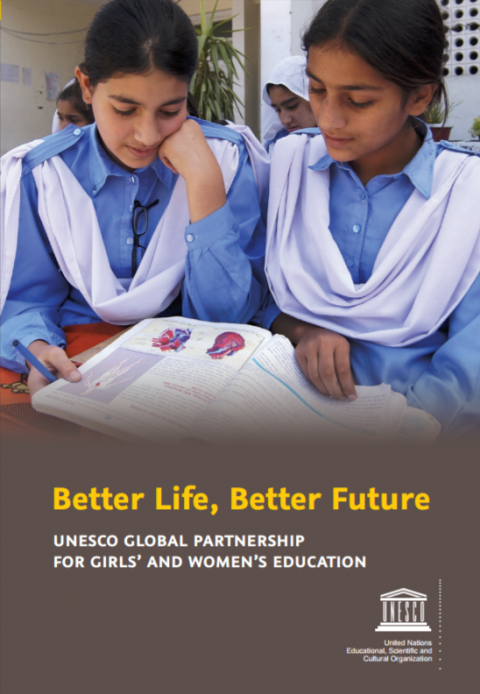 Better Life, Better Future: UNESCO Global Partnership for Girls' and Women's Education Год публикации: 2014 Организация-автор: UNESCO Since its creation, UNESCO has been advocating for, promoting and defending the right to quality education for all, especially for girls and women. As fundamental human rights, gender equality and education stand at the core of UNESCO’s mandate. UNESCO launched the Global Partnership for Girls’ and Women’s Education in 2011 guided by the conviction that educating girls and women can break the cycle of poverty and foster greater social justice. The Partnership seeks to increase learning opportunities for adolescent girls and women and to find solutions to some of the biggest challenges and obstacles to their education. The Partnership addresses two main areas which require increased attention: secondary education and literacy.
 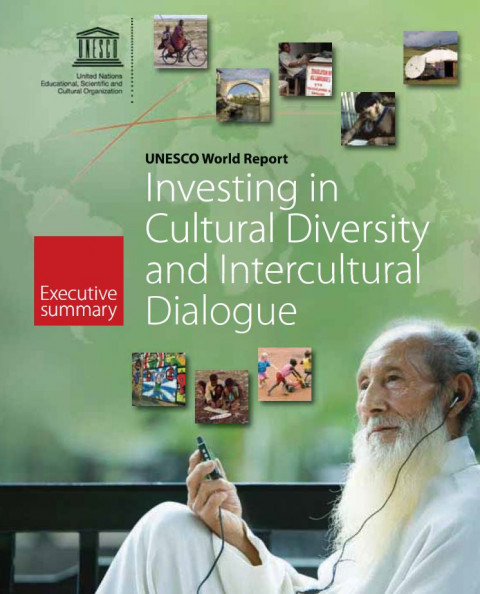 [Summary] Investing in Cultural Diversity and Intercultural Dialogue: UNESCO World Report; Executive Summary Год публикации: 2009 Организация-автор: UNESCO Cultural diversity has emerged as a key concern at the turn of a new century. Yet the meanings attached to this catch-all term are as varied as they are shifting. Some see cultural diversity as inherently positive, insofar as it points to a sharing of the wealth embodied in each of the world’s cultures and, accordingly, to the links uniting us all in processes of exchange and dialogue. For others, cultural differences are what cause us to lose sight of our common humanity and are therefore at the root of numerous conflicts.This second diagnosis is today all the more plausible since globalization has increased the points of interaction and friction between cultures, giving rise to identity-linked tensions, withdrawals and claims, particularly of a religious nature, which can become potential sources of dispute. The essential challenge, therefore, would be to propose a coherent vision of cultural diversity and thereby to clarify how, far from being a threat, it can become beneficial to the action of the international community. This is the essential purpose of the present report.
  Global Citizenship Education: Topics and Learning Objectives Год публикации: 2015 Организация-автор: UNESCO This publication, titled Global Citizenship Education: Topics and learning objectives, is the first pedagogical guidance from UNESCO on global citizenship education. It is the result of an extensive research and consultation process with experts from different parts of the world. This guidance draws on the UNESCO publication Global Citizenship Education: Preparing learners for the challenges of the 21st century and the outcomes of three key UNESCO events on global citizenship education: the Technical Consultation on Global Citizenship Education (September 2013), as well as the First and Second UNESCO Fora on Global Citizenship Education, organized in December 2013 and January 2015 respectively. Before it was finalized, the guidance was field-tested by education stakeholders in selected countries in all regions to ensure its relevance in different geographical and socio-cultural contexts. Following the foundational work of UNESCO to clarify the conceptual underpinnings of global citizenship education and provide policy and programmatic directions, this document has been developed in response to the needs of Member States for overall guidance on integrating global citizenship education in their education systems. It presents suggestions for translating global citizenship education concepts into practical and age-specific topics and learning objectives in a way that allows for adaptation to local contexts. It is intended as a resource for educators, curriculum developers, trainers as well as policy-makers, but it will also be useful for other education stakeholders working in non-formal and informal settings.
  Éducation à la citoyenneté mondiale: thèmes et objectifs d'apprentissage Год публикации: 2015 Организация-автор: Organisation des Nations Unies pour l'éducation, la science et la culture (UNESCO) Le présent ouvrage, intitulé Éducation à la citoyenneté mondiale : Thèmes et objectifs d’apprentissage, est le premier guide pédagogique de l’UNESCO sur l’éducation à la citoyenneté mondiale. Il est le fruit d’un processus approfondi de recherche et de consultation avec des spécialistes de différentes régions du monde. Ce guide s’inspire de la publication de l’UNESCO intitulée Éducation à la citoyenneté mondiale : Préparer les apprenants aux défis du XXIe siècle ainsi que des résultats de trois événements clés de l’UNESCO sur l’éducation à la citoyenneté mondiale : la Consultation technique sur l’éducation à la citoyenneté mondiale (septembre 2013) et les premier et deuxième Forums de l’UNESCO sur l’éducation à la citoyenneté mondiale, organisés en décembre 2013 et en janvier 2015. Avant sa finalisation, le guide a été expérimenté sur le terrain par des acteurs de l’éducation dans différents pays de chaque région, afin de veiller à ce qu’il soit adapté à des contextes géographiques et socioculturels divers. Inspirée des travaux de base de l’UNESCO visant à clarifier les fondements conceptuels de l’éducation à la citoyenneté mondiale, et à fournir des orientations politiques et programmatiques, cette publication a été élaborée pour répondre aux besoins des États membres, en leur donnant des indications générales sur l’intégration de l’éducation à la citoyenneté mondiale dans leurs systèmes éducatifs. Elle propose des moyens de transposer l’éducation à la citoyenneté mondiale dans des thèmes et des objectifs d’apprentissage pratiques et tenant compte de l’âge de l’apprenant, qui puissent être adaptés aux contextes locaux. Cette publication a été conçue pour servir de document de référence aux éducateurs, aux concepteurs de programmes éducatifs, aux formateurs et aux décideurs, mais elle sera également utile à d’autres acteurs de l’éducation travaillant dans des contextes non formels et informels.