
Ресурсы
Изучайте широкий спектр ценных ресурсов ВГГ, чтобы углубить своё понимание и повысить эффективность исследований, просветительской деятельности, преподавания и обучения.
Найдено: 3,385
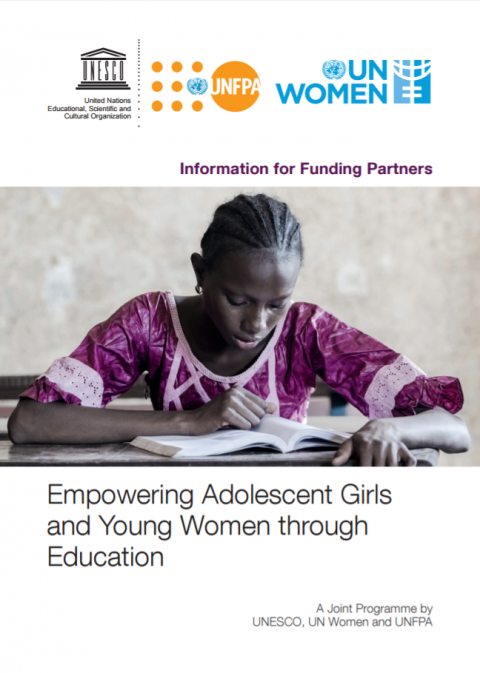 Empowering Adolescent Girls and Young Women through Education: Information for Funding Partners Год публикации: 2016 Организация-автор: UNESCO | United Nations Population Fund (UNFPA) | United Nations Entity for Gender Equality and the Empowerment of Women (UN Women) Empowering Adolescent Girls and Young Women through Education: Information for Funding Partners
 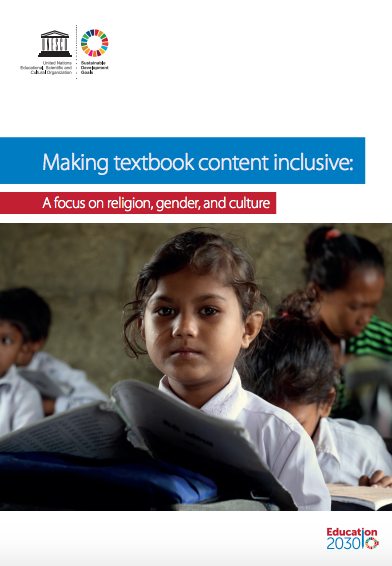 Making Textbook Content Inclusive: A Focus on Religion, Gender, and Culture Год публикации: 2017 Организация-автор: UNESCO UNESCO has been working on textbook development issues since its inception in 1945 as part of its fundamental mandate to “build peace in the minds of men and women.” The present guide’s primary task is to enable its users to address and counter stereotypes in a variety of educational contexts, through teaching and learning materials. The three key issues – religion, gender and culture – were chosen for their common link to the concept of human diversity. These three potentially controversial topics are important aspects of inclusive education because they help shape the learning environment of a school as well as its educational practices.The guide was intentionally written in a simple, practical style so as to be immediately accessible to textbook developers, adopters, and users, even those who are working on their own. Although it is designed primarily for textbook authors, curriculum developers, and teachers, it might also be particularly useful for publishers, political stakeholders, and teacher educators. Pour des manuels scolaires au contenu inclusif Год публикации: 2017 Организация-автор: Organisation des Nations Unies pour l'éducation, la science et la culture (UNESCO) UNESCO has been working on textbook development issues since its inception in 1945 as part of its fundamental mandate to “build peace in the minds of men and women.” The present guide’s primary task is to enable its users to address and counter stereotypes in a variety of educational contexts, through teaching and learning materials. The three key issues – religion, gender and culture – were chosen for their common link to the concept of human diversity. These three potentially controversial topics are important aspects of inclusive education because they help shape the learning environment of a school as well as its educational practices.The guide was intentionally written in a simple, practical style so as to be immediately accessible to textbook developers, adopters, and users, even those who are working on their own. Although it is designed primarily for textbook authors, curriculum developers, and teachers, it might also be particularly useful for publishers, political stakeholders, and teacher educators.
  Consolidated Report on the Implementation of the 1974 Recommendation Concerning Education for International Understanding, Cooperation and Peace and Education Relating to Human Rights and Fundamental Freedoms Год публикации: 2013 Организация-автор: UNESCO Background: In accordance with 34 C/Resolution 87, 177 EX/Decision 35 (I) and 184 EX/Decision 20, the Executive Board has monitored the implementation of the 1974 Recommendation concerning Education for International Understanding, Cooperation and Peace and Education relating to Human Rights and Fundamental Freedoms. Pursuant to 192 EX/Decision 20 (III), the Director-General hereby submits the consolidated report on the implementation by Member States of the Recommendation.Purpose: This document reports on the results of the Fifth Consultation on the Implementation of the Recommendation concerning Education for International Understanding, Cooperation and Peace and Education relating to Human Rights and Fundamental Freedoms (covering the period 2009-2012). The analysis was prepared on the basis of 55 national reports from Member States received by the Secretariat.
 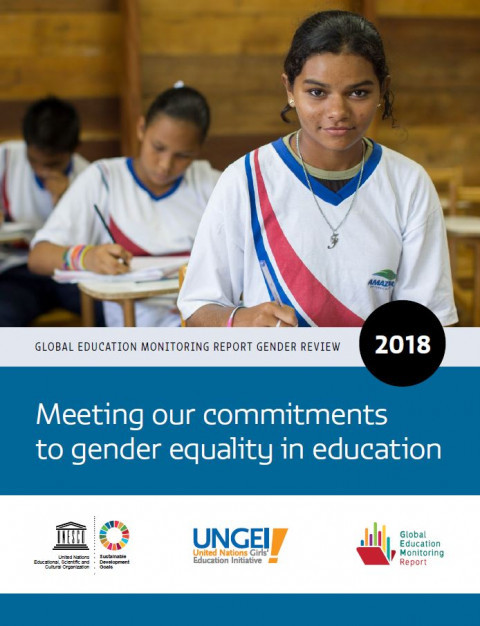 Meeting Our Commitments to Gender Equality in Education: Global Education Monitoring Report Gender Review 2018 Год публикации: 2018 Организация-автор: UNESCO The Education 2030 Framework for Action, a tool aimed at helping the international community achieve SDG 4 on education, explicitly recognizes gender equality as a guiding principle linked to the realization of the right to education. It states clearly that girls and boys, women and men, must be equally empowered ‘in and through education’.In this sixth Gender Review, in a series that began in 2011, the Global Education Monitoring Report team maintains the focus on a broad conception of gender equality that extends beyond counting boys and girls in classrooms. The review’s first part examines disparities in participation and skills, in education and political leadership positions, and in selected aspects of infrastructure and curricula. It also examines gender issues in professional development by exploring the role of education in three other SDGs: those concerning agriculture, health, and water and sanitation.The second part of the review analyses institutions, laws and policies to explore ways to determine and enforce accountability for gender equality in education. Tenir nos engagements en faveur de l'égalité des genres dans l'éducation: Rapport mondial de suivi sur l'éducation, résumé sur l'égalité des genres 2018 Год публикации: 2018 Организация-автор: Organisation des Nations Unies pour l'éducation, la science et la culture (UNESCO) Le Cadre d’action Éducation 2030, outil qui vise à aider la communauté internationale à atteindre l’ODD 4 sur l’éducation, reconnaît explicitement l’égalité des genres comme principe directeur lié à la réalisation du droit à l’éducation. Il stipule clairement que les filles et les garçons, les femmes et les hommes, doivent bénéficier des mêmes possibilités « dans et par l’éducation ».Dans ce sixième résumé sur l’égalité des genres, qui fait partie d’une série qui a commencé en 2011, l’équipe du Rapport mondial de suivi sur l’éducation reste concentrée sur une large conception de l’égalité des genres, qui va au-delà du simple comptage du nombre de filles et de garçons dans les classes. La première partie du résumé examine les disparités en matière de participation et de compétences, aux postes à responsabilité des secteurs éducatif et politique et dans certains aspects des infrastructures et des programmes scolaires. Elle examine également les questions liées au genre dans le cadre de la formation professionnelle, en explorant le rôle de l’éducation dans trois autres ODD concernant l’agriculture, la santé, et l’eau et l’assainissement.La deuxième partie du résumé analyse les institutions, les lois et les politiques afin d’explorer des manières de déterminer et de faire appliquer le principe de responsabilité pour l’égalité des genres dans l’éducation. Cumplir nuestros compromisos de igualdad de género en la educación: Resumen sobre género del informe de seguimiento de la educación en el mundo 2018 Год публикации: 2018 Организация-автор: Organización de las Naciones Unidas para la Educación, la Ciencia y la Cultura (UNESCO) El Marco de Acción para la Educación 2030, que es una herramienta encaminada a contribuir a que la comunidad internacional alcance el ODS 4 relativo a la educación, reconoce explícitamente la igualdad de género como un principio rector para la realización del derecho a la educación para todos. Dice claramente que las niñas y los niños, las mujeres y los hombres, deben adquirir las mismas competencias “en la educación y mediante ella”.En este sexto Resumen sobre Género de una serie que se inició en 2011, los autores del Informe de Seguimiento de la Educación en el Mundo siguen centrándose en un concepto amplio de la igualdad de género que va más allá del simple recuento del número de niños y niñas en las aulas.En la primera parte del documento se examinan las disparidades en materia de participación y de competencias, de puestos de dirección de alto nivel en el ámbito educativo y político, y en determinados aspectos de las infraestructuras y los programas de enseñanza. Se examinan asimismo las cuestiones de género en el desarrollo profesional, estudiando el papel de la educación en otros tres ODS, los relativos a la agricultura, la salud, y el agua y saneamiento.En la segunda parte se analizan las instituciones, leyes y políticas, con miras a explorar modalidades que permitan determinar y aplicar la rendición de cuentas en materia de igualdad de género en la educación.
 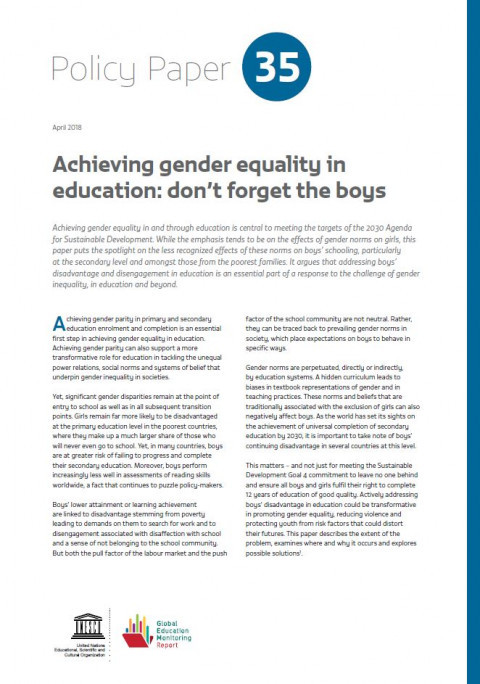 Achieving Gender Equality in Education: Don't Forget the Boys (Policy Paper 35) Год публикации: 2018 Организация-автор: UNESCO Achieving gender equality in and through education is central to meeting the targets of the 2030 Agenda for Sustainable Development. While the emphasis tends to be on the effects of gender norms on girls, this paper puts the spotlight on the less recognized effects of these norms on boys’ schooling, particularly at the secondary level and amongst those from the poorest families. It argues that addressing boys’ disadvantage and disengagement in education is an essential part of a response to the challenge of gender inequality, in education and beyond.
 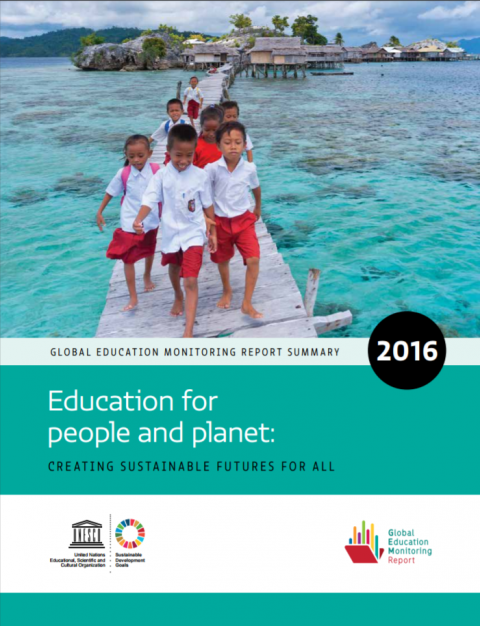 教育造福 人类与地球:为全民创造可持续的未来, 2016 全球教育监测报告; 摘要 Год публикации: 2016 Организация-автор: 联合国教科文组织 (UNESCO) The GEM Report provides an authoritative account of how education is the most vital input for every dimension of sustainable development. Better education leads to greater prosperity, improved agriculture, better health outcomes, less violence, more gender equality, higher social capital and an improved natural environment. Education is key to helping people around the world understand why sustainable development is such a vital concept for our common future. Education gives us the key tools – economic, social, technological, even ethical – to take on the SDGs and to achieve them. These facts are spelled out in exquisite and unusual detail throughout the report. Yet the report also emphasizes the remarkable gaps between where the world stands today on education and where it has promised to arrive as of 2030. التعليم من أجل الناس والكوكب: بناء مستقبل مستدام للجميع Год публикации: 2016 Организация-автор: منظمة الأمم المتحدة للتربية والعلم والثقافة (UNESCO) The GEM Report provides an authoritative account of how education is the most vital input for every dimension of sustainable development. Better education leads to greater prosperity, improved agriculture, better health outcomes, less violence, more gender equality, higher social capital and an improved natural environment. Education is key to helping people around the world understand why sustainable development is such a vital concept for our common future. Education gives us the key tools – economic, social, technological, even ethical – to take on the SDGs and to achieve them. These facts are spelled out in exquisite and unusual detail throughout the report. Yet the report also emphasizes the remarkable gaps between where the world stands today on education and where it has promised to arrive as of 2030.