
Ресурсы
Изучайте широкий спектр ценных ресурсов ВГГ, чтобы углубить своё понимание и повысить эффективность исследований, просветительской деятельности, преподавания и обучения.
Найдено: 3,451
 The round table: putting human rights into practice-the role of education; report Год публикации: 2008 Организация-автор: UNESCO This publication highlights some of the key ideas and features of the events based on the theme “60 years of Human Rights Education” at UNESCO headquarters in Paris from the 2nd of December 2008 till the 27th of February 2009. In addition to substantial opening and closing sessions, the Round Table consisted of four panels, the reporting of each consists of Summary, Introduction, Case Studies, Discussion and Recommendations. This publication can be read on a number of levels: as a retrospective commemoration of human rights education; as a celebration of current good practice; and, through its discussion and recommendations, as a source of guidance for future directions in human right education. The round table: putting human rights into practice-the role of education; report Год публикации: 2008 Организация-автор: Organisation des Nations Unies pour l'éducation, la science et la culture (UNESCO) Cette publication met en lumière quelques-unes des idées et des caractéristiques des événements clés sur le thème "60 ans d'Éducation aux Droits de l’Homme" au siège de l'UNESCO à Paris du 2 Décembre 2008 au 27 Février 2009. En plus importante ouverture et de fermeture sessions, la Table Ronde se composait de quatre panneaux, les rapports de chaque compose de Résumé, Introduction, Étude de Cas, Discussion et Recommandations. Cette publication peut être lue sur un certain nombre de niveaux: comme une commémoration rétrospective de l'éducation des droits de l'homme; comme une célébration de la bonne pratique actuelle; et, à travers la discussion et des recommandations, comme une source de conseils pour les orientations futures en matière d'éducation droit humain. 라운드 테이블 보고서: ‘교육의 실천적 역할에 인권을 넣어’ Год публикации: 2008 Организация-автор: 유네스코 본 간행물은 2008년 12월 2일부터 2009년 2월 27일까지 파리 유네스코 본부에서 개최 된 “인권 교육의 60년(60 years of Human Rights Education)”에서 다룬 주제를 토대로 한 주요 개념들과 그 행사의 특징들에 대한 하이라이트이다. 행사의 실질적인 개회와 폐회 세션 이외에도, 라운드 테이블은 네 개의 패널, 각각의 요약본(summary) 이 포함된 보고서, 소개, 사례 연구, 토론과 권고안들로 구성되어 있다. 이 간행물은 다양한 수준에서 읽기가 가능하다. 즉, 인권 교육에 대한 일종의 회고전으로, 현재의 바람직한 관례를 기념하기 위해, 그리고 그들에 대한 토론과 권고안들을 통해서 인권 교육이 나아갈 미래의 방향을 위한 지침 자료로 읽을 수 있다. Déclaration d'Aichi-Nagoya sur l'Education au Développement Durable Год публикации: 2014 Организация-автор: Organisation des Nations Unies pour l'éducation, la science et la culture (UNESCO) We, the participants of the UNESCO World Conference on Education for Sustainable Development held in AichiNagoya, Japan, from 10 to 12 November 2014, adopt this Declaration and call for urgent action to further strengthen and scale up Education for Sustainable Development (ESD), in order to enable current generations to meet their needs while allowing future generations to meet their own, with a balanced and integrated approach regarding the economic, social and environmental dimensions of sustainable development. This Declaration recognises that people are at the centre of sustainable development and builds on the achievements of the United Nations (UN) Decade of ESD (2005-2014); the deliberations of the UNESCO World Conference on ESD in Aichi-Nagoya; and the Stakeholder Meetings held in Okayama, Japan, from 4 to 8 November 2014, namely, UNESCO ASPnet International ESD events, the UNESCO ESD Youth Conference, the Global Regional Centres of Expertise Conference, and other relevant events and consultation processes, including regional ministerial meetings. We express our sincere gratitude to the Government of Japan for hosting the UNESCO World Conference on ESD. Aichi-Nagoya Declaration on Education for Sustainable Development Год публикации: 2014 Организация-автор: UNESCO We, the participants of the UNESCO World Conference on Education for Sustainable Development held in AichiNagoya, Japan, from 10 to 12 November 2014, adopt this Declaration and call for urgent action to further strengthen and scale up Education for Sustainable Development (ESD), in order to enable current generations to meet their needs while allowing future generations to meet their own, with a balanced and integrated approach regarding the economic, social and environmental dimensions of sustainable development. This Declaration recognises that people are at the centre of sustainable development and builds on the achievements of the United Nations (UN) Decade of ESD (2005-2014); the deliberations of the UNESCO World Conference on ESD in Aichi-Nagoya; and the Stakeholder Meetings held in Okayama, Japan, from 4 to 8 November 2014, namely, UNESCO ASPnet International ESD events, the UNESCO ESD Youth Conference, the Global Regional Centres of Expertise Conference, and other relevant events and consultation processes, including regional ministerial meetings. We express our sincere gratitude to the Government of Japan for hosting the UNESCO World Conference on ESD. Déclaration d'Aichi-Nagoya sur l'Éducation pour le Développement Durable Год публикации: 2014 Организация-автор: Organisation des Nations Unies pour l'éducation, la science et la culture (UNESCO) Développement durable tenu à Aichi Nagoya, au Japon, du 10 au 12 Novembre 2014, adopte la présente Déclaration et appel à une action urgente pour renforcer et intensifier l'éducation pour le développement durable (EDD), afin de permettre aux générations actuelles de répondre à leurs besoins tout en permettant l'avenir générations à répondre à leurs propres, avec une approche équilibrée et intégrée en ce qui concerne les dimensions économiques, sociales et environnementales du développement durable. Cette Déclaration reconnaît que les gens sont au centre du développement durable et se fonde sur les résultats de la Décennie des Nations Unies (ONU) de l'EDD (2005-2014); les délibérations de la conférence mondiale sur EDD UNESCO à Aichi-Nagoya; et les réunions des parties prenantes tenues à Okayama, au Japon, du 4 au 8 Novembre 2014, à savoir, le réseau des écoles associées à l'UNESCO (réSEAU), les événements JED International, la Conférence des jeunes de l'UNESCO sur l'EDD, la Conférence des centres régionaux d'expertise, et d'autres événements pertinents et les processus de consultation, y compris les réunions ministérielles régionales. Nous exprimons notre sincère gratitude au Gouvernement du Japon pour avoir accueilli la Worldconférenceon EDD UNESCO.
 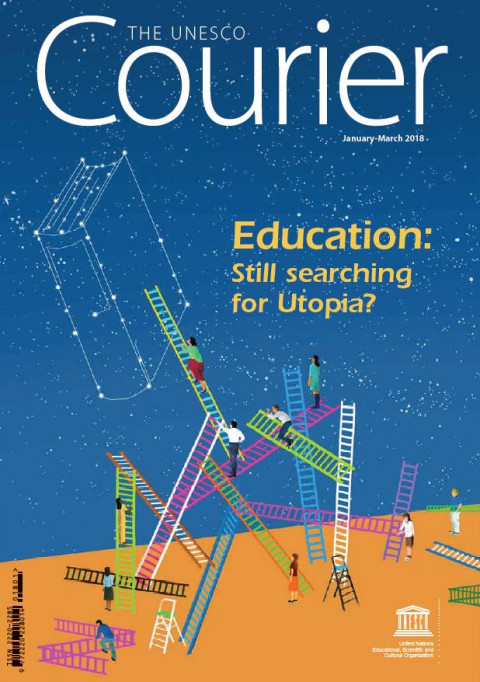 Education: Still Searching for Utopia? (The UNESCO Courier no. 1, January-March 2018) Год публикации: 2018 Организация-автор: UNESCO At a time of heightened global tension, when human rights, freedom of speech, peace and the future of the planet itself may seem challenged as never before, the transformational power of education is of critical importance.In Learning: The Treasure Within, the landmark Report to UNESCO by the International Commission on Education for the Twenty-first Century in 1996, Jacques Delors, then Chairman of the Commission (1992 to 1996), spoke of education as “the necessary Utopia” and “an indispensable asset in its attempt to attain the ideals of peace, freedom and social justice.”Education was held up as neither miracle nor magic, but rather the best means to foster a climate where humanity would be improved −. and where the rich potential for learning, inherent in every individual, would be tapped. Our humanity is confronted with a very strange paradox: the world’s population has never been better educated, and yet, according to the UNESCO Institute for Statistics, 263 million children and young people are out of school, 617 million children and adolescents worldwide do not meet the minimum threshold for literacy and mathematics, at least 750 million adults are illiterate, and girls remain more likely than boys to never set foot in a classroom. Yet education is still called upon to address inequalities, poverty, terrorism and conflict. It is seen as one of the keys to global citizenship and sustainable development, two of UNESCO’s fields of action. The Organization is also mandated to lead the Education 2030 global agenda with a special focus on ensuring that no one is left behind. Under the title, “Education: Still searching for Utopia?”, the UNESCO Courier evaluates the state of global education and explores how it responds to some of the main challenges we face. Education: en quête d'une utopie nécessaire (Le Courrier de l’UNESCO no. 1, Janvier-Mars 2018) Год публикации: 2018 Организация-автор: Organisation des Nations Unies pour l'éducation, la science et la culture (UNESCO) À une époque où la tension ne cesse de croître, où les droits de l'homme, la liberté d'expression, la paix et l'avenir de la planète semblent plus que jamais remis en question, le pouvoir de transformation véhiculé par l'éducation revêt une importance cruciale.L’éducation est une « utopie nécessaire », elle est « un atout indispensable pour permettre à l’humanité de progresser vers les idéaux de paix, de liberté et de justice sociale », lit‑on dans le rapport historique de l’UNESCO, L’éducation : un trésor est caché dedans, élaboré par la Commission internationale sur l'éducation pour le XXIe siècle, présidée en 1996 par Jacques Delors.L'éducation n'y est présentée ni comme miracle, ni comme baguette magique, mais comme le meilleur moyen de favoriser un climat permettant à l'humanité de s’améliorer.Notre humanité est confrontée à un paradoxe très étrange : la population mondiale n’a jamais été aussi instruite, alors que, selon l’Institut de statistiques de l’UNESCO, 263 millions d’enfants et de jeunes ne sont pas scolarisés, que 617 millions d’enfants et d’adolescents dans le monde n’atteignent pas le seuil minimal de compétence en lecture et en mathématiques, qu’au moins 750 millions d’adultes sont analphabètes, et que les filles demeurent plus susceptibles que les garçons de ne jamais mettre les pieds dans une classe. Cependant l’éducation est toujours appelée à remédier aux inégalités, à la pauvreté, au terrorisme et aux conflits. Elle est considérée comme une des clés essentielles de la citoyenneté mondiale et du développement durable, deux domaines d’action de l’UNESCO, qui a aussi pour mandat de diriger l’agenda mondial Éducation2030 en veillant tout particulièrement à ce que personne ne soit laissé pour compte.Sous le titre « Éducation : en quête d'une utopie nécessaire », Le Courrier de l'UNESCO porte un regard panoramique sur l'éducation dans le monde et explore comment elle peut répondre à certains grands défis. La Educación, una utopia necesaria (El Correo de la UNESCO no.1, Enero-Marzo 2018) Год публикации: 2018 Организация-автор: Organización de las Naciones Unidas para la Educación, la Ciencia y la Cultura (UNESCO) El poderoso vector de transformación que es la educación reviste una importancia fundamental en estos tiempos en que parecen ponerse en tela de juicio más que nunca los derechos humanos, la libertad de expresión, la paz y el futuro de nuestro planeta.La educación es una “utopía necesaria” y “constituye un instrumento indispensable para que la humanidad pueda progresar hacia los ideales de paz, libertad y justicia social”, tal como se afirma en el histórico informe “La educación encierra un tesoro”, presentado a la UNESCO en 1996 por la Comisión Internacional sobre la Educación para el siglo XXI presidida por Jacques Delors.La educación, según ese informe, no es un remedio milagroso ni un mágico “ábrete sésamo”, sino una vía mejor que otras para lograr que la humanidad sea mejor.Nuestra época afronta una situación extremadamente paradójica. Mientras que el nivel de instrucción de la población mundial ha alcanzado su más alto nivel histórico, todavía quedan en el mundo 263 millones de niños y adolescentes sin escolarizar y otros 617 millones no logran alcanzar un nivel mínimo de competencia en lectura, escritura y matemáticas. Además, hay 750 millones de adultos analfabetos y actualmente la posibilidad de que las niñas y las jóvenes no pisen jamás una escuela es mucho más alta que en el caso de los varones. Ahora bien, la educación sigue siendo un instrumento indispensable para reducir las desigualdades, la pobreza, elterrorismo y los conflictos armados, así como un factor clave para la mentalización de las personas con vistas a que lleguen a “ciudadanos del mundo” y coadyuven a al desarrollo sostenible. La educación para la ciudadanía y para el desarrollo sostenible son dos ámbitos de acción de la UNESCO, que además tiene el mandato de liderar la agenda mundial Educación 2030, procurando en especial que los sistemas educativos no dejen a nadie atrás.Bajo el título “La educación, una utopía necesaria”, El Correo de la UNESCO traza una panorámica de determinados aspectos de la educación en el mundo, así como de la manera en que ésta puede responder a algunos de los grandes retos planteados a la humanidad.
  [Video] How Many Languages Can You Recognize? Год публикации: 2018 Организация-автор: UNESCO How many languages can you recognize in the video? People have the right to receive education in their mother language!More languages will be added to the SDG4 video!So don't forget to have a look at our playlist (link below) and let us know your mother tongue on our social media channels!SDG4 PLAYLIST: http://bit.ly/UNESCO-SDG4International Mother Language Day webpage: https://en.unesco.org/international-days/international-mother-language-day