
Ресурсы
Изучайте широкий спектр ценных ресурсов ВГГ, чтобы углубить своё понимание и повысить эффективность исследований, просветительской деятельности, преподавания и обучения.
Найдено: 3,448
 La Prévention de l’extrémisme violent par l’éducation: activités efficaces et impact; note d’orientation Год публикации: 2018 Организация-автор: Organisation des Nations Unies pour l'éducation, la science et la culture (UNESCO) Depuis 2015, l’UNESCO a mis en avant l’importance de l’éducation dans la prévention de l’extrémisme violent (PEV-E), dans le cadre de ses efforts pour faire progresser l’éducation à la citoyenneté mondiale (ECM). Malgré le nombre croissant d’activités de PEV-E à travers le monde, il manque des preuves de leur efficacité et leur impact.Ce document d’orientation a pour objectif de répondre à deux questions : (i) Quels types d’activités de PEV-E paraissent plus efficaces ? et (ii) Quel est l’impact prouvé des activités de PEV-E ?L’objectif est d’aider les acteurs de l’éducation à entreprendre des programmes ayant un plus grand impact et à prendre des décisions éclairées sur les priorités en matière de dépenses.Le document d’orientation montre que la PEV-E fonctionne, mettant en évidence divers types d’activités qui se sont avérées particulièrement efficaces. Il recommande enfin des actions à entreprendre pour obtenir davantage de preuves sur ce qui fonctionne ou pas.
  Media and Information Literacy: Reinforcing Human Rights, Countering Radicalization and Extremism (The MILID Yearbook, 2016) Год публикации: 2016 Автор: Jagtar Singh | Paulette Kerr | Esther Hamburger Организация-автор: UNESCO | Alliance of Civilizations Media and Information Literacy (MIL) is a strong tool, cutting across educational, cultural and social contexts. It can help overcome disinformation, stereotypes and intolerance conveyed through some media and in online spaces. Here, stimulating critical empathy is one of the vital components and there are many stakeholders that have a role to play in this dimension of MIL.This year’s edition is focused on a highly relevant theme of “Media and Information Literacy: Reinforcing Human Rights, Countering Radicalization and Extremism”. It is a relevant reference point to initiate discussion and offer perspectives to stakeholders seeking to apply MIL as a tool to counter violent extremism. There is evident need for evidence-based research, assessment and evaluation that can provide insight into the impact of media and information literacy on societies. UNESCO trusts that this publication will contribute to ongoing scholarship and debate on these key topics.For media and other information providers to serve their purpose, we need critical minds in the public, which means to develop MIL programmes at the national, regional and international levels.
  Diversity, Dialogue and Sharing: Online Resources for a More Resourceful World Год публикации: 2017 Автор: Francine Saillant Организация-автор: UNESCO The different societies and regions of the world are developing original perspectives on diversity, cultural rapprochement and intercultural dialogue. These perspectives arise through the complex interactions between regional structures, governmental bodies, civil society and cultural institutions. The tools available to these actors are easily identifiable on a global scale, particularly those regularly produced by UNESCO. However, other tools exist - intercultural universities, virtual libraries, training programs for urban policies, MOOCS, video conferences, virtual exhibitions, online archives, to name but a few - their visibility limited by their fragmented distribution. It is through these resources that countries and regions succeed in producing responses in support and promotion of diversity adapted to their context specific problems.This book provides a reinterpretation of the concept of intercultural dialogue rooted in regional perspectives on diversity, giving a broad panorama of the shared theoretical, practical and technical tools and online resources available.This book comprises three parts. Part 1 examines the perspectives selected for our inquiry from a conceptual and reflective standpoint. Topics covered will include the notions of diversity and dialogue, an examination of these notions, and finally our methodology. Part 2 introduces the regions (in the sense established by UNESCO), their diversity-related characteristics and issues, and the regional strategies adopted in order to promote not only diversity but also rapprochement and dialogue. Finally, Part 3 details the various actions that embody the regions’ strategies and broad orientations, with each action being presented based on its underlying aims. Parts 2 and 3 represent two different ways of approaching the shared and shareable resources in question, of which we hope to present the most promising aspects.
 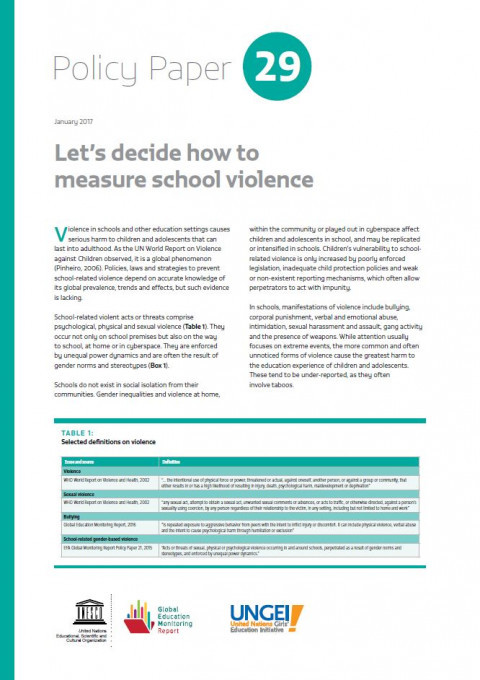 Let's Decide How to Measure School Violence (Policy Paper 29) Год публикации: 2017 Организация-автор: UNESCO Violence in schools and other education settings causes serious harm to children and adolescents that can last into adulthood. As the UN World Report on Violence against Children observed, it is a global phenomenon (Pinheiro, 2006). Policies, laws and strategies to prevent school-related violence depend on accurate knowledge of its global prevalence, trends and effects, but such evidence is lacking.In schools, manifestations of violence include bullying, corporal punishment, verbal and emotional abuse, intimidation, sexual harassment and assault, gang activity and the presence of weapons. While attention usually focuses on extreme events, the more common and often unnoticed forms of violence cause the greatest harm to the education experience of children and adolescents. These tend to be under-reported, as they often involve taboos.To collect data on aspects of violence in schools, large-scale, multi-country school-based surveys are increasingly used; some countries also have well-established monitoring mechanisms. Overall, however, consistent evidence on the global prevalence and trends of school-related violence is lacking. To ensure reliable data is gathered, action is needed to bridge differences between the various monitoring methods. This paper, launched to coincide with the International Symposium on School Violence and Bullying: From Evidence to Action, in Seoul, Republic of Korea (January 17–19, 2017), aims to inform the current debate and propose options for the future.
 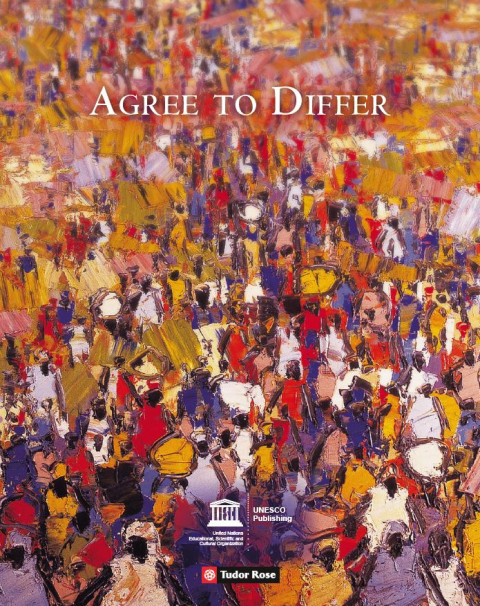 Agree to Differ Год публикации: 2015 Организация-автор: UNESCO Dialogue on the basis of respect, tolerance, human rights and dignity has never been so important. This is the spirit of the International Decade for the Rapprochement of Cultures (2013-2022). The International Decade originates in the United Nations General Assembly Resolution 67/104 adopted in December 2012, co-sponsored by Kazakhstan and designating UNESCO as lead agency. This drew on a Resolution of the UNESCO General Conference and the experience of the 2010 International Year for the Rapprochement of Cultures which UNESCO led forward with activities across the world.The objective of the International Decade is to promote mutual understanding and respect for diversity, rights and equal dignity between peoples, through intercultural dialogue and concrete initiatives. This is essential for all societies today, undergoing deep transformation. The surge of conflict, acts of violence, extremism and intolerance pose a threat to peace, undermining the unity of humanity and calling on us all to redouble our efforts to advance a culture of peace, through dialogue, the safeguarding of cultural heritage, and the promotion of global citizenship education.The International Decade for the Rapprochement of Cultures embodies a commitment to explore new articulations between cultural diversity and universal values. The rapprochement of cultures calls for a commitment to the principles of human dignity and solidarity as the corner stones of living together within and between societies, making the most of all sources of diversity.This publication bears testimony to the urgency of addressing contemporary challenges through intercultural and interreligious dialogue in order to deepen understanding and cooperation for peace. Through concrete examples, including experiences at the community level from across the world, the publication showcases why cultural diversity, intercultural dialogue and responsive democratic governance are vital for the enhancement of mutual understanding, the growth of tolerance, and the building of bridges of mutual respect and dignity.
 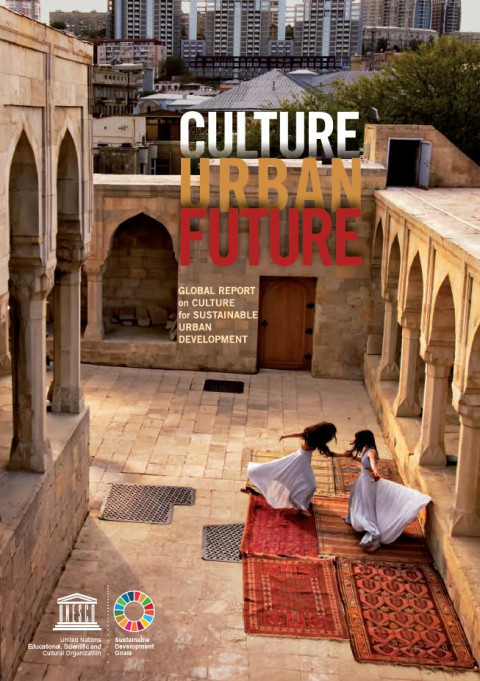 Culture: Urban Future; Global Report on Culture for Sustainable Urban Development Год публикации: 2016 Организация-автор: UNESCO As the cornerstone of society, culture must lie at the heart of sustainable policies and strategies. Yet, despite its vital importance, key questions such as: ‘How has culture influenced urban development across the world?’ and ‘How can culture make a difference to our urban future?’ have often remained unexplored.This report, the first of its kind, explores the role of culture for sustainable urban development. It is intended as a policy framework document to support governments in the implementation of the 2030 Agenda for Sustainable Urban Development and the New Urban Agenda.In search of a common thread between the past and the future, the report examines the contribution of culture to urban sustainability from two analytical angles: a global survey implemented with nine regional partners across the world; and key thematic insights. The report thus analyses the situation, trends, threats and existing opportunities in different regional contexts, and presents a global picture of urban heritage safeguarding, conservation and management, as well as the promotion of cultural and creative industries, as resources for sustainable urban development. The report also includes a set of maps and a section on UNESCO’s strategic networks reflecting the Organization’s various fields of competence.Building on the findings of this global research and thematic reflection, the report presents new guidelines and recommendations, rooted in culture, to ensure that the cities of tomorrow are safe, inclusive, resilient and sustainable.
 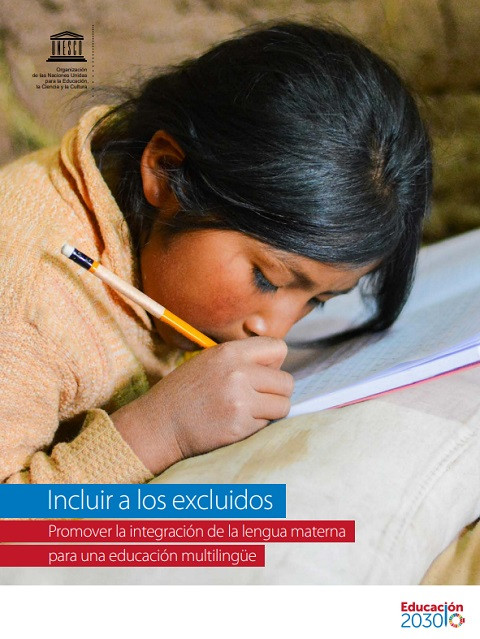 Including the Excluded: Promoting the Integration of the Mother Tongue for a Multilingual Education Год публикации: 2020 Организация-автор: UNESCO This publication presents the advantages of including the mother tongue and promoting multilingual education, as well as guidelines for achieving it. Incluir a los excluidos: Promover la integración de la lengua materna para una educación multilingüe Год публикации: 2020 Организация-автор: Organización de las Naciones Unidas para la Educación, la Ciencia y la Cultura (UNESCO) Esta publicación presenta las ventajas de incluir la lengua materna y promover una educación multilingue, así como orientaciones para lograrlo.
  Education pour le développement durable: bonnes pratiques en matière de biodiversité Год публикации: 2012 Организация-автор: Organisation des Nations Unies pour l'éducation, la science et la culture (UNESCO) To support the growing interest in biodiversity issues and ESD, UNESCO is publishing this volume containing 24 examples of programmes addressing biodiversity in ESD settings and practices. These good practices and shared experiences, which were provided by a range of different stakeholders, are concrete examples of successful implementation of ESD in different fields and sectors, from the political to the school level, and including formal, non-formal and informal learning situations. Education for sustainable development; good practices in addressing biodiversity Год публикации: 2012 Организация-автор: UNESCO To support the growing interest in biodiversity issues and ESD, UNESCO is publishing this volume containing 24 examples of programmes addressing biodiversity in ESD settings and practices. These good practices and shared experiences, which were provided by a range of different stakeholders, are concrete examples of successful implementation of ESD in different fields and sectors, from the political to the school level, and including formal, non-formal and informal learning situations.