
Ресурсы
Изучайте широкий спектр ценных ресурсов ВГГ, чтобы углубить своё понимание и повысить эффективность исследований, просветительской деятельности, преподавания и обучения.
Найдено: 3,376
 Новый взгляд на содействие ЕС образовательному сектору в Центральной Азии (Брифинг EUCAM No. 37, сентябрь 2019) Год публикации: 2019 Автор: Sebastien Peyrouse Организация-автор: Europe-Central Asia Monitoring (EUCAM) Этот брифинг основан на более углубленном исследовании системы образования в Центральной Азии, которое включает интервью в регионе (с учителями, родителями и учащимися) в Казахстане, Кыргызстане и Узбекистане.Ряд выводов позаимствованы из работы Себастьяна Пейруза ‘How to Strengthen Western Engagement in Central Asia: Spotlight on EU Education Assistance in Uzbekistan’, PONARS Policy Memo, no. 524, апрель 2018,http://www.ponarseurasia.org/memo/strengthen-western-engagement-central-asia-spotlight-eu-education-assistance-uzbekistan.
  Teacher Policy Development Guide Год публикации: 2019 Организация-автор: UNESCO | International Task Force on Teachers for Education 2030 Countries will need to have a broad perspective on teacher issues in order to meet Sustainable Development Goal 4 and address the provisions on Teachers in the Incheon Declaration with the Framework for Action of Education 2030. A system to orient the elaboration and/or review of national teacher policies will be a useful tool. The International Teacher Task Force builds on its comparative advantage as a global multiple-stakeholder alliance joining hands to address the global teacher challenges, to offer the present Teacher Policy Development Guide.Users will find relevant definitions of concepts, description of the different dimensions of teacher issues and how they correlate, and suggestions of phases in the process of developing a national teacher policy. Of utmost importance is the involvement of all stakeholders, especially the teachers, in the process.
 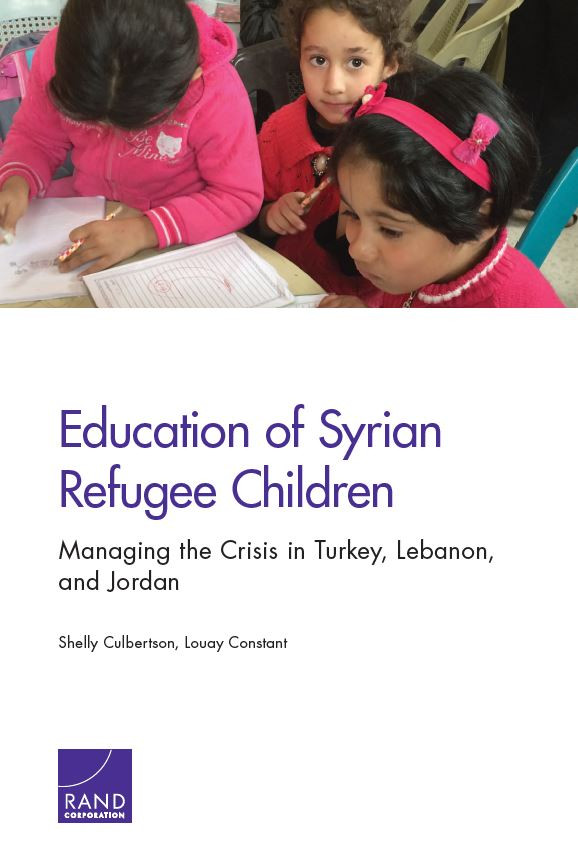 Education of Syrian Refugee Children: Managing the Crisis in Turkey, Lebanon, and Jordan Год публикации: 2015 Автор: Shelly Culbertson | Louay Constant Организация-автор: RAND Corporation With four million Syrian refugees as of September 2015, there is urgent need to develop both short-term and long-term approaches to providing education for the children of this population. This report reviews Syrian refugee education for children in the three neighboring countries with the largest population of refugees — Turkey, Lebanon, and Jordan — and analyzes four areas: access, management, society, and quality. Policy implications include prioritizing the urgent need to increase access to education among refugees; transitioning from a short-term humanitarian response to a longer-term development response; investing in both government capacity to provide education and in formal, quality alternatives to the public school systems; improving data in support of decisionmaking; developing a deliberative strategy about how to integrate or separate Syrian and host-country children in schools to promote social cohesion; limiting child labor and enabling education by creating employment policies for adults; and implementing particular steps to improve quality of education for both refugees and citizens.
  Global citizenship curriculum in higher education: evolving policy and practice and a future research agenda; proceedings of a symposium held on 9-10 December 2013 in Hong Kong Год публикации: 2013 Организация-автор: Bath Spa University | General Education Centre (Hong Kong) | Polytechnic University This symposium was an outgrowth of a UK Economic and Social Research Council (ESRC) funded International Networking Project. A collaboration between academics in the United Kingdom/Europe, North America, and Asia, this project responds to the fact that there is an increasing interest in understanding how universities can educate students to become more engaged and globally-minded citizens. The premise is that higher education should contribute to the public good by training more global citizens with cultural awareness, a strong sense of civic responsibility and skills to participate in a knowledge-based global economy. The following report documents the symposium proceedings, summarises the presentations and provides key insights drawn from presentations. Comments made by individuals are paraphrased and/or synthesized. Programme de Citoyenneté Mondiale dans l'enseignement supérieur: la politique et la pratique en évolution et un futur programme de recherche; actes d'un colloque tenu les 9-10 Décembre 2013 à Hong Kong Год публикации: 2013 Организация-автор: Bath Spa University | General Education Centre (Hong Kong) | Polytechnic University Ce symposium était une excroissance du Conseil de la recherche économique et sociale du Royaume-Uni (en. ESRC) financé Projet international de réseautage. Une collaboration entre les universitaires au Royaume-Uni / Europe, Amérique du Nord, et en Asie, ce projet répond au fait qu'il ya un intérêt croissant pour comprendre comment les universités peuvent éduquer les élèves à devenir des citoyens plus engagés et ouverts sur le monde. La prémisse est que l'enseignement supérieur doit contribuer au bien public par la formation des citoyens plus globales avec la conscience culturelle, un fort sentiment de responsabilité et les compétences civiques de participer à une économie mondiale fondée sur le savoir. Le rapport suivant documente les actes du colloque, résume les présentations et fournit des informations clés tirées des présentations. Commentaires formulés par les individus sont paraphrasés et / ou synthétisés.
  Six ways to ensure higher education leaves no one behind Год публикации: 2017 Организация-автор: UNESCO International Institute for Educational Planning (IIEP) This policy paper, written in partnership with the UNESCO International Institute for Education Planning (IIEP), makes policy recommendations for equitable and affordable higher education to better support the implementation of the SDG agenda. To do this, it reviews recent trends in higher education expansion, identifies disparities in student participation, examines policy tools and practices for fostering equity, and explores ways to target assistance at those who need it most. Six façons de garantir que l'enseignement supérieur ne laisse personne sur le carreau Год публикации: 2017 Организация-автор: UNESCO International Institute for Educational Planning (IIEP) This policy paper, written in partnership with the UNESCO International Institute for Education Planning (IIEP), makes policy recommendations for equitable and affordable higher education to better support the implementation of the SDG agenda. To do this, it reviews recent trends in higher education expansion, identifies disparities in student participation, examines policy tools and practices for fostering equity, and explores ways to target assistance at those who need it most. Seis maneras de asegurar que la educación superior no deje a nadie atrás Год публикации: 2017 Организация-автор: UNESCO International Institute for Educational Planning (IIEP) This policy paper, written in partnership with the UNESCO International Institute for Education Planning (IIEP), makes policy recommendations for equitable and affordable higher education to better support the implementation of the SDG agenda. To do this, it reviews recent trends in higher education expansion, identifies disparities in student participation, examines policy tools and practices for fostering equity, and explores ways to target assistance at those who need it most.
  Shared Responsibility, Global Solidarity: Responding to the Socio-Economic Impacts of COVID-19 Год публикации: 2020 Организация-автор: United Nations (UN) We are facing a global health crisis unlike any in the 75-year history of the United Nations — one that is killing people, spreading human suffering, and upending people’s lives. But this is much more than a health crisis. It is a human crisis. The coronavirus disease (COVID-19) is attacking societies at their core. The IMF has just reassessed the prospect for growth for 2020 and 2021, declaring that we have entered a recession – as bad as or worse than in 2009. The IMF projects recovery in 2021 only if the world succeeds in containing the virus and take the necessary economic measures.In the face of such an unprecedented situation in recent history, the creativity of the response must match the unique nature of the crisis – and the magnitude of the response must match its scale. No country will be able to exit this crisis alone.This report is a call to action, for the immediate health response required to suppress transmission of the virus to end the pandemic; and to tackle the many social and economic dimensions of this crisis. It is, above all, a call to focus on people – women, youth, low-wage workers, small and medium enterprises, the informal sector and on vulnerable groups who are already at risk.
 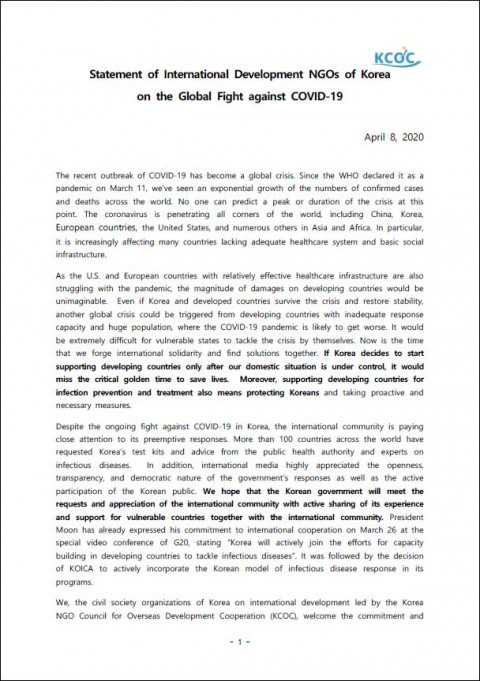 Statement of International Development NGOs of Korea on the Global Fight against COVID-19 Год публикации: 2020 Организация-автор: Korea NGO Council for Overseas Development Cooperation (KCOC) The recent outbreak of COVID-19 has become a global crisis. Since the WHO declared it as a pandemic on March 11, we’ve seen an exponential growth of the numbers of confirmed cases and deaths across the world. No one can predict a peak or duration of the crisis at this point.As the U.S. and European countries with relatively effective healthcare infrastructure are also struggling with the pandemic, the magnitude of damages on developing countries would be unimaginable. It would be extremely difficult for vulnerable states to tackle the crisis by themselves. Now is the time that we forge international solidarity and find solutions together.