
Ресурсы
Изучайте широкий спектр ценных ресурсов ВГГ, чтобы углубить своё понимание и повысить эффективность исследований, просветительской деятельности, преподавания и обучения.
Найдено: 3,780
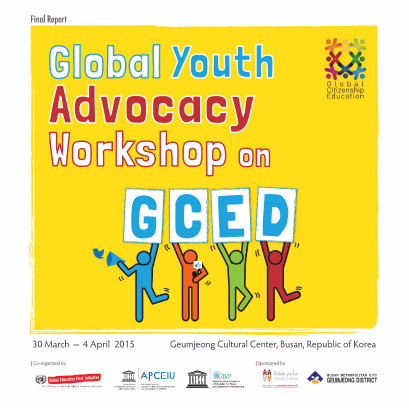 La jeunesse mondiale atelier de plaidoyer sur ECM: rapport final Год публикации: 2015 Организация-автор: Centre Asie-Pacifique d'éducation pour la compréhension internationale (APCEIU) À l'appui de SGNU GEFI, l'UNESCO a tenu son Forum mondial Deuxième sur L'éducation à la citoyenneté Mondiale (ECM) sur la construction de sociétés pacifiques et durables: Préparation de L'après 2015 du 28 au 30 Janvier 2015 à Paris, France. Le forum visait à identifier les entrées liées à l'ECM au Cadre émergent d'action sur l'éducation pour le programme de développement post 2015, ainsi que les dimensions clés de l'ECM par rapport à la paix. En outre, il a eu une séance simultanée dédiée aux jeunes sur la conduite du ECM Agenda Forward: Agir avec et pour les jeunes à assembler les perspectives, les idées et les priorités de la jeunesse sur ECM. Dans ce contexte, l'atelier de plaidoyer mondial de la jeunesse sur ECM, co-organisé par GEFI, le Centre Asie-Pacifique d'éducation pour la compréhension internationale (APCECI) et de l'Institut Mahatma Gandhi de l'UNESCO de l'éducation pour la paix et le développement durable (MGIEP) visant à construire le la capacité des jeunes leaders dynamiques des pays du monde entier à plaider pour ECM. Les participants de l'atelier ont été sélectionnés sur la base de leurs expériences précédentes, l'engagement présent et futur engagement dans l'éducation des jeunes aux niveaux local et national. Les objectifs de l'atelier étaient les suivants: 1. Pour construire une compréhension commune de l'ECM et de ses domaines prioritaires en misant sur le dialogue initié lors du Forum ECM Paris. 2. Pour permettre aux jeunes leaders participants d'élaborer une stratégie de plaidoyer approprié pour la mise en œuvre aux niveaux local et national pour faire avancer l'ordre du jour de l'ECM au-delà de 2015. 3. Pour établir un réseau plus large de défenseurs des jeunes sur ECM pour faire avancer l'ordre du jour à l'échelle mondiale. 글로벌시민교육 청소년 리더십 워크숍 최종보고서 Год публикации: 2015 Организация-автор: 유네스코 아시아태평양 국제이해교육원 본 보고서는 2015년 3월 30일부터 4월 4일까지 부산에서 열린 ‘글로벌시민교육 청소년 리더십 워크숍(Global Youth Advocacy Workshop on GCED)’의 최종보고서이다. 이번 워크숍은 글로벌시민교육 청소년 옹호활동에 초점을 둔 첫 번째 워크숍으로서, 전세계 34개국에서 45명의 청소년 활동가들이 참가하여 글로벌시민교육에 대한 아이디어를 교환하며, 글로벌시민교육을 전 세계적으로 확산하고 지역·국가적 차원의 청소년 글로벌시민교육 활동을 증진하기 위한 핵심 전략을 논의하는 장이었다. 본 보고서는 6일 간의 워크숍 활동들에 대한 기록과 더불어 글로벌시민교육의 주체로서 글로벌시민교육의 의미와 우선 과제들에 대한 젊은이들의 목소리를 담고자 했다. 본 워크숍은 유네스코 아태교육원과 유엔 사무총장의 글로벌교육우선구상(GEFI), 유네스코 마하트마간디 평화지속가능발전교육원(MGIEP)가 공동주최하고 부산시 금정구와 에듀케이트어차일드(Educate A Child)가 후원했다.문의: 유네스코 아태교육원 교육연수팀(ent@unescoapceiu.org)
  Global citizenship education: goals and challenges in the new millennium Год публикации: 2013 Автор: Soonyong Pak Организация-автор: APCEIU The research report examines what issues are at stake in delivering global citizenship education, a new emerging education initiative. Revisiting the conceptual and operational framework of global citizenship education, readers can have a broad picture on the current status of global citizenship education and a way forward towards effective implementation of it. Éducation à la citoyenneté mondiale: objectifs et défis dans le nouveau millénaire Год публикации: 2013 Автор: Soonyong Pak Организация-автор: APCEIU Le rapport de recherche examine les questions qui sont en jeu dans la prestation de l'éducation à la citoyenneté mondiale, une nouvelle initiative émergente de l'éducation. Revisiter le cadre conceptuel et opérationnel de l'éducation à la citoyenneté mondiale, les lecteurs peuvent avoir une vue d'ensemble sur l'état actuel de l'éducation à la citoyenneté mondiale et une voie à suivre pour la mise en œuvre effective de celui-ci. 글로벌 시민 교육: 새 천년의 목표와 도전 Год публикации: 2013 Автор: 박순용 Организация-автор: 유네스코 아시아태평양 국제이해교육원 이 연구 보고서는 새로운 신흥 교육 이니셔티브인 글로벌 시민 교육을 제공하는 데에 어떤 문제가 있는지를 조사하고 있다. 글로벌 시민 교육의 운영 체제와 개념을 다시 살펴보면, 독자는 글로벌 시민 교육의 현 상태와 이를 효과적으로 이를 구현할 수 있는 방법에 관한 폭넓은 그림을 그릴 수 있다.
 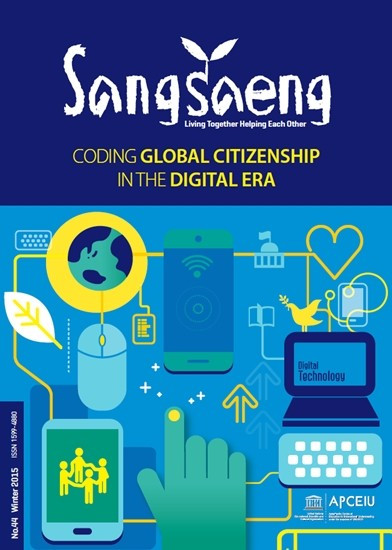 Coding global citizenship in the digital era (SangSaeng no. 44 winter 2015) Год публикации: 2015 Организация-автор: APCEIU Summary:The 44th issue of SangSaeng, “Coding Global Citizenship in the Digital Era,” has been released. The advancement of digital technology has connected the world, accelerating globalization. In this global digital age, Global Citizenship Education (GCED) is drawing enormous attention. Recognizing its significance, this Winter edition brings out the topic of GCED for digital citizens through the lens of education policymakers, children and youth, and corporations. In particular, the articles suggest actively participating in and contributing to the information society through ethical, safe, and responsible use of digital technology as the core competency for global citizens in the digital era.8 Striking a Balance Between Digital Opportunities & Related Risks12 Young People as Active Citizens in the Digital Age16 Empowering Children to Become Creative Digital Leaders20 Fostering Inclusive Innovation for a Better World38 Interview38 Understanding Culture through Media and Language40 Embracing Diversity to Live Together42 Peace in My MemoryTo achieve Peace, Must Understand Peace46 Understanding the Asia-Pacific RegionGlimpse into Ancient Healing Ritual of Ulik Mayang50 APCEIU in Action Codage de la citoyenneté mondiale à l'ère du numérique (SangSaeng no 44 hiver 2015) Год публикации: 2015 Организация-автор: Centre Asie-Pacifique d'éducation pour la compréhension internationale (APCEIU) Le 44e numéro de SangSaeng, intitulé «Codage de la citoyenneté mondiale à l'ère numérique», a été publié. L'avancement de la technologie numérique a connecté le monde, l'accélération de la mondialisation. À l'ère numérique mondiale, l'éducation à la citoyenneté mondiale (ECM) attire l'attention. Reconnaissant son importance, cette édition d'hiver met en évidence le thème du ECM pour les citoyens numériques à travers l'optique des responsables de l'éducation, des enfants et des jeunes et des entreprises. En particulier, les articles proposent de participer activement à la société de l'information et de contribuer à celle-ci par une utilisation éthique, sûre et responsable des technologies numériques comme compétence fondamentale pour les citoyens du monde à l'ère du numérique.8 Trouver un équilibre entre les Débouchés Numériques et les Risques Connexes12 Les Jeunes en tant que Citoyens Actifs à l'ère du Numérique16 Permettre aux enfants de devenir des leaders numériques créatifs20 Favoriser l'innovation inclusive pour un monde meilleur38 Entretien38 Comprendre la Culture par le biais des Médias et de la Langue40 Adopter la Diversité pour Vivre Ensemble42 La Paix dans ma MémoirePour atteindre la paix, il faut comprendre la paix46 Comprendre la région Asie-PacifiqueDécouvrez le rituel de guérison antique d'Ulik Mayang50 APCEIU en action
 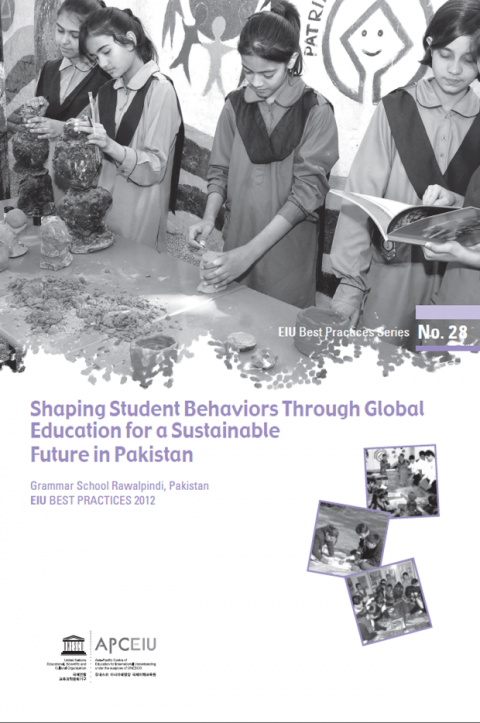 EIU Best Practice Series No. 28: Shaping student behaviors through global education for a sustainable future in Pakistan Год публикации: 2012 Автор: Nasreen Iqbal Организация-автор: APCEIU Issue No. 28 introduces a Global Education programme with its various activities from Grammar School Rawalpindi in Pakistan. It aims to enable and empower young people to become responsible and humane citizens to achieve a peaceful and sustainable future. It is targeted at all levels of students, including preschool level, to increase their awareness of social and civic values. The programme mainly focuses on EIU while equipping learners with conflict resolution skills, cultural and national identities and global citizenship. Also, it incorporates issues such as universal values, human rights, health, sustainable development, gender, multiculturalism, respect for minority groups, identity and self-worth, tolerance, etc. into the school ethos and curriculum so that the students will be able to perform positive changes on national as well as on international level. Façonner le comportement des élèves par le biais de l'éducation mondiale pour un avenir durable au Pakistan (ECI Série des Meilleures Pratiques no.28) Год публикации: 2012 Автор: Nasreen Iqbal Организация-автор: Centre Asie-Pacifique d'éducation pour la compréhension internationale (APCEIU) Question n ° 28 introduit un programme d’Éducation Mondiale avec ses diverses activités de Grammar School Rawalpindi au Pakistan. Il vise à permettre et permettre aux jeunes de devenir des citoyens responsables et humains pour parvenir à un avenir pacifique et durable. Il est destiné à tous les niveaux des élèves, y compris le niveau préscolaire, afin d'accroître leur prise de conscience des valeurs sociales et civiques. Le programme se concentre principalement sur ECI tout aux apprenants des compétences de résolution des conflits, des identités culturelles et nationales et la citoyenneté mondiale. En outre, il intègre des questions telles que les valeurs universelles, les droits de l'homme, la santé, le développement durable, l'égalité, le multiculturalisme, le respect pour les groupes minoritaires, l'identité et l'estime de soi, la tolérance, etc. dans l'ethos et le curriculum de sorte que les étudiants seront en mesure école pour effectuer des changements positifs sur le national et au niveau international.
 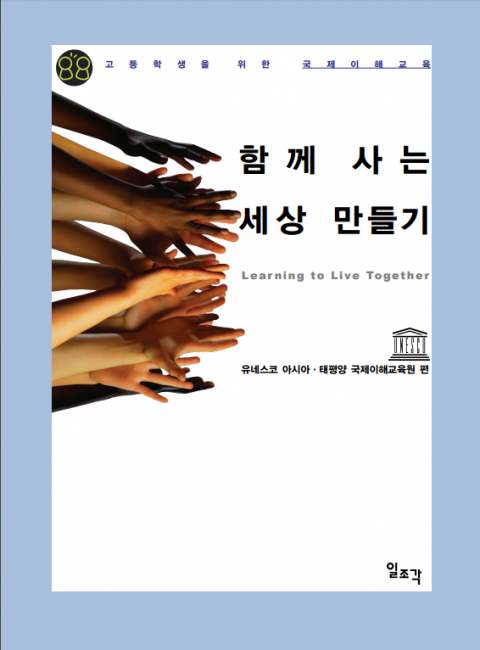 함께 사는 세상 만들기 Год публикации: 2004 Организация-автор: APCEIU This book, in essence, aims to introduce Education for International Understanding (EIU) to high school students, college students and teachers at all levels as well as the general public. The growing interconnectedness and interdependence compels all of us to understand the world beyond our immediate living space, to critically reflect on issues affecting us and others, and to work together to make our world a more peaceful and sustainable one. It requires values education that is transformative and participatory in nature to arouse genuine interests and passions to learn more and eventually to make positive changes. The book is comprised of five parts, organized by five thematic areas of EIU, namely, intercultural understanding, globalization, human rights, peace and Education for Sustainable Development (ESD). It introduces carefully chosen topics and discussions which may pique readers’ interest in some of the issues at stake, thus, encourage them to critically reflect on the complexities surrounding the issues and motivate them to engage further. Using an interdisciplinary lens, the book also borrows some ideas and approaches commonly practiced in critical anthropology.