
Ресурсы
Изучайте широкий спектр ценных ресурсов ВГГ, чтобы углубить своё понимание и повысить эффективность исследований, просветительской деятельности, преподавания и обучения.
Найдено: 3,433
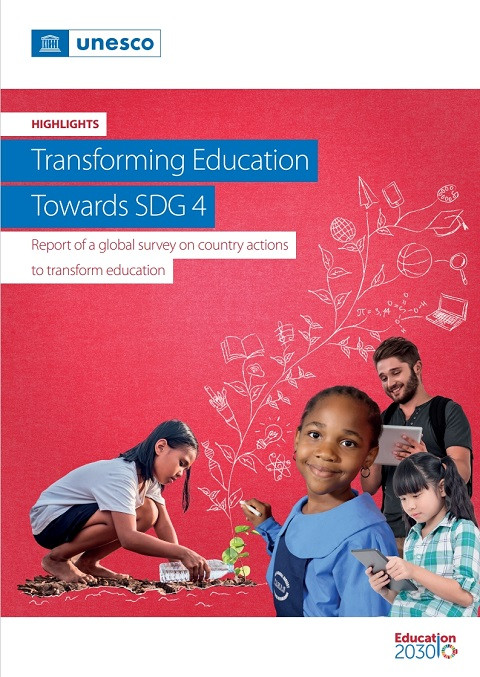 Transforming Education Towards SDG4: Report of a Global Survey on Country Actions to Transform Education; Highlights Год публикации: 2024 Организация-автор: UNESCO In 2022, the United Nations Transforming Education Summit responded decisively to mobilize action, ambition and solidarity as well as to elevate education to the top of the political agenda. This powerful mobilization led to 143 countries presenting national statements of commitment, demonstrating their political resolve to reimagine and transform their education systems. On the Summit’s fi rst anniversary, UNESCO invited its Member States to participate in the Survey on Country Actions to Transform Education and report on how they have translated their commitments into actions. This document presents highlights from the Transforming Education Towards SDG 4: Report of a global survey on country actions to transform education. It showcases transformative actions that countries have undertaken to accelerate progress towards SDG 4. The report emphasizes that education must adopt a holistic, lifelong and comprehensive approach that addresses the development and well-being of individual learners and society. Transforming education requires placing inclusion, equity and gender equality at the core of policies and interventions. It also requires more and better education fi nancing, and investments in the teaching profession.
 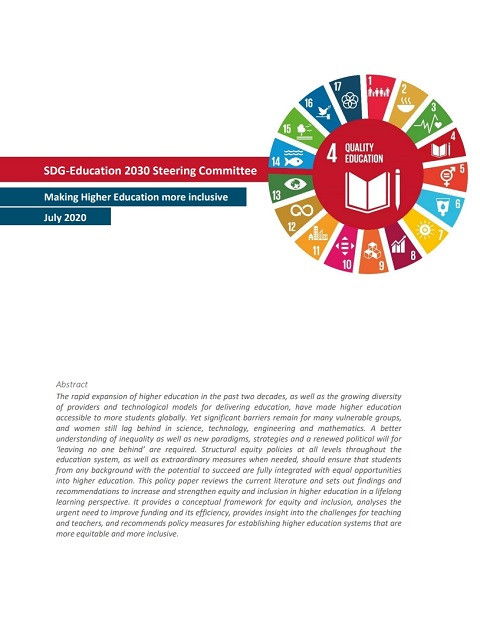 SDG-Education 2030 Steering Committee: Making Higher Education More Inclusive, July 2020 Год публикации: 2020 Организация-автор: UNESCO The rapid expansion of higher education in the past two decades, as well as the growing diversity of providers and technological models for delivering education, have made higher education accessible to more students globally. Yet significant barriers remain for many vulnerable groups, and women still lag behind in science, technology, engineering and mathematics. A better understanding of inequality as well as new paradigms, strategies and a renewed political will for ‘leaving no one behind’ are required. Structural equity policies at all levels throughout the education system, as well as extraordinary measures when needed, should ensure that students from any background with the potential to succeed are fully integrated with equal opportunities into higher education. This policy paper reviews the current literature and sets out findings and recommendations to increase and strengthen equity and inclusion in higher education in a lifelong learning perspective. It provides a conceptual framework for equity and inclusion, analyses the urgent need to improve funding and its efficiency, provides insight into the challenges for teaching and teachers, and recommends policy measures for establishing higher education systems that are more equitable and more inclusive.
 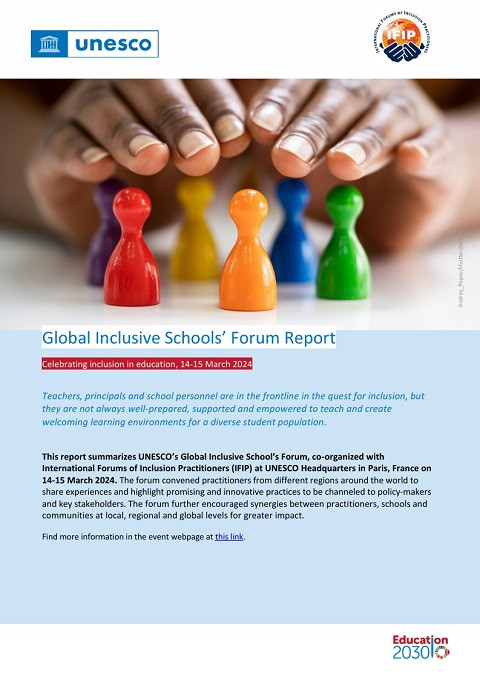 Global Inclusive Schools’ Forum Report: Celebrating Inclusion in Education, 14-15 March 2024 Год публикации: 2024 Организация-автор: UNESCO | International Forums of Inclusion Practitioners This report summarizes UNESCO’s Global Inclusive School’s Forum, co-organized with International Forums of Inclusion Practitioners (IFIP) at UNESCO Headquarters in Paris, France on 14-15 March 2024. The forum convened practitioners from different regions around the world to share experiences and highlight promising and innovative practices to be channeled to policy-makers and key stakeholders. The forum further encouraged synergies between practitioners, schools and communities at local, regional and global levels for greater impact.
  Quality Physical Education Policies and Practice: The Global State of Play Год публикации: 2023 Организация-автор: UNESCO With the majority of countries around the world investing less than 2% of their education budgets into physical education, the well-being of our future generations is at risk. Quality physical education (QPE) can deliver broad physical, social, emotional, and academic benefits. However, QPE is often under-prioritized and poorly implemented, suffering from deficiencies in funding, inclusivity, allocated time, and well-trained staff. UNESCO’s sport flagship, Fit for Life, aims to address this by working with governments to develop quality PE policies and building the capacities of teachers and coaches to deliver inclusive lessons as part of a well-rounded curricula. UNESCO’s work in QPE is directly informed by data collected via a unique global survey, gathering insights on PE policy and provision. Key data highlights from the most recent survey demonstrate the urgent need to increase the status of this subject in our schools. This requires collective action to establish and implement standards, promote knowledge-sharing, and foster inclusive participation for all youth.
 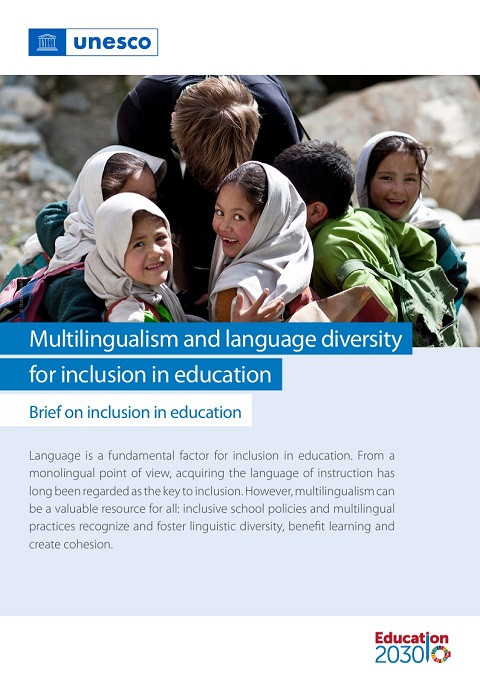 Multilingualism and Language Diversity for Inclusion in Education: Brief on Inclusion in Education Год публикации: 2024 Автор: Piet Van Avermart Организация-автор: UNESCO Language is a fundamental factor for inclusion in education. From a monolingual point of view, acquiring the language of instruction has long been regarded as the key to inclusion. However, multilingualism can be a valuable resource for all: inclusive school policies and multilingual practices recognize and foster linguistic diversity, benefit learning and create cohesion.
  High Level Ministerial Dialogue on Education for Peace Год публикации: 2023 Организация-автор: UNESCO This High-level event brought together voices from around the world to discuss what quality and relevant education needs to look like today to bring about real and lasting peace.
 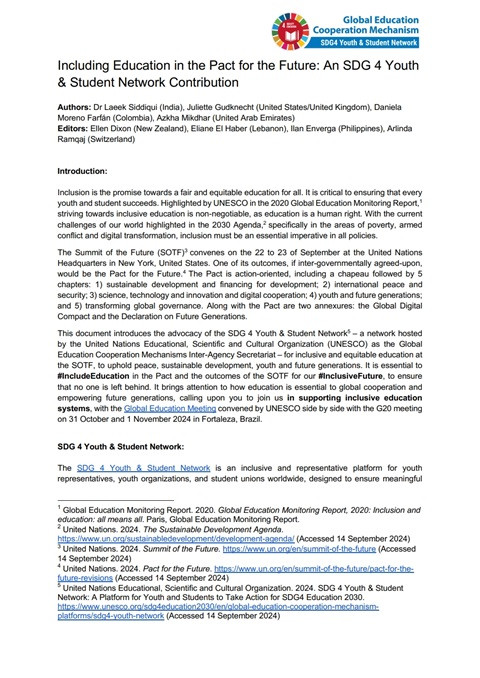 Including Education in the Pact for the Future: An SDG 4 Youth & Student Network Contribution Год публикации: 2024 Автор: Laeek Siddiqui | Juliette Gudknecht | Daniela Moreno Farfán | Azkha Mikdhar Организация-автор: SDG 4 Youth & Student Network | UNESCO Inclusion is the promise towards a fair and equitable education for all. It is critical to ensuring that every youth and student succeeds. Highlighted by UNESCO in the 2020 Global Education Monitoring Report, striving towards inclusive education is non-negotiable, as education is a human right. With the current challenges of our world highlighted in the 2030 Agenda, specifically in the areas of poverty, armed conflict and digital transformation, inclusion must be an essential imperative in all policies. The Summit of the Future (SOTF) convenes on the 22 to 23 of September at the United Nations Headquarters in New York, United States. One of its outcomes, if inter-governmentally agreed-upon, would be the Pact for the Future. The Pact is action-oriented, including a chapeau followed by 5 chapters: 1) sustainable development and financing for development; 2) international peace and security; 3) science, technology and innovation and digital cooperation; 4) youth and future generations; and 5) transforming global governance. Along with the Pact are two annexures: the Global Digital Compact and the Declaration on Future Generations. This document introduces the advocacy of the SDG 4 Youth & Student Network – a network hosted by the United Nations Educational, Scientific and Cultural Organization (UNESCO) as the Global Education Cooperation Mechanisms Inter-Agency Secretariat – for inclusive and equitable education at the SOTF, to uphold peace, sustainable development, youth and future generations. It is essential to #IncludeEducation in the Pact and the outcomes of the SOTF for our #InclusiveFuture, to ensure that no one is left behind. It brings attention to how education is essential to global cooperation and empowering future generations, calling upon you to join us in supporting inclusive education systems, with the Global Education Meeting convened by UNESCO side by side with the G20 meeting on 31 October and 1 November 2024 in Fortaleza, Brazil.
  World Heritage Glaciers: Sentinels of Climate Change Год публикации: 2022 Организация-автор: UNESCO | International Union for Conservation of Nature (IUCN) It outlines the importance of glaciers for sustaining life, their role as indicators of climate change, and their accelerated retreat due to global warming. The report emphasizes the urgent need to drastically reduce greenhouse gas emissions to limit global warming to 1.5°C, which could save glaciers in two-thirds of World Heritage sites. Additionally, it underscores the importance of adaptive measures like improved monitoring networks, early warning systems, and targeted policies to address the inevitable changes in glacierized areas. It also advocates for inclusive stakeholder engagement, particularly involving Indigenous Peoples and local communities, to develop effective responses to the challenges posed by climate change. The document serves as a call to action for international cooperation and collaboration to protect the Outstanding Universal Value of World Heritage glaciers and ensure their continued benefits for humanity.
  Transforming Knowledge and Research for Just and Sustainable Futures: Towards a New Social Imaginary for Higher Education (Education, Research and Foresight: Working Papers; No.33, 2024) Год публикации: 2024 Автор: Leon Tikly Организация-автор: UNESCO The paper considers why it is important to transform knowledge and research for just and sustainable futures and discusses the role of higher education in these transformation processes. The paper sets out how knowledge, research, and knowledge systems can be understood and critiques knowledge hierarchies that have emerged in the context of colonialism, leading to the marginalization of the knowledge systems and languages of the colonized. It is argued that there is a need to create new ecologies of knowledge that value and develop synergies between ‘all of the archives of the world’ and that can revitalize and expand the knowledge commons and contribute to more just and sustainable futures. Higher education has a pivotal role to play in the creation of new ecologies of knowledge and a revitalized knowledge commons through promoting socially and ethically engaged research, the decolonization and reorientation of university curricula and pedagogy to foster sustainable futures, and the democratization of universities to better represent historically marginalized groups. Underpinning this role must be a shift from a Western modernist social imaginary of higher education to one based on a new planetary consciousness.
  Guidelines for the governance of digital platforms: safeguarding freedom of expression and access to information through a multi-stakeholder approach Год публикации: 2023 Организация-автор: UNESCO Guidelines for an Internet for TrustSafeguarding freedom of expression and the right to information while dealing with dis- and misinformation, hate speech, and conspiracy theories requires a multistakeholder approach. This is the reason why UNESCO, the leading UN agency for the promotion and protection of freedom of expression and to information, is launching Guidelines for the Governance of Digital Platforms. The Guidelines outline a set of duties, responsibilities and roles for States, digital platforms, intergovernmental organizations, civil society, media, academia, the technical community and other stakeholders to enable the environment where freedom of expression and information are in the core of digital platforms governance processes. The Guidelines were produced through a multi-stakeholder consultation that gathered more than 10,000 comments from 134 countries. These global-scale consultations fostered inclusive participation, ensuring a diversity of voices to be heard, including those from groups in situation of marginalization and vulnerability. Cultivating an Internet of Trust is a shared responsibility among all stakeholders. It calls upon us all to sustain an enabling environment for freedom of expression and the right to information.