
Ресурсы
Изучайте широкий спектр ценных ресурсов ВГГ, чтобы углубить своё понимание и повысить эффективность исследований, просветительской деятельности, преподавания и обучения.
Найдено: 3,777
 다문화가정 대상국가와의 교육교류사업: 2021년도 최종 결과보고서 Год публикации: 2021 Организация-автор: 유네스코 아시아태평양 국제이해교육원 2012년부터 시행되어 2021년에 10년차를 맞은 「다문화가정 대상국가와의 교육교류사업」은 팬데믹 상황으로 인해 비대면 온라인 교육교류 방식으로 이루어졌다. 본 보고서에는 2021년도 교육교류 추진 실적과 결과, 교육활동 결과물 등이 수록 되었다.
  2021 다문화가정 대상국가와의 교육교류사업 성과분석: 글로벌 역량과 디지털 리터러시 역량을 중심으로 Год публикации: 2021 Автор: 박주형 | 문찬주 Организация-автор: 유네스코 아시아태평양 국제이해교육원 본 보고서는 2021년 온라인으로 시행한 「다문화가정 대상국가와의 교육교류사업」의 참가자를 대상으로 교육교류사업의 핵심성과인 글로벌 역량과 디지털 리터러시 역량의 향상도를 측정하여 제시하고 있다.
  2021 다문화가정 대상국가와의 교육교류사업 성과분석: 성과측정도구 개발 Год публикации: 2021 Автор: 박현정 | 박민호 | 권현주 Организация-автор: 유네스코 아시아태평양 국제이해교육원 이 보고서는 유네스코 아태교육원이 시행하는 「다문화가정 대상국가와의 교육교류사업」의 성과를 측정하는데 있어 보다 적합한 ‘글로벌 역량’ 측정 도구를 개발하고자 진행된 연구 내용을 담고 있다.
  2021 다문화가정 대상국가와의 교육교류사업 성과분석: 온라인 교육교류 참가학교 학생 및 교사의 다문화 수용성 개선도 측정을 중심으로 Год публикации: 2021 Автор: 한유경 Организация-автор: 유네스코 아시아태평양 국제이해교육원 유네스코 아태교육원은 「다문화가정 대상국가와의 교육교류사업」의 일환으로 외국(말레이시아, 몽골, 베트남, 인도네시아, 캄보디아, 태국, 필리핀)교사를 초청하여 교육활동을 수행한 국내 학교의 교사 및 학생의 다문화 수용성 향상도를 측정·분석해왔다. 본 보고서는 21년도 온라인 교육교류사업을 통한 참가자의 다문화 수용성 개선 정도를 측정하여 제시하고 있다.
 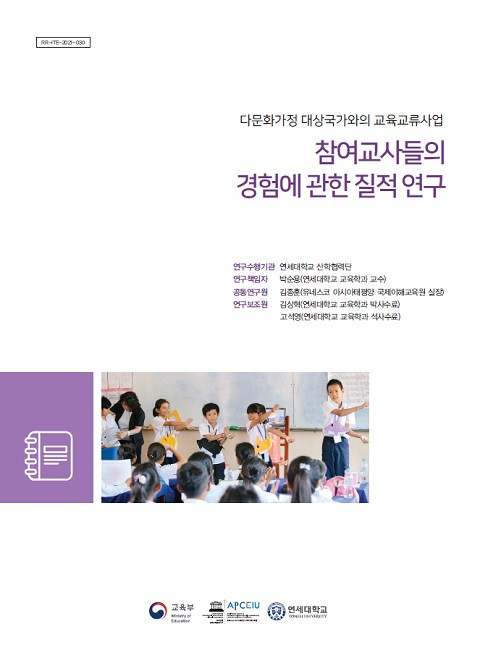 2021 다문화가정 대상국가와의 교육교류사업 성과분석: 참여교사들의 경험에 관한 질적 연구 Год публикации: 2021 Автор: 박순용 | 김종훈 | 김상혁 | 고석영 Организация-автор: 연세대학교 산학협력단 | 유네스코 아시아태평양 국제이해교육원 유네스코 아태교육원이 시행하는 「다문화가정 대상국가와의 교육교류사업」의 성과분석과 개선을 위한 정책연구에 대한 보고서이다. 본 연구는 여러 나라에 걸쳐 다른 경험을 한 참여교사들을 다층위의 질적 연구를 통해 상호주관적 맥락성을 살펴보고 프로그램의 과정과 전후에 참여하는 여러 주체들의 주관적 경험을 들여다봄으로써 그로부터 의미와 시사점 및 향후의 과제들을 성찰해보기 위한 것이다.
 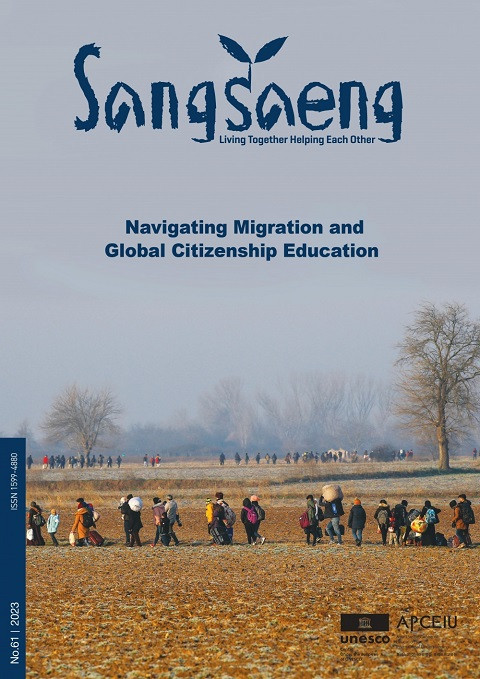 Navigating Migration and Global Citizenship Education (SangSaeng no. 61, 2023) Год публикации: 2023 Организация-автор: APCEIU Migration is reshaping our societies and challenging traditional notions of identity, belonging, and cultural diversity. Global Citizenship Education, with its emphasis on fostering an understanding of global interconnectedness, human rights, social justice, and intercultural competence, is uniquely positioned to address the complex issues arising from migration. In this context, SangSaeng No. 61 explores the multifaceted relationship between migration and GCED to inspire innovative approaches to education and advocacy that address the challenges and opportunities presented by migration. Contents 03 Editor's Note 04 Special Column Renewing Our Commitment — Global Citizenship Education Should Address International Migration / Geon-soo Han 08 FOCUS: Navigating Migration and Global Citizenship EducationAfrican Migration Narratives — Mozambican Migrants in Southern Africa and Trends of African International Migration in Contemporary Africa / Joel das Neves TembeReimagining Thai Society — Burmese Migrant Children and Their Education in Thailand / Nongyao NawaratFortress Europe’s Educational Obstructions — Accessing Education for Refugees and Asylum Seekers in Europe / Prem Kumar RajaramCost of Invasion and Colonial War — Russian Invasion of Ukrainian, Refugees and Migration Governance / Franck DüvellPathway to Empowerment — Self-Reliance: A New Vision Toward Sustainable Solutions for Refugees / Kari Diener 24 Special ReportExploring Transformative Learning for Critical Empowerment through GCED / APCEIU IGCED and RND 26 Best PracticesTaking It Local — Using a Collaborative Approach to Contextualise an International Global Competence Framework / Karena Menzie-BallantyneHarmonizing the Streets for Youth — Jelajah Harmoni: Exploring the Meaning of Harmony through Community-Based Learning / Anna TanTeach to Transform — Creating Empowering Learning Spaces and Building Community of Changemakers / Rajvi Trivedi 35 Story TimeUnparalleled Look into Lives of Migrants / Virginia Pittaro 38 Peace in My MemoryCultivating Tranquillity: Thoughts on Peace / Wisdom Addo 42 GCED YOUTH NETWORKMigration and Global Citizenship Education — Youth Voices from the Ground / Oshan M. GunathilakeEducation without Borders — Empowering Displaced Children and Youth through Global Citizenship Education / Victoria Ibiwoye 48 LetterFacilitating Connections through My Experience with APCEIU / Lorena Gamerra 50 APCEIU in Action
  2023 Asia-Pacific Training Workshop on EIU: Mentorship Programme Final Report Год публикации: 2023 Организация-автор: APCEIU Asia-Pacific Training Workshop on EIU/GCED (APTW) is APCEIU's flagship Training of Trainers (TOT) programme for educators and teacher trainers in the Asia-Pacific region. Over the last 23 years, APCEIU benefitted more than 650 educators through the workshop. Especially, since 2021, the workshop has been carried out online training workshops, mentorship, and local project implementation to further support the participants to bring positive and sustainable changes in their local communities. In 2023, the 22nd APTW was virtually held from 30 May to 8 June with the theme of 'GCED as a Common Vision for Change.' 56 enthusiastic educators from 16 UNESCO member states in the Asia-Pacific region joined the programme. The workshop provided a venue to learn and discuss how GCED could contribute to transforming current education. This report summarizes 14 GCED projects implemented in the Asia-Pacific region by the 22nd APTW alumni who participated in the mentorship programme.
  Global Capacity-Building Workshop on GCED 2023: Follow-Up Activity Report Год публикации: 2023 Организация-автор: APCEIU This report summarizes 15 GCED projects implemented by the selected mentees/grantees of APCElU's 8th Global Capacity-Building Workshop on GCED on 13-21 July 2023. The projects include teacher training workshops, curriculum development, school-based activities, and community development projects, undertaken by educators, teachers, and practitioners in Asia, Europe, Africa, Latin America, and the Caribbean. The mentees/grantees first participated in the 8th Global Capacity-Building Workshop on GCED in August 2023. After completing the Workshop, graduates submitted GCED proposals to be selected as grantees/mentees. The selected 15 mentees/grantees were matched with expert mentors who guided them in their project development and implementation. This report describes the summary of 15 projects held in different corners of the world along with their outputs.
  Asia-Pacific Living Heritage Lesson Plan 2023 Год публикации: 2023 Организация-автор: APCEIU | UNESCO Bangkok | International Information and Networking Centre for Intangible Cultural Heritage in the Asia-Pacific Region (ICHCAP) In partnership with UNESCO Bangkok and ICHCAP (International Information and Networking Centre for Intangible Cultural Heritage in the Asia-Pacific Region), APCEIU (Asia-Pacific Centre of Education for International Understanding) carried out “Bringing Living Heritage to the Classroom in the Asia-Pacific” since 2020. As a part of this multi-year project, the UNESCO Asia-Pacific Living Heritage Lesson Plan Contest 2023, co-organized by UNESCO Bangkok, APCEIU, and ICHCAP was launched and 18 lesson plans from 10 countries – Bhutan, China, India, Indonesia, the Republic of Korea, Malaysia, Nepal, The Philippines, Singapore, and Viet Nam - were selected as follows. - Saykha Offering (Subject: English), Tsirangtoe Central School, Bhutan- Setting Up a Herbarium, Learning about Medicinal Herbs and their Cultural and Traditional Uses in the Community (Subject: Science/Grades 7–9), Zilukha Middle Secondary School, Bhutan- Shamanistic Worship and Propitiation to the Spirits (Subject: Bhutan History and Civics and Citizenship Education/Grade 8), Bajothang Higher Secondary School, Bhutan- Beauty of Intangible Cultural Heritage (Subject: Foundations of College Art Education/ Freshman Year), Anhui Medical University, China- The Folk Custom of Building the Peace Kiln for the Mid-Autumn Festival in Jingdezhen (Subject: Mathematics/Grade 7), Jingdezhen No.13 Secondary School, China - When Xiabu Meets Batik (Subject: Art/Grade 5–6), ChongQing Shuren Primary School, China- Agricultural Practices (Subject: Biology/Grade 8), Paramita Heritage School, India- Living Heritage – Quilting in the Kalbelia Community of Rajasthan (Subject: Social Science/Grade 9), St. Stephen's Senior Secondary School, India- My City: Varanasi (Subject: Environmental Studies/Grade 2), Sunbeam School Lahartara, India - Bringing Back the Javanese Saka Calendar through Ethnomathematics (Subject: Mathematics/Grade 7–12), Binus School Bekasi, Indonesia- Song, Play, and Dance (Subject: Interdisciplinary for Indonesian Language, Balinese Culture, Music and Physical Education/Grade 3), Green School Bali, Indonesia- Teaching Sound Wave with Sundanese Traditional Instruments (Subject: Physics/Grade 8), Binus School Bekasi, Indonesia- Wau – The Malays Traditional Kite: Introduction, Wau Bulan Appreciation, Wau Making and Flying Workshop and Wau Corner (Subject: Traditional Games/Grades 4–5), SMU (A) Tarbiah Islamiah (SABK), Malaysia- Himalayan Aromatic Incense-Making and Meditation Workshop (Subject: Economics and Social Studies/ Grades 8–9, 11–12), Pragati Pathshala, Nepal- Influence of Biodiversity on the Stability of Ecosystems (Subject: Science/Grade 10), Philippine Normal University Mindanao, The Philippines- Understanding the Nature of Religion: From the Perspective of the Tripeople (Christians, Muslims, & Lumads) of Kidapawan City, North Cotabato (Subject: Humanities and Social Sciences/Grade 12), Kidapawan City National High School, The Philippines- Bongsan Talchum that Helps the Community Become More Sustainable (Subject: Korean Language and Literature, Social Studies, P.E., Arts/Grade 6), Kimje Buk Elementary School, Republic of Korea- Exploring Community Gardens – How and why are they so precious to humans? (Subject: Geography/Grade 9), Admiralty Secondary School, Singapore 무형유산을 통해 키우는 세계시민성: 2023 아태지역 무형유산 교수학습계획안 Год публикации: 2023 Организация-автор: 유네스코 아시아태평양 국제이해교육원 | UNESCO Bangkok | 유네스코아태무형유산센터 유네스코 아태교육원은 2020년부터 유네스코 방콕사무소와 유네스코아태무형유산센터(ICHCAP)와 협력하여 「아시아태평양 교실에서 만나는 무형유산 사업」을 수행하였다. 이 사업의 일환으로, <2023 아태지역 무형유산 교수학습계획안 공모전 >을 개최하였으며, 총 10개국(네팔, 말레이시아, 베트남, 부탄, 싱가포르, 인도, 인도네시아, 중국, 필리핀, 한국)의 18개 교수학습계획안을 모범사례로 최종 선정하였다. 다음은 수상작 목록이다. - Saykha Offering (Subject: English), Tsirangtoe Central School, Bhutan- Setting Up a Herbarium, Learning about Medicinal Herbs and their Cultural and Traditional Uses in the Community (Subject: Science/Grades 7–9), Zilukha Middle Secondary School, Bhutan- Shamanistic Worship and Propitiation to the Spirits (Subject: Bhutan History and Civics and Citizenship Education/Grade 8), Bajothang Higher Secondary School, Bhutan- Beauty of Intangible Cultural Heritage (Subject: Foundations of College Art Education/ Freshman Year), Anhui Medical University, China- The Folk Custom of Building the Peace Kiln for the Mid-Autumn Festival in Jingdezhen (Subject: Mathematics/Grade 7), Jingdezhen No.13 Secondary School, China - When Xiabu Meets Batik (Subject: Art/Grade 5–6), ChongQing Shuren Primary School, China- Agricultural Practices (Subject: Biology/Grade 8), Paramita Heritage School, India- Living Heritage – Quilting in the Kalbelia Community of Rajasthan (Subject: Social Science/Grade 9), St. Stephen's Senior Secondary School, India- My City: Varanasi (Subject: Environmental Studies/Grade 2), Sunbeam School Lahartara, India - Bringing Back the Javanese Saka Calendar through Ethnomathematics (Subject: Mathematics/Grade 7–12), Binus School Bekasi, Indonesia- Song, Play, and Dance (Subject: Interdisciplinary for Indonesian Language, Balinese Culture, Music and Physical Education/Grade 3), Green School Bali, Indonesia- Teaching Sound Wave with Sundanese Traditional Instruments (Subject: Physics/Grade 8), Binus School Bekasi, Indonesia- Wau – The Malays Traditional Kite: Introduction, Wau Bulan Appreciation, Wau Making and Flying Workshop and Wau Corner (Subject: Traditional Games/Grades 4–5), SMU (A) Tarbiah Islamiah (SABK), Malaysia- Himalayan Aromatic Incense-Making and Meditation Workshop (Subject: Economics and Social Studies/ Grades 8–9, 11–12), Pragati Pathshala, Nepal- Influence of Biodiversity on the Stability of Ecosystems (Subject: Science/Grade 10), Philippine Normal University Mindanao, The Philippines- Understanding the Nature of Religion: From the Perspective of the Tripeople (Christians, Muslims, & Lumads) of Kidapawan City, North Cotabato (Subject: Humanities and Social Sciences/Grade 12), Kidapawan City National High School, The Philippines- Bongsan Talchum that Helps the Community Become More Sustainable (Subject: Korean Language and Literature, Social Studies, P.E., Arts/Grade 6), Kimje Buk Elementary School, Republic of Korea- Exploring Community Gardens – How and why are they so precious to humans? (Subject: Geography/Grade 9), Admiralty Secondary School, Singapore