
Ресурсы
Изучайте широкий спектр ценных ресурсов ВГГ, чтобы углубить своё понимание и повысить эффективность исследований, просветительской деятельности, преподавания и обучения.
Найдено: 3,777
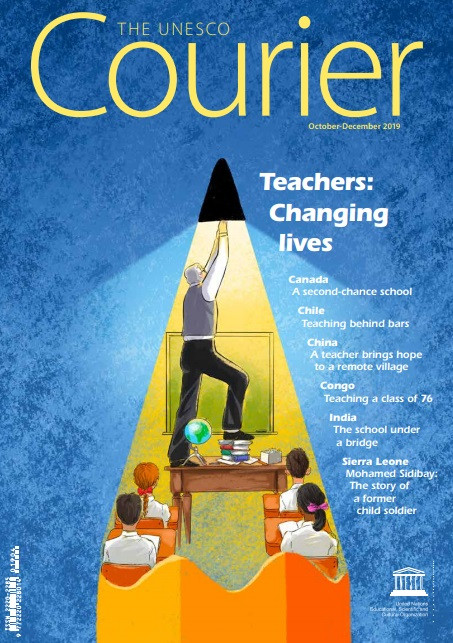 Teachers: changing lives (The UNESCO Courier no. 4, October-December 2019) Год публикации: 2019 Организация-автор: UNESCO Certainly, everyone recognizes the key role teachers play. On a personal level, we can all name at least one teacher who made a difference – sometimes to such an extent that it redirected our whole lives. At the international level, the United Nations Sustainable Development Goals (SDGs), Goal 4 in particular, recognize the importance of teachers in the implementation of the Sustainable Development Agenda by 2030. Yet, the profession is being undermined. The development of cognitive neuroscience and the many applications of new technologies in the field of education are forcing the profession to adapt and reinvent itself. Ces profs qui changent le monde (Le Courrier de l'UNESCO 4, octobre-décembre 2019) Год публикации: 2019 Организация-автор: UNESCO Certes, tout le monde reconnaît le rôle clé que jouent les enseignants. À titre personnel, chacun peut citer le nom d’au moins un professeur qui a compté, parfois au point de réorienter une vie entière. Sur le plan international, les Objectifs de développement durable (ODD) des Nations Unies, en particulier l’Objectif no 4, reconnaissent l’importance des enseignants dans la mise en œuvre du Programme de développement durable à l’horizon 2030. Pourtant, la profession est mise à mal. Le développement des neurosciences cognitives, les multiples applications des nouvelles technologies dans le domaine de l’éducation obligent la profession à s’adapter, se réinventer. Docentes que cambian el mundo (El Correo de la UNESCO 4, Octubre-Diciembre 2019) Год публикации: 2019 Организация-автор: Organización de las Naciones Unidas para la Educación, la Ciencia y la Cultura (UNESCO) Sin duda, todo el mundo reconoce la función esencial que desempeñan los docentes. A título individual, cada uno de nosotros puede mencionar el nombre de al menos un maestro que le influyó decisivamente, a veces hasta el punto de reorientar toda su vida. En el ámbito internacional, los Objetivos de Desarrollo Sostenible (ODS) de las Naciones Unidas, en particular el ODS 4, destacan la importancia del profesorado en la consecución de la Agenda 2030 de desarrollo sostenible.Y, sin embargo, la profesión docente está en crisis. El desarrollo de la neurociencia cognitiva y las múltiples aplicaciones de las nuevas tecnologías en el sector educativo imponen al magisterio la necesidad de adaptarse, de reinventarse.
  为学生赋能,建设公正社会: 小学教师手册 Год публикации: 2019 Организация-автор: 联合国教科文组织 (UNESCO) | UN. Office on Drugs and Crime (UNODC) 该文件为小学阶段的教师提供一个公民教育指导手册,包含众多易于获取的教育资源,用于进行青少年公民教育。
  Early childhood care and education and education for sustainable development & global citizenship Год публикации: 2019 Организация-автор: UNESCO This document brings together the responses to a survey on Early Childhood Care and Education in the context of Education for Sustainable Development and Global Citizenship, initiated by GAP Partner Network 3 on educators, in the framework of preparing the UNESCO 2019 Forum. Key findings A majority of respondents recommend better cooperation, both in sharing of educational resources and in general, between early childhood structures and GAP Key Partners. According to them, the best way to transmit values and teach ESD to children is through play. This must be done in a fun way, in contact with nature. Concerning training, practical and continuous training of childcare educators is requested and recommended. This should facilitate the integration of ESD and global citizenship, as well as provide insights for enhancing the content of teacher education.
  Evaluation of the Networks of Mediterranean Youth (NET-MED Youth) Project (2014-2018) Год публикации: 2019 Автор: Maksymilian Fras | Yael Ohana | Kimiko Hibri Pedersen | Christophe Dietrich | Mamoun Besaiso Организация-автор: UNESCO The Networks of Mediterranean Youth (NET-MED Youth) Project is a regional project funded by the European Union and implemented by UNESCO from 2014 until 2018. It followed a comprehensive approach through interdisciplinary activities in different thematic areas aimed at advancing youth legal and policy frameworks, enhancing youth representation in media, and reinforcing youth employability and skills in response to the challenges experienced by young women and men in the region regarding their transition to full autonomous citizenship in the civic, political, economic, social and cultural spheres. NET-MED Youth contributed to the creation of an enabling environment for young women and men from nine of the Southern countries of the European Neighbourhood Policy (i.e. Algeria, Israel, Jordan, Lebanon, Libya, Morocco, Palestine, Syria and Tunisia) to develop their competencies, to exercise their rights and meaningfully engage as active citizens in the development and implementation of national strategies on youth. The evaluation found that, overall, the NET-MED Youth Project was a successful initiative and created a momentum for Youth empowerment in the respective beneficiary countries. Its high relevance in the context of the Agenda 2030 resulted not least from UNESCO’s longstanding experience and good practices in working with youth organizations and youth-related stakeholders through youth engagement as partners and beneficiaries. The Project thus constituted a significant contribution to the UNESCO Operational Strategy on Youth 2014-2021. Gender equality was a central concern of NET-MED Youth, and systematically embedded throughout all activities as a transversal feature. In line with the Agenda 2030 commitment of leaving no one behind, several activities focused on issues of disadvantaged or traditionally underserved groups, such as youth with disabilities. Challenges identified are mainly related to the often difficult and in some countries unstable political environments. Together with the needs-based and rather context-specific approach in each country, this also affected to some extent the full implementation of the regional perspective. Furthermore, in the absence of a coherent and explicit longer-term exit strategy, the structures and results achieved risk not to be maintained, or scaled up over time, despite the strong local commitment and ownership created over the project duration. Through successfully incorporating youth aspirations in its design and implementation, the NET-MED Youth Project represented a new and innovative approach to youth engagement and empowerment in an interdisciplinary fashion, and should thus be considered as a basis for new thinking on which to build in the future. The high potential for replication of the NET-MED Youth Project, as a continuation or as an example of good practice for a comprehensive and interdisciplinary approach is thus to be further explored.
 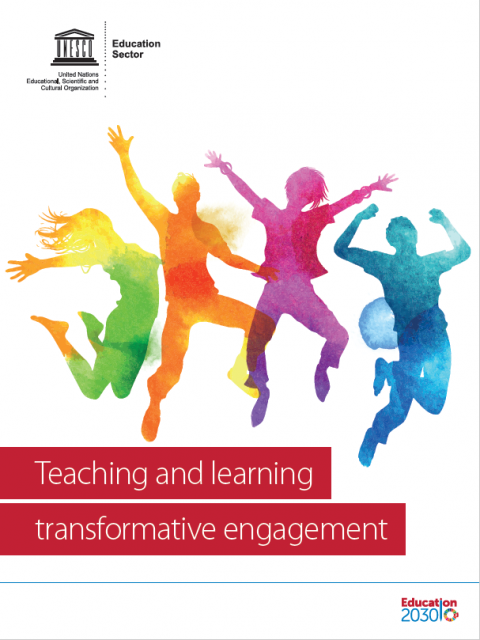 Teaching and Learning Transformative Engagement Год публикации: 2019 Организация-автор: UNESCO While there is a large body of literature on citizenship and civic education, there is less clarity about the meaning of ‘responsible transformative engagement’ for young learners in relation to GCED and ESD – notably, the types of transformative engagement and the meaning of ‘responsible’. Understanding better the connection between learners’ engagement and education can clarify the knowledge, skills and competencies that schools may provide, as well as how the role of education can vary depending on context. In this light, this paper explores the meaning of ‘responsible transformative engagement’ with a view to clarifying the role of education in ways that may be reflected by UNESCO and other education stakeholders. Enseigner et apprendre l'engagement transformatif Год публикации: 2019 Организация-автор: Organisation des Nations Unies pour l'éducation, la science et la culture (UNESCO) Si les ouvrages consacrés à la citoyenneté et à l’éducation civique foisonnent, le sens d’un « engagement transformatif responsable » pour de jeunes apprenants dans le contexte de l’ECM et de l’EDD est moins clairement défini, notamment les types d’engagement transformatif et la notion de « responsabilité ». Mieux comprendre le lien entre l’engagement des apprenants et l’éducation permet de clarifier les connaissances, aptitudes et compétences que l’école peut enseigner, ainsi que le rôle variable que peut jouer l’éducation selon le contexte. Dans cette optique, le présent document s’interroge sur le sens d’un « engagement transformatif responsable » en vue d’apporter des éclaircissements sur le rôle de l’éducation qui peuvent être pris en compte par l’UNESCO et d’autres acteurs de l’éducation. Enseñando y aprendiendo para una participación transformadora Год публикации: 2019 Организация-автор: Organización de las Naciones Unidas para la Educación, la Ciencia y la Cultura (UNESCO) Si bien existe una extensa bibliografía sobre educación cívica y ciudadana, hay menos claridad acerca del significado del concepto de una "participación transformadora responsable" de jóvenes estudiantes en relación con la ECM y la EDS, en particular, los tipos de participación transformadora y la definición del término "responsable". Comprender mejor la relación entre la participación de los estudiantes y la educación puede contribuir a mejorar la definición de los conocimientos, aptitudes y competencias que las escuelas pueden enseñar, así como las maneras en que el papel de la educación puede variar según el contexto. En este sentido, el presente documento explora el significado de una "participación transformadora responsable", con miras a explicar el papel de la educación de formas que puedan reflejar la UNESCO y otros actores de la educación
 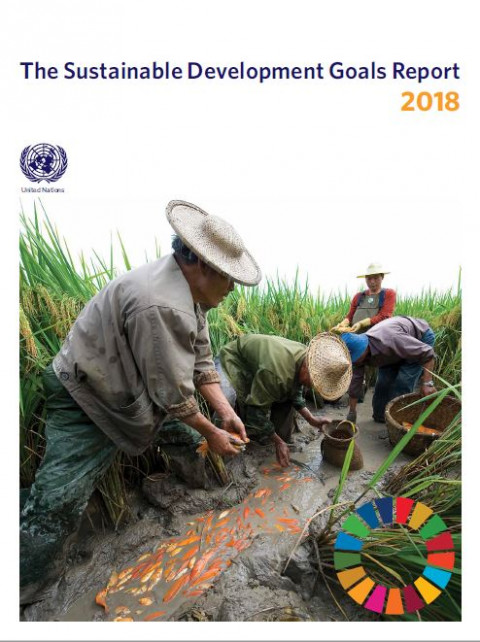 The Sustainable Development Goals Report 2018 Год публикации: 2018 Организация-автор: United Nations (UN) The 2030 Agenda for Sustainable Development provides a global blueprint for dignity, peace and prosperity for people and the planet, now and in the future. Three years into the implementation of the Agenda, countries are translating this shared vision into national development plans and strategies.