
Ресурсы
Изучайте широкий спектр ценных ресурсов ВГГ, чтобы углубить своё понимание и повысить эффективность исследований, просветительской деятельности, преподавания и обучения.
Найдено: 518
 지속가능발전교육 렌즈: 정책 및 실행 평가도구 Год публикации: 2013 Организация-автор: 유네스코 The Education for Sustainable Development (ESD) Lens has been prepared to support UN Member States to respond to these challenges through implementation of the United Nations Decade of Education for Sustainable Development (DESD, 2005- 2014). The ESD Lens supports the goals of the DESD, and encourages policy-makers and practitioners in Member States to initiate the process of re-orienting education, particularly the formal education system, towards sustainable development. The overall goal of the UN Decade of Education for Sustainable Development (DESD) is for countries to integrate the understandings, skills and values inherent in sustainable development into all aspects of national education plans to encourage changes in lifestyles and behaviour that allow for a more sustainable and just society for all. This complements existing Education for All initiatives, and strengthens the objectives of the Millennium Development Goals. Education for Sustainable Development has the potential to improve the quality and relevance of education everywhere. ESD レンズ政策および実践のためのリビュー・ツール Год публикации: 2010 Организация-автор: UNESCO The Education for Sustainable Development (ESD) Lens has been prepared to support UN Member States to respond to these challenges through implementation of the United Nations Decade of Education for Sustainable Development (DESD, 2005- 2014). The ESD Lens supports the goals of the DESD, and encourages policy-makers and practitioners in Member States to initiate the process of re-orienting education, particularly the formal education system, towards sustainable development. The overall goal of the UN Decade of Education for Sustainable Development (DESD) is for countries to integrate the understandings, skills and values inherent in sustainable development into all aspects of national education plans to encourage changes in lifestyles and behaviour that allow for a more sustainable and just society for all. This complements existing Education for All initiatives, and strengthens the objectives of the Millennium Development Goals. Education for Sustainable Development has the potential to improve the quality and relevance of education everywhere. La Lente de la educación para el desarollo sostenible: una herramienta para examinar las políticas y la práctica Год публикации: 2010 Организация-автор: Organización de las Naciones Unidas para la Educación, la Ciencia y la Cultura (UNESCO) The Education for Sustainable Development (ESD) Lens has been prepared to support UN Member States to respond to these challenges through implementation of the United Nations Decade of Education for Sustainable Development (DESD, 2005- 2014). The ESD Lens supports the goals of the DESD, and encourages policy-makers and practitioners in Member States to initiate the process of re-orienting education, particularly the formal education system, towards sustainable development. The overall goal of the UN Decade of Education for Sustainable Development (DESD) is for countries to integrate the understandings, skills and values inherent in sustainable development into all aspects of national education plans to encourage changes in lifestyles and behaviour that allow for a more sustainable and just society for all. This complements existing Education for All initiatives, and strengthens the objectives of the Millennium Development Goals. Education for Sustainable Development has the potential to improve the quality and relevance of education everywhere. Le Prisme de l'éducation pour le développement durable: un outil d'analyse des politiques et des pratiques Год публикации: 2010 Организация-автор: Organisation des Nations Unies pour l'éducation, la science et la culture (UNESCO) The Education for Sustainable Development (ESD) Lens has been prepared to support UN Member States to respond to these challenges through implementation of the United Nations Decade of Education for Sustainable Development (DESD, 2005- 2014). The ESD Lens supports the goals of the DESD, and encourages policy-makers and practitioners in Member States to initiate the process of re-orienting education, particularly the formal education system, towards sustainable development. The overall goal of the UN Decade of Education for Sustainable Development (DESD) is for countries to integrate the understandings, skills and values inherent in sustainable development into all aspects of national education plans to encourage changes in lifestyles and behaviour that allow for a more sustainable and just society for all. This complements existing Education for All initiatives, and strengthens the objectives of the Millennium Development Goals. Education for Sustainable Development has the potential to improve the quality and relevance of education everywhere. Education, diversité et cohésion sociale en Méditerranée occidentale Год публикации: 2010 Автор: Sobhi Tawil | Abdeljalil Akkari | Bouthaïna Azami Организация-автор: UNESCO La diversité culturelle constitue une caractéristique essentielle des différentes sociétés de la région de la Méditerranée occidentale où une multitude de traditions religieuses et culturelles se sont côtoyées et réciproquement influencées, créant ainsi une mosaïque sociale particulièrement intéressante. Or, la diversité, source de créativité et d'enrichissement culturel, peut aussi amener à renforcer les tensions sociales et creuser les divisions, menaçant ainsi la cohésion sociale à l'intérieur des sociétés comme entre les pays de la région. En effet, des événements récents ont attiré l'attention sur des tensions sociales et politiques liées à l'identité et à la cohésion sociale dans un contexte de mondialisation, d’accroissement des disparités des niveaux de développement économique entre les deux rives de la Méditerranée occidentale et de diversification grandissante des flux migratoires, contexte trop souvent marqué, par ailleurs, par une exacerbation du phénomène de l’exclusion sociale, de la montée de la xénophobie et de l’extrémisme religieux. Conscients de l’importance de la contribution essentielle de l’éducation pour promouvoir un dialogue interculturel axé sur les principes d’équité, de justice, et de respect de la dignité et de la diversité culturelle, la Chaire UNESCO Droits de l’homme et éthique de la coopération internationale de l’Université de Bergame, le Bureau multipays de l’UNESCO à Rabat, et l’ISESCO ont conjointement lancé, en 2007, le projet Education, diversité et cohésion sociale en Méditerranée occidentale. Le projet s’inscrit dans une dynamique de recherche, de dialogue et d’action, renforçant ainsi les efforts de chacun des trois partenaires visant à promouvoir la culture de la justice et de la paix. Cette recherche propose de nouveaux éclairages sur le rôle des systèmes éducatifs nationaux dans la promotion du respect de la diversité et le renforcement de la cohésion sociale, et esquisse des pistes d’action et de coopération. Nous formons le vœu que cet ouvrage commun, fruit des travaux de recherche se rapportant au projet, puisse contribuer à la promotion du respect de la diversité et de la cohésion sociale en Méditerranée occidentale. عدسة التعليم من أجل التنمية المستدامة أداة استعراض السياسات والممارسات Год публикации: 2010 Организация-автор: UNESCO The UN Decade of Education for Sustainable Development (DESD) calls on the Governments to consider the inclusion of measures to implement the Decade in their respective education systems and strategies and, where appropriate, into national development plans’.2 This ESD Lens provides tools to start this process. It can be adapted to different educational contexts, and country specific policy and practice needs. It is not prescriptive, but provides guidelines and starting points for reviewing education policy and practice using an ESD perspective. ESD Lens Review Tools are provided for planning, for building knowledge of ESD, for reviewing national policy and the aims of education, for reviewing quality learning outcomes, and for reviewing more specific and detailed aspects of the education system such as curriculum, learning materials, assessment and teacher education. The tool is flexible and can be used at different levels of the system.Some of the tools are more suited to policy-makers, while others can be used by teachers and principals in schools. Ideally they should all be used to ensure a more systemic re-orientation of the education system in a country, province, region or district.The pilot testing of the ESD Lens showed that it helps to build synergy for understanding and implementing ESD at national level and at sub-regional levels. The key question being addressed by the ESD Lens is:How can education policies, curriculum and other support processes sufficiently integrate the principles of ESD to inform and strengthen the quality of learning experiences for sustainable development? Joint E-9 Statement on Education Beyond 2015: Islamabad Statement Год публикации: 2014 Организация-автор: UNESCO This statement is adopted by the participants of the 10th E-9 Ministerial Review Meeting held in Islamabad, Pakistan, on November 27-28, 2014. They have taken stock of the progress made since 2000 and challenges remaining in the nine countries in achieving the six Education for All (EFA) goals, and reflected on the priorities and prospects for each country to sustain and further advance educational development beyond 2015. Their deliberations were based on a careful examination of the National EFA 2015 Reviews of the countries concerned, the Muscat Agreement adopted at the Global Education for All Meeting (Muscat, Oman, 12-14 May 2014), the Outcome Document of the United Nations General Assembly Open Working Group on Sustainable Development Goals, and took into account the Aichi-Nagoya Declaration on Education for Sustainable Development as well as the changing global environment that shapes the cooperation among the E-9 countries. Joint E-9 Déclaration sur l'éducation Au-delà de 2015: Déclaration Islamabad Год публикации: 2014 Организация-автор: Organisation des Nations Unies pour l'éducation, la science et la culture (UNESCO) Cette déclaration est adoptée par les participants de la 10e E-9 Réunion Ministérielle tenue à Islamabad, au Pakistan, le 27-28 Novembre 2014. Ils ont fait le point sur les progrès réalisés depuis 2000 et des défis restant dans les neuf pays dans la réalisation des six éducation pour tous (EPT), et réfléchi sur les priorités et les perspectives de chaque pays pour soutenir et faire progresser le développement de l'éducation au-delà de 2015. Leurs délibérations se sont fondées sur un examen attentif des nationaux EPT 2015 Avis sur les pays concernés, le Muscat Accord adopté à l'éducation globale pour tous Réunion (Muscat, Oman, 12-14 mai 2014), le document final du groupe de travail à composition Assemblée Générale des Nations Unies sur les objectifs de développement durable, et a pris en compte la Déclaration d'Aichi-Nagoya sur l'éducation pour développement durable, ainsi que l'évolution du contexte mondial qui façonne la coopération entre les pays E-9.
  Informe de las Naciones Unidas sobre el desarrollo de los recursos hídricos en el mundo 2016: agua y empleo Год публикации: 2016 Организация-автор: UNESCO Three out of four jobs worldwide rely on water. As such, water shortages and lack of access may limit economic growth in the years to come, according to the World Water Development Report 2016. From its collection, through various uses, to its ultimate return to the natural environment, water is a key factor in the development of job opportunities either directly related to its management (supply, infrastructure, wastewater treatment, etc.) or in economic sectors that are heavily water-dependent such as agriculture, fishing, power, industry and health. In its analysis of the economic impact of access to water, the report cites numerous studies that show a positive correlation between investments in the water sector and economic growth. It also highlights the key role of water in the transition to a green economy.
 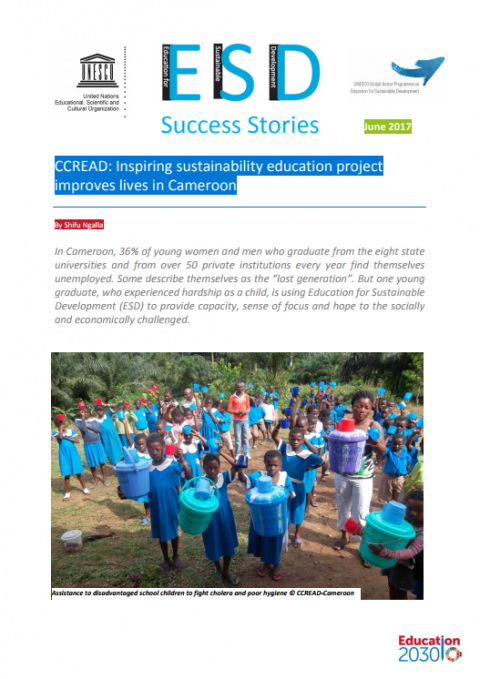 CCREAD: Inspiring sustainability education project improves lives in Cameroon (CAMEROON) Год публикации: 2017 Автор: Shifu Ngalla Организация-автор: UNESCO In Cameroon, 36% of young women and men who graduate from the eight state universities and from over 50 private institutions every year find themselves unemployed. Some describe themselves as the “lost generation”. But one young graduate, who experienced hardship as a child, is using Education for Sustainable Development (ESD) to provide capacity, sense of focus and hope to the socially and economically challenged.