
Ресурсы
Изучайте широкий спектр ценных ресурсов ВГГ, чтобы углубить своё понимание и повысить эффективность исследований, просветительской деятельности, преподавания и обучения.
Найдено: 3,433
 소셜미디어 시대의 정보리터러시에 관한 소고: 재정의, 교육내용, 교육방법을 중심으로 Год публикации: 2013 Автор: Euikyung Oh Организация-автор: Korean Society for Library and Information Science 본 연구는 정보리터러시의 개념을 재정의하고, 이를 바탕으로 정보리터러시의 교육내용과 교육방법을 제안하였다. 재정의를 위하여, 오늘날의 정보환경을 표현하는 정보리터러시 2.0, 사회적 맥락, 메타리터러시, 트랜스리터러시, 소셜미디어 리터러시의 개념을 조사, 분석하였다. 정보리터러시를 구성하는 주요 요소로 ‘사회적 관계’, ‘미디어 융합과 다양성 인식’, ‘정보에 대한 평가적 안목’ 등을 추출하였다. 교육의 방법(미디어)을 결정하기 위하여, 소셜미디어의 편재성을 조사하였고, 조사결과 소셜미디어는 편재성이 높은 미디어로서, 정보리터러시 교육에 활용되는 것이 적절함을 밝혔다. 후속연구로 소셜미디어를 활용한 정보리터러시 교육에 관한 실증적 연구가 수행되어야 할 것을 제안하였다.
  2018 International Symposium on Media and Information Literacy Год публикации: 2018 Организация-автор: Korean National Commission for UNESCO | Community Media Foundation | National Association of Community Mediacenters | Korea Education and Research Information Service (KERIS) | Korea Press Foundation (KPF) This book is a conference report of 2018 International Symposium on Media and Information Literacy. The Symposium on MIL is hosted by the Korea Press Foundation (KPF), the Korea Education and Research Information Service (KERIS), and the Korean National Commission for UNESCO (KNCU), in cooperation with the Community Media Foundation, the National Association of Community Mediacenters. 2018 미디어·정보리터러시: 국제심포지엄 자료집 Год публикации: 2018 Организация-автор: 유네스코한국위원회 | Community Media Foundation | National Association of Community Mediacenters | 한국교육학술정보원 | 한국언론진흥재단 이 책은 유네스코한국위원회, 한국언론진흥재단, 한국교육학술정보원, 시청자미디어재단, 전국미디어센터협의회가 공동주최하고 교육부, 문화체육관광부, 방송통신위원회가 후원한 「2018 미디어·정보리터러시: 국제심포지엄」의 자료집으로 기조연설 및 주제별 발표내용을 담고 있다.
  Life After Youth Media: Insights About Program Influence Into Adulthood Год публикации: 2014 Автор: Suniya Farooqui | Amy Terpstra Организация-автор: Social IMPACT Research Center * Do the skills, attitudes, and behaviors imparted in youth programs "stick" into adulthood? * If they do, how do they manifest in career, education, and life decisions? * How do the skills, attitudes, and behaviors that youth programs try to impart differ based on program intensity or levels of engagement? * Do these elements look different for people who went through youth media programs versus people who went through other types of youth programs? These are common questions that youth program providers, funders, public officials, and other leading thinkers regularly wrestle with. This report tells the story of a group in Chicago committed to providing quality youth media programming in the city and how, through a collective evaluation, they were able to begin to answer these critical questions.
  Digital Empowerment of Girls Год публикации: 2018 Организация-автор: Plan International Despite the accumulated efforts and commitments of the past 20 years, today’s women and girls continue to face gender-based barriers that prevent them from accessing and utilising technology and digital tools at the same level as boys and men.Girls are 5 times less likely to consider a career in tech than boys.Equality of education is essential to redress the digital gender gap – which is sadly growing – but it’s not the only method.We must make tech safe, affordable and accessible to girls – wherever they live. We must tackle the ingrained gender norms that prevent girls from seeing digital roles as accessible career paths.Rather than making assumptions about what girls want and need from technology, we must work with them to create solutions for the issues that affect them by enabling them to learn digital skills.Technology can be a powerful tool for girls’ voices to become even louder and reach even further.This briefing paper provides recommendations for closing the digital gender gap that will enable girls to participate in and contribute to our increasingly digital future.Despite the accumulated efforts and commitments of the past 20 years, today’s women and girls continue to face gender-based barriers that prevent them from accessing and utilising technology and digital tools at the same level as boys and men.Promoting girls’ digital literacy and closing the digital gender gap will play an important role in achieving gender equality and promoting the rights of girls and women worldwide.Plan International strives to build a world in which girls have the tools and the power to shape their own futures and influence decision making and policy processes at local and global levels. Technology is not a prerequisite for being a change agent or a leader, but it can be a powerful tool for girls’ voices to become even louder and reach even further. Similarly, social media can be used as a vehicle to spread inspirational stories of female leaders and connect activists and changemakers across the world.Digital technologies have a strong potential to empower girls and women economically and socially. Girls feel safer and more connected when they have a mobile phone, and they use mobile phones to save time and money and access educational opportunities. Yet girls and women are, on average, less likely than men to own a mobile phone, use mobile data, social media apps or SMS. There is also a stark gender disparity in access to the Internet, which limits the ability of girls and women to benefit from many innovations of the digital economy, such as digital payments and mobile money. The gender disparity in access to technology is compounded by a significant gender divide in terms of career and academic aspirations related to ICTs.Advancing digital equality for girlsThis briefing paper argues that promoting girls’ digital literacy and closing the digital gender gap will play an important role in achieving gender equality and promoting the rights of girls and women worldwide. Indeed, bridging the digital gender divide is essential in ensuring girls and women are not left behind in an increasingly digital future.The paper also argues that actions promoting girls’ digital empowerment should be guided by the principle of engaging girls and women as active, capable partners in our work, not merely passive recipients or targets. Rather than making assumptions about what girls want and need from technology, it is important to work together with girls to strengthen and develop their use and creation of technology and digital tools. Empoderamiento digital de las niñas Год публикации: 2018 Организация-автор: Plan International Este documento informativo argumenta que mediante la promoción de la alfabetización digital de las niñas y el cierre de la brecha digital de género se podrá conseguir importantes logros con respecto a la igualdad de género y la promoción de los derechos de las niñas y mujeres en todo el mundo.
 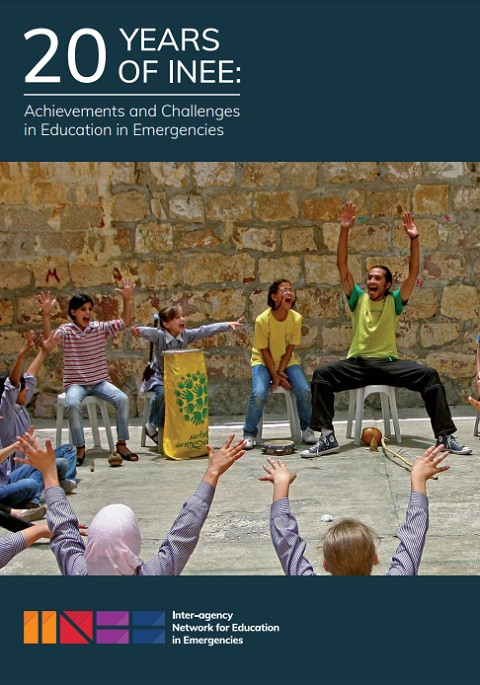 20 Years of INEE: Achievements and Challenges in Education in Emergencies Год публикации: 2020 Организация-автор: Inter-agency Network for Education in Emergencies (INEE) This report highlights the continued relevance of INEE 20 years on. It presents new data that shows 127 million primary and secondary school-age children and young people living in crisis-affected countries were out of school in 2019. This is equivalent to almost half of the global out-of-school population, even though only around 29% of children and young people in this age group globally live in crisis-affected countries. These figures are based on new data provided by the UNESCO Institute for Statistics (UIS). The report also demonstrates the still urgent need to prioritize education and financing of education in emergencies, particularly in ‘forgotten’ crises. 20 ans de l’INEE : Réalisations et Défis dans l’Éducation en Situations d’Urgence Год публикации: 2020 Организация-автор: Inter-agency Network for Education in Emergencies (INEE) Ce rapport, qui marque le 20e anniversaire de l’INEE, souligne les réalisations dans le domaine de l’ESU au cours des deux dernières décennies et identifie les défis permanents. Il retrace les changements qui ont amené l’ESU dans les programmes mondiaux de planification et d’action et note les étapes clés du développement de l’ESU en tant que domaine reconnu. Reconnaissant également les engagements énoncés dans l’Agenda 2030 pour le développement durable, notamment la promesse de veiller à ce que « personne ne soit laissé de côté » (ONU, 2015), ce rapport se tourne vers l’avenir en recommandant des actions immédiates et durables pour atteindre l’Objectif de Développement Durable 4 (ODD 4), une éducation de qualité et des possibilités de formations permanente inclusives et équitables pour tous - incluant les enfants et les jeunes dans les contextes de crise (ONU, 2015). 20º aniversario de la INEE: Logros y desafíos en la educación en situaciones de emergencia Год публикации: 2020 Организация-автор: Inter-agency Network for Education in Emergencies (INEE) Este informe, con motivo del 20.º aniversario de la INEE, enfatiza los logros alcanzados en el ámbito de la EeE en las últimas dos décadas y señala los desafíos que siguen existiendo. Explora los cambios que facilitaron la inclusión de la EeE en los programas globales de planificación y acción, y señala los hitos principales en el desarrollo de la EeE como un campo reconocido. Asimismo, este informe reconoce los compromisos establecidos en la Agenda de Desarrollo Sostenible de 2030, incluido el compromiso de «no dejar a nadie atrás» (ONU, 2015), y enfrenta el futuro con la recomendación de acciones inmediatas y sostenidas para alcanzar el Objetivo de Desarrollo Sostenible 4 (ODS 4),una educación de calidad inclusiva y equitativa, y oportunidades de aprendizaje durante toda la vida para todos; incluidos los niños, niñas y jóvenes en contextos de crisis (UN, 2015).
  Flexible Learning Pathways in Malaysian Higher Education: Balancing Human Resources Development and Equity Policies Год публикации: 2020 Автор: Morshidi Sirat | Abdul Karim Alias | Hazri Jamil | Wan Zuhainis Saad | Muhamad Saiful Bahri Yusoff | Munir Shuib | Mahiswaran Selvanathan | Muhammad Muftahu | Majid Ghasemy | Mazlinawati Mohamed Организация-автор: Commonwealth Tertiary Education Facility (CTEF) | UNESCO International Institute for Educational Planning (IIEP) Malaysia’s higher education system is highly centralized, with a set of legislations to govern and monitor public universities and regulate the private higher education sector. The latest discourse, the Sustainable Development Goals (SDGs), particularly SDG4, pitted against existing policies on lifelong learning, presented an opportunity to assess practices at the institutional level. In the national context, there is a need to confirm the extent to which the linkages between national policies on lifelong learning, strategies, instruments, and institutional practices in terms of flexible learning pathways (FLPs) have benefited nontraditional learners, disadvantaged and marginalized groups. Hence, this research aims to investigate how FLPs have benefited particularly the bottom 40 percent of households (B40 households), disadvantaged and marginalized groups, persons with disabilities, and also women in Malaysia.