
Ресурсы
Изучайте широкий спектр ценных ресурсов ВГГ, чтобы углубить своё понимание и повысить эффективность исследований, просветительской деятельности, преподавания и обучения.
Найдено: 875
 Education and Disability: Analysis of Data from 49 Countries (UIS Information Paper No. 49) Год публикации: 2018 Организация-автор: UNESCO Institute for Statistics (UIS) Sustainable Development Goal (SDG) 4 calls for “inclusive and quality education for all”. Persons with a disability are among the population groups most likely to suffer from exclusion from education but data that permit an analysis of the links between disability and education remain scarce.This paper examines educational disparities linked to disability based on data from 49 countries and territories for five education indicators: Proportion of 15- to 29-year-olds who ever attended school Out-of-school rate (primary school age, lower secondary school age) Completion rate (primary education, lower secondary education) Mean years of schooling of the population 25 years and older Adult literacy rate (population 15 years and older)
 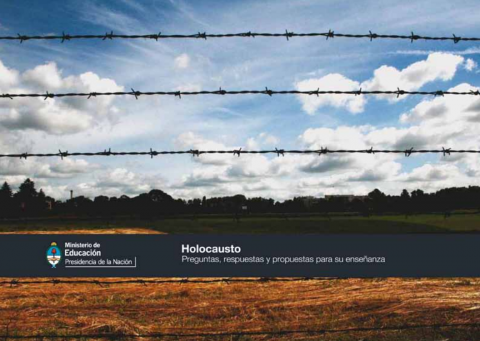 Holocausto : Preguntas, respuestas y propuestas para su ensenanza Год публикации: 2010 Организация-автор: Argentina. Ministerio de Educacion This publication, released by the "Education and Memory" department of the Ministry of National Education of Argentina, is a handout to think about, debate and discuss some of the issues relevant to teaching about the Holocaust. Holocausto : Preguntas, respuestas y propuestas para su ensenanza Год публикации: 2010 Организация-автор: Argentina. Ministerio de Educacion This publication, released by the "Education and Memory" department of the Ministry of National Education of Argentina, is a handout to think about, debate and discuss some of the issues relevant to teaching about the Holocaust. Holocauste: questions, réponses et propositions pour l'enseignement Год публикации: 2010 Организация-автор: Argentina. Ministerio de Educacion Cette publication, publiée par le «Education et Mémoire » département du Ministère de l'Education Nationale de l'Argentine, est un document à réfléchir, débattre et discuter de certaines des questions relatives à l'enseignement de l'Holocauste.
 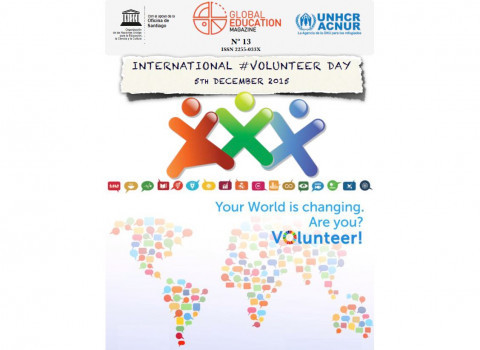 Global Education Magazine No. 13: International #Volunteer Day Год публикации: 2015 Автор: Global Education Magazine This year’s International Volunteer Day (IVD) theme, "The world is changing. Are you? Volunteer!" is challenging each and every one of us to be part of implementing the newly launched Global Goals. The 2030 Agenda for Sustainable Development is a plan of action for ending poverty in all its dimensions, irreversibly, everywhere. Volunteerism, and each one of your volunteer actions, are critical to ensure we “leave no one behind” in this effort.The contribution of volunteers in the new development agenda is two-fold. Volunteerism is a way for us all to be directly involved in achieving sustainable development and peace. At the same time, this essential way of fostering people’s participation makes it a key element for success when striving for sustainability of development. Volunteer organizations can be brokers of civic engagement, connecting institutional initiatives with volunteer action at local, national and global levels.
  Los derechos humanos, el holocausto y los genocidos recientes Год публикации: 2008 Организация-автор: Ecuador. Ministerio de Educacion This resource guide designed for high school students in Ecuador broaches Holocaust history through broader thematics such as Human Rights, mass violence and a comparative analysis with other genocides. It is an valuable document for understanding worldwide issues.
  Global Citizenship in the English Language Classroom Год публикации: 2008 Автор: Susan Hillyard | Elena Tarasheva | Clarissa Jordão | Francisco Fogaça | Esperanza Revelo Jiménez | Sabiha Khuram | Telma Gimenez | Vanessa Andeotti Организация-автор: British Council This booklet contains a collection of papers on global citizenship in language education around the world. It provides theoretical frameworks and practical applications in different contexts.Following on from Audrey Osler and Hugh Starkey’s 'Citizenship and Language Learning: international perspectives', published in 2005, this collection aims at offering ideas and practical suggestions on how teachers around the world have tackled the teaching of English within a citizenship education perspective. There are seven chapters, from authors working in different parts of the world, such as Argentina, Bulgaria, Brazil, Colombia, and Pakistan.There are five report style chapters that deal with courses, teaching materials, research and curriculum innovation. The two remaining contributions can be seen as proposals for implementation of a global citizenship perspective in English language classrooms.The diverse interpretations teachers of English around the world have been giving to the task of promoting global citizenship in their classrooms are reflected in this collection with understandings that range from a more prescriptive approach to a transformational one. They bring the potential for new approaches to be tried out in different contexts. The aim is to inspire teachers to experiment and evaluate the results.
  Alternative bilingual Miskito-Spanish intercultural literacy education linked to the exercise of citizenship and community production Год публикации: 2008 Организация-автор: Regional Literacy and CONFINTEA VI Preparatory Conference in Latin America and the Caribbean: From Literacy to Lifelong Learning: Towards the Challenges of the 21st Century, Mexico City, 2008 The Alternative Bilingual Intercultural Literacy Education project is carried out in five rural indigenous communities and eleven urban neighbourhoods of Bilwi (Puerto Cabezas) in the North Atlantic Autonomous Region (RAAN) of Nicaragua. In this region, illiteracy is the result of poverty, historical social exclusion and the lack of any official or State programme of adult literacy education in the Miskito language. This constitutes a negation of the right to bilingual intercultural education of the young and adult indigenous population and an obstacle to individual, social and regional development. The project provides literacy classes for young people and adults in their mother tongue Miskito and in Spanish, and deals with intercultural themes of their world view, the environment and indigenous rights. In Nicaragua, this experiment is a unique and alternative model of literacy provision in Miskito, with a Miskito-Spanish bilingual intercultural curriculum of its own. The texts have been produced by authors from the Miskito ethnic group, with contents determined on the basis of a needs analysis and the identification of fundamental features of the Miskito world view. Éducation Interculturelle bilingue Miskito-Espagnol liée à l'exercice de la citoyenneté et de la communauté production Год публикации: 2008 Организация-автор: Regional Literacy and CONFINTEA VI Preparatory Conference in Latin America and the Caribbean: From Literacy to Lifelong Learning: Towards the Challenges of the 21st Century, Mexico City, 2008 Le projet de l'éducation interculturelle bilingue est réalisée dans cinq communautés autochtones rurales et onze quartiers urbains de Bilwi (Puerto Cabezas) dans la région de l'Atlantique Nord autonome (RAAN) du Nicaragua. Dans cette région, l'analphabétisme est le résultat de la pauvreté, l'exclusion sociale historique et l'absence de tout programme officiel ou de l'Etat de l'alphabétisation des adultes dans la langue Miskito. Ceci constitue une négation du droit à l'éducation interculturelle bilingue des jeunes et des adultes population indigène et un obstacle au développement individuel, social et régional. Le projet offre des cours d'alphabétisation pour les jeunes et les adultes dans leur Miskito langue maternelle et en espagnol, et traite des thèmes interculturels de leur vision du monde, l'environnement et les droits des autochtones. Au Nicaragua, cette expérience est un modèle unique et alternatif de la prestation de l'alphabétisation en Miskito, avec un bilingue Miskito-espagnol curriculum interculturel propre. Les textes ont été rédigés par des auteurs du groupe ethnique Miskito, avec des contenus déterminés sur la base d'une analyse des besoins et l'identification des caractéristiques fondamentales de la vision du monde Miskito.
 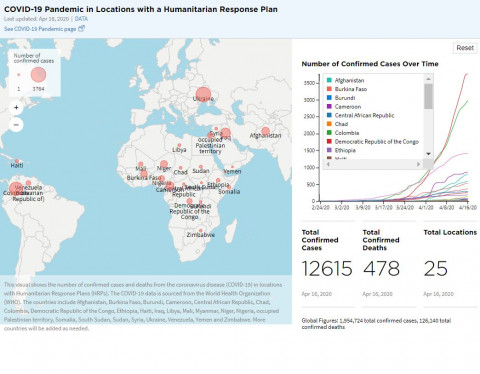 COVID-19 Pandemic in Locations with a Humanitarian Response Plans Год публикации: 2020 Организация-автор: United Nations Office for the Coordination of Humanitarian Affairs (OCHA) This visual shows the number of confirmed cases and deaths from the coronavirus disease (COVID-19) in locations with Humanitarian Response Plans (HRPs). The COVID-19 data is sourced from the World Health Organization (WHO). The countries include Afghanistan, Burkina Faso, Burundi, Cameroon, Сentral African Republic, Chad, Colombia, Democratic Republic of the Congo, Ethiopia, Haiti, Iraq, Libya, Mali, Myanmar, Niger, Nigeria, occupied Palestinian territory, Somalia, South Sudan, Sudan, Syria, Ukraine, Venezuela, Yemen and Zimbabwe. More countries will be added as needed.