
Ресурсы
Изучайте широкий спектр ценных ресурсов ВГГ, чтобы углубить своё понимание и повысить эффективность исследований, просветительской деятельности, преподавания и обучения.
Найдено: 306
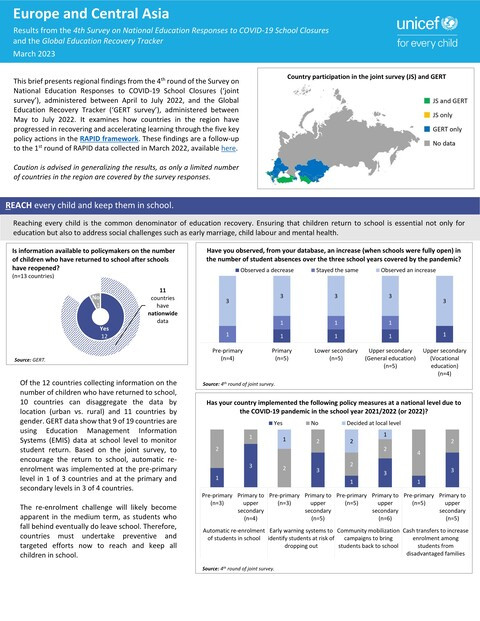 Education in a Post-COVID World: Towards a Rapid Transformation; Europe and Central Asia Regional Brief Год публикации: 2023 Организация-автор: United Nations Children's Fund (UNICEF) On March 11, 2020, the World Health Organization declared COVID-19 a global pandemic, resulting in disruptions to education at an unprecedented scale. In response to the urgent need to recover learning losses, countries worldwide have taken RAPID actions to: Reach every child and keep them in school; Assess learning levels regularly; Prioritize teaching the fundamentals; Increase the efficiency of instruction; and Develop psychosocial health and wellbeing. This brief presents regional findings from the 4th round of the Survey on National Education Responses to COVID-19 School Closures (‘joint survey’), administered between April to July 2022, and the Global Education Recovery Tracker (‘GERT survey’), administered between May to July 2022. It examines how countries in the region have progressed in recovering and accelerating learning through the five key policy actions in the RAPID framework. These findings are a follow-up to the 1st round of RAPID data collected in March 2022.
  Educating for global competence: preparing our youth to engage the world Год публикации: 2011 Автор: Veronica Boix Mansilla | Anthony Jackson Организация-автор: Asia Society | Council of Chief State School Officers (CCSSO) Contemporary societies are marked by new global trends - economic, cultural, technological, and environmental shifts that are part of a rapid and uneven wave of globalization. The growing global interdependence that characterizes our time calls for a generation of individuals who can engage in effective global problem solving and participate simultaneously in local, national, and global civic life. Put simply, preparing our students to participate fully in today's and tomorrow's world demands that we nurture their global competence.This document introduces a definition of global competence developed by the Global Competence Task Force - a group of state education agency leaders, education scholars, and practitioners - under the auspices of the Council of Chief State School Officers EdSteps initiative (CCSSO-EdSteps) and the Asia Society Partnership for Global Learning (see page (iv) for task force participants). The definition builds on seminal work within the states and a broad range of organizations working to advance global knowledge and critical thinking skills. A process of careful articulation and vetting yielded the definition of global competence here proposed:Global competence is the capacity and disposition to understand and act on issues of global significance.Globally competent individuals are aware, curious, and interested in learning about the world and how it works. They can use the big ideas, tools, methods, and languages that are central to any discipline (mathematics, literature, history, science, and the arts) to engage the pressing issues of our time. They deploy and develop this expertise as they investigate such issues, recognize multiple perspectives, communicating their views effectively, and taking action to improve conditions.Educating for Global Competence: Preparing Our Youth to Engage the World is intended for classroom teachers, administrators, informal educators, policymakers, community leaders, researchers, parents, students, and all other stakeholders interested in preparing our youth for the 21st century. Becoming better at education for global competence involves rethinking practices and recognizing that there are no simple recipes for success. As such, this book is meant to be used flexibly - browse, make connections, and concentrate on the chapters that you find most pertinent to your work. Experiment with ideas, challenge concepts, and share with colleagues. Ultimately this book must work for you. It is meant to be read in the way that best meets your needs, inspires your curiosity, and proves fruitful in the classroom.Chapter one offers a rational for global education in our nation and worldwide. Chapter two introduces a conceptual framework for global competence and explains the key role of disciplinary and interdisciplinary foundations in student learning. Chapter three, four, five and six focus, respectively, on four core capacities associated with global competence: investigating the world, recognizing perspectives, communicating ideas, and taking action. Chapter seven considers core principles of instruction for teaching global competence. Chapter eight looks at what students and education institutions can do to promote global competence - and how they might create a culture of global competence for youth and adults. Finally, chapter nine places global competence in the larger framework of public education systems in and beyond the United States. Eduquer pour compétence globale: préparer nos jeunes à engager le monde Год публикации: 2011 Автор: Veronica Boix Mansilla | Anthony Jackson Организация-автор: Asia Society | Council of Chief State School Officers (CCSSO) Les sociétés contemporaines sont marquées par de nouvelles tendances mondiales - changements économiques, culturels, technologiques et environnementaux qui font partie d'une vague rapide et inégal de la mondialisation. L'interdépendance mondiale croissante qui caractérise notre temps appelle à une génération de personnes qui peuvent se livrer à la résolution de problème mondial efficace et participer simultanément à la vie civique locale, nationale et mondiale. Simplement, la préparation de nos étudiants de participer pleinement au monde les exigences d'aujourd'hui et de demain que nous entretenons leur compétence mondiale. Ce document présente une définition de la compétence globale développée par le Groupe de travail mondial Compétence - un groupe de chefs d'Etat de l'agence de l'éducation, spécialistes de l'éducation, et les praticiens - sous les auspices du Conseil de l'école Chief State initiative des officiers de EdSteps (CCSSO-EdSteps) et la Asia Partnership Society for global Learning (voir page (iv) pour les participants du groupe de travail). La définition se fonde sur le travail séminal dans les états et un large éventail d'organisations de travail pour faire avancer les connaissances mondiales et de la pensée critique. Un processus d'articulation minutieuse et vetting a abouti à la définition de la compétence globale proposée ici: la compétence globale est la capacité et la disposition pour comprendre et agir sur les questions d'importance mondiale. Globalement les personnes compétentes sont au courant, curieux et intéressés à en apprendre sur le monde et comment il fonctionne. Ils peuvent utiliser les grandes idées, des outils, des méthodes et des langues qui sont au cœur de toutes les disciplines (mathématiques, la littérature, l'histoire, la science et les arts) pour engager les questions pressantes de notre temps. Ils déploient et développer cette expertise comme ils enquêtent sur ces questions, reconnaissent de multiples points de vue, de communiquer leurs points de vue de manière efficace, et prendre des mesures pour améliorer les conditions. Eduquer pour Global Competence: Préparer les jeunes d'engager le monde est destiné aux enseignants, administrateurs, éducateurs informels, les décideurs, les leaders communautaires, les chercheurs, les parents, les étudiants et toutes les autres parties intéressées à préparer nos jeunes pour le 21e siècle. Devenir meilleur à l'éducation pour la compétence globale implique de repenser les pratiques et en reconnaissant qu'il n'y a pas de recettes simples pour le succès. En tant que tel, ce livre est destiné à être utilisé avec souplesse - parcourir, faire des liens, et de se concentrer sur les chapitres que vous trouverez les plus pertinents pour votre travail. Expérience avec des idées, des concepts de défi, et de partager avec des collègues. En fin de compte ce livre doit travailler pour vous. Il est destiné à être lu de la manière qui répond le mieux à vos besoins, inspire votre curiosité, et prouve fructueuse dans la salle de classe. Le premier chapitre offre un rationnel pour l'éducation mondiale dans notre pays et dans le monde. Le deuxième chapitre présente un cadre conceptuel pour la compétence globale et explique le rôle clé des fondations disciplinaires et interdisciplinaires dans l'apprentissage des élèves. Chapitre trois, quatre, cinq et six focus, respectivement, sur quatre capacités essentielles associées à la compétence mondiale: enquête dans le monde, reconnaissant les perspectives, communiquer des idées, et de prendre des mesures. Le chapitre sept considère les principes de base de l'enseignement pour l'enseignement de la compétence globale. Chapitre huit examine ce que les étudiants et les établissements d'enseignement peuvent faire pour promouvoir la compétence globale - et comment ils pourraient créer une culture de compétence globale pour les jeunes et les adultes. Enfin, le chapitre neuf places compétence globale dans le cadre plus large des systèmes d'éducation du public dans et au-delà des États-Unis.
  Expert group meeting “youth civic engagement:enabling youth participation in political, social and economic life” 16-17 June 2014 UNESCO Headquarters Paris, France: concept note Год публикации: 2014 Организация-автор: UN. Department of Economic and Social Affairs (UN. DESA) From 16-17 June 2014, the Division for Social Policy and Development in the Department of Economic and Social Affairs of the United Nations and UNESCO will organize an Expert Group Meeting at UNESCO Headquarters, Paris, under the theme “Youth Civic Engagement: enabling youth participation in political, social and economic life.” The meeting will bring together experts and representatives of youth organizations, academia, representatives of Member States, United Nations entities, and intergovernmental organizations to discuss the ways in which youth civic engagement can be an enabler for political, social and economic participation, as well as to examine current opportunities and challenges affecting such potential. These topics will be considered under the framework of both the World Programme of Action for Youth1 and of the UN System-Wide Action Plan on Youth which respectively incorporate youth participation and youth civic engagement among their priority areas for action. Réunion du groupe d'experts "engagement civique des jeunes: permettre la participation des jeunes à la vie politique, sociale et économique" 16-17 Juin 2014 Siège de l'UNESCO Paris, France: note conceptuelle Год публикации: 2014 Организация-автор: UN. Department of Economic and Social Affairs (UN. DESA) De 16-17 Juin 2014, la Division des politiques sociales et du développement du Département des affaires économiques et sociales des Nations Unies et l'UNESCO organisera une réunion d'experts au Siège de l'UNESCO, Paris, sous le thème «engagement civique des jeunes: les jeunes permettant participation à la vie politique, sociale et économique. » La réunion rassemblera des experts et des représentants d'organisations de jeunesse, des universitaires, des représentants des États membres, les organismes des Nations Unies et les organisations intergouvernementales pour discuter de la façon dont les jeunes l'engagement civique peut être un catalyseur pour participation politique, sociale et économique, ainsi que d'examiner les possibilités et les défis actuels affectant un tel potentiel. Ces sujets seront examinés dans le cadre à la fois du Programme d'action mondial pour jeunesse1 et du Plan d'action de l'ONU l'échelle du système sur les jeunes qui intègrent respectivement la participation des jeunes et l'engagement civique des jeunes parmi leurs domaines d'action prioritaires.
  How Digital is Transforming the Lives of Young People in Small Island Developing States Год публикации: 2024 Организация-автор: United Nations Development Programme (UNDP) Young people represent a sizeable and vital population in Small Island Developing States (SIDS). For them, digital technologies are more than just tools; they are gateways to new horizons. Digital is creating fresh opportunities, opening doors to unconventional careers, and redefining how knowledge is acquired and shared. Young people are using digital to start new businesses, explore new opportunities, learn new knowledge and skills, and to build global connections. However, young people are also cautious about digital – and they recognise risks and issues posed by digital channels, tools, and technologies. ‘How Digital is Transforming the Lives of Young People in SIDS’ explores these opportunities and challenges by hearing from young people – in their own words. Through a bespoke survey chatbot, running on messaging platforms most used by young people living in SIDS, more than 5,000 respondents from over 30 countries discuss how they’re using digital to transform their lives and livelihoods. And the barriers and challenges that they are facing on their digital journeys.
  Girl Goals: What has Changed for Girls? Adolescent Girls’ Rights over 30 Years Год публикации: 2025 Организация-автор: United Nations Children's Fund (UNICEF) | United Nations Entity for Gender Equality and the Empowerment of Women (UN Women) | Plan International This report makes three key recommendations on action we can take now to advance adolescent girls’ rights at scale, in ways that account for fiscally constrained contexts and multiple competing priorities: 1. Ensure tangible and actionable support for adolescent girls’ voices, advocacy and action. The current generation of girls are raising their voices to be heard and are already at the forefront of making change around the world. With the right support, resources and seats at the table, adolescent girls can help transform the world for the better, shaping better policy outcomes for themselves and everyone. This is not about girls’ voices above all others, or endless consultation, but about specific, meaningful actions that ensure girls get the support they need and are heard on policy issues that matter to them. 2. Establish and track explicit targets for change for adolescent girls, who are too often invisible and sidelined Setting explicit targets to monitor outcomes for adolescent girls is key to making progress. Context-specific prioritization will be necessary, but there are some issues that stand out globally. Gaps in progress (such as child marriage gains accruing disproportionately to wealthier households) demonstrate the need forprogrammes that address poverty and economic realities alongside harmful social norms. The disproportionate number of adolescent girls not in education, employment or training, not entering the labour market as young women, and left behind when it comes to digital skills, is a threat to the gains made for girls and to economic growth that will benefit everyone. Stagnation on issues like underweight also stand out. Country- specific priorities supported by data- driven accountability mechanisms and investments are needed to translate policy commitments into change on the ground. 3. Resource and deliver smartly to unlock the social and economic dividend Governments and partners should invest in solutions proven to change outcomes across multiple SDGs at scale – for example, investing in education and skills, cash transfers and economic empowerment programmes designed to support girls. Existing systems, from maternal health care to school curricula, should be adapted to meet girls’ needs rather than creating small- scale, separate projects. Streamlined, evidence-based ‘add-ons’ – such as adding parenting support to existing maternal health-care programmes – can be cost effective and accelerate outcomes if well designed. Change is possible, and this report shows that great gains have been made. Smart investments now can transform the world for girls, families, communities and national economies. It is time to act.
  Schools for Conflict or for Peace in Afghanistan Год публикации: 2015 Автор: Dana Burde The publication provides a systematic analysis of the relationship between education and conflict, tracing how different approaches have been applied in Afghanistan as the rationale for aid has shifted from a policy of benign neglect, to an effort to support war, to an effort to mitigate conflict. Using this history as a case study, the book explores how foreign intervention in education can contribute either to conflict or to peace.. Schools for Conflict or for Peace in Afghanistan Год публикации: 2015 Автор: Dana Burde Cette publication est une analyse de la relation entre l'éducation et les conflits, retraçant l’évolution des motifs mobilisés pour justifier le recours à une aide extérieure en Afghanistan, et le passage d’une politique du laissez faire à celle de soutien à l’effort de guerre, puis aux tentatives d’apaisement du conflit. En s’appuyant sur cet exemple, cet ouvrage analyse comment l'intervention étrangère en matière d'éducation peut aussi bien contribuer à la guerre qu’à la paix.
  Shared Responsibility, Global Solidarity: Responding to the Socio-Economic Impacts of COVID-19 Год публикации: 2020 Организация-автор: United Nations (UN) We are facing a global health crisis unlike any in the 75-year history of the United Nations — one that is killing people, spreading human suffering, and upending people’s lives. But this is much more than a health crisis. It is a human crisis. The coronavirus disease (COVID-19) is attacking societies at their core. The IMF has just reassessed the prospect for growth for 2020 and 2021, declaring that we have entered a recession – as bad as or worse than in 2009. The IMF projects recovery in 2021 only if the world succeeds in containing the virus and take the necessary economic measures.In the face of such an unprecedented situation in recent history, the creativity of the response must match the unique nature of the crisis – and the magnitude of the response must match its scale. No country will be able to exit this crisis alone.This report is a call to action, for the immediate health response required to suppress transmission of the virus to end the pandemic; and to tackle the many social and economic dimensions of this crisis. It is, above all, a call to focus on people – women, youth, low-wage workers, small and medium enterprises, the informal sector and on vulnerable groups who are already at risk.