
Ресурсы
Изучайте широкий спектр ценных ресурсов ВГГ, чтобы углубить своё понимание и повысить эффективность исследований, просветительской деятельности, преподавания и обучения.
Найдено: 1,407
 Inclusion from the start: guidelines on inclusive early childhood care and education for Roma children Год публикации: 2014 Организация-автор: UNESCO | Council of Europe Inclusion from the start: guidelines on inclusive early childhood care and education for Roma children (Guidelines hereafter) is a joint contribution by the Council of Europe and UNESCO to improving access to quality early childhood services for Roma children. They are a concrete follow-up to the recommendations arising from an expert meeting, organised by the two organisations in 2007.1 Recognising that quality early childhood experience is an important stepping stone toward inclusive participation in school and society, the Guidelines address the challenges specifc to Roma children in the early years and transition to primary education. They provide guidance on key themes, such as the conceptualisation of early childhood care and education (ECCE) services, agenda-setting, stakeholders’ responsibilities, curricular and pedagogical approaches, staf training and professional development, assessment and transition to primary education. The Guidelines primarily address formal ECCE services – such as kindergartens and preschools – which typically cater for children from ages 3-6 years. The reason for this focus is that providing care and education experience prior to primary school entry is crucial for supporting Roma children’s school readiness and for facilitating an equal start in their frst year. This being said, the Guidelines also acknowledge the critical importance of the years pre-natal to age 3, and consider health and nutrition interventions and non-formal ECCE programmes (e.g. community-based childcare, parenting education) as essential services in deprived neighbourhoods and settlements. Inclusion dès le début: les lignes directrices sur les soins de la petite enfance inclusive et éducation pour les enfants roms Год публикации: 2014 Организация-автор: Organisation des Nations Unies pour l'éducation, la science et la culture (UNESCO) | Conseil de l'Europe Inclusion dès le début: les lignes directrices sur les soins de la petite enfance inclusive et l'éducation des enfants roms (lignes directrices ci-après) est une contribution conjointe du Conseil de l'Europe et de l'UNESCO à l'amélioration de acesss aux services de la petite enfance de qualité pour les enfants roms. Ils sont un suivi concret aux recommandations découlant d'une réunion d'experts, organisée par les deux organisations en 2007.1. Reconnaissant que l'expérience de qualité de la petite enfance est une étape importante vers la participation inclusive à l'école et de la société, les lignes directrices abordent les défis spécifques aux enfants roms dans les premières années et la transition à l'enseignement primaire. Ils fournissent des conseils sur des thèmes clés, tels que la conceptualisation des soins de la petite enfance et les services d'éducation (EPPE), l'établissement de l'ordre du jour, les responsabilités des parties prenantes, des programmes et des approches pédagogiques, la formation des staf et le perfectionnement professionnel, l'évaluation et la transition à l'enseignement primaire. Les lignes directrices traitent principalement des services formels EPPE - tels que les jardins d'enfants et les écoles maternelles - qui répondent généralement pour les enfants âgés de 3-6 ans. La raison de cette mise au point est que la prestation de soins et de l'expérience de l'éducation avant l'entrée de l'école primaire est cruciale pour soutenir la maturité scolaire des enfants roms et pour faciliter un départ égal dans leur année frst. Ceci étant dit, les lignes directrices reconnaissent également l'importance critique des années pré-natal à 3 ans, et d'envisager des interventions de santé et de la nutrition et des programmes non formels EPPE (garde d'enfants, l'éducation parentale à base communautaire) comme des services essentiels dans les quartiers défavorisés et colonies.
 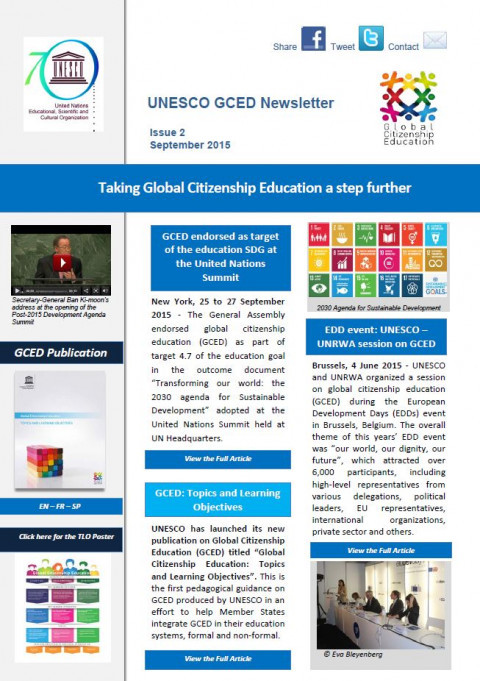 UNESCO GCED eNewsletter Issue 2 Год публикации: 2015 Организация-автор: UNESCO Featuring:Taking Global Citizenship Education a step furtherGCED endorsed as target of the education SDG at the United Nations SummitGCED: Topics and Learning ObjectivesEDD event: UNESCO-UNRWA session on GCEDCapacity-building workshops-providing assistance for GCED implementationGCED for West African countries – building on peace and human rights educationTool for writing textbooks free of prejudiceOrientation and Capacity Building on GCED for Latin American and Caribbean countriesKey tweetsUpcoming events Replantear la educación: ¿Hacia un bien común mundial? Год публикации: 2015 Организация-автор: Organización de las Naciones Unidas para la Educación, la Ciencia y la Cultura (UNESCO) The changes in the world today are characterized by new levels of complexity and contradiction. These changes generate tensions for which education is expected to prepare individuals and communities by giving them the capability to adapt and to respond. This publication contributes to rethinking education and learning in this context. It builds on one of UNESCO’s main tasks as a global observatory of social transformation with the objective of stimulating public policy debate. It is a call for dialogue among all stakeholders. It is inspired by a humanistic vision of education and development, based on respect for life and human dignity, equal rights, social justice, cultural diversity, international solidarity, and shared responsibility for a sustainable future. These are the fundamentals of our common humanity. This book enhances the vision provided by the two landmark UNESCO publications: Learning to Be: The world of education today and tomorrow (1972), the ‘Faure Report’, and Learning: The treasure within (1996), the ‘Delors Report’. Переосмысливая образование: Образование как всеобщее благо? Год публикации: 2015 Организация-автор: Организация Объединенных Наций по вопросам образования, науки и культуры (UNESCO) The changes in the world today are characterized by new levels of complexity and contradiction. These changes generate tensions for which education is expected to prepare individuals and communities by giving them the capability to adapt and to respond. This publication contributes to rethinking education and learning in this context. It builds on one of UNESCO’s main tasks as a global observatory of social transformation with the objective of stimulating public policy debate.It is a call for dialogue among all stakeholders. It is inspired by a humanistic vision of education and development, based on respect for life and human dignity, equal rights, social justice, cultural diversity, international solidarity, and shared responsibility for a sustainable future. These are the fundamentals of our common humanity. This book enhances the vision provided by the two landmark UNESCO publications: Learning to Be: The world of education today and tomorrow (1972), the ‘Faure Report’, and Learning: The treasure within (1996), the ‘Delors Report’.
 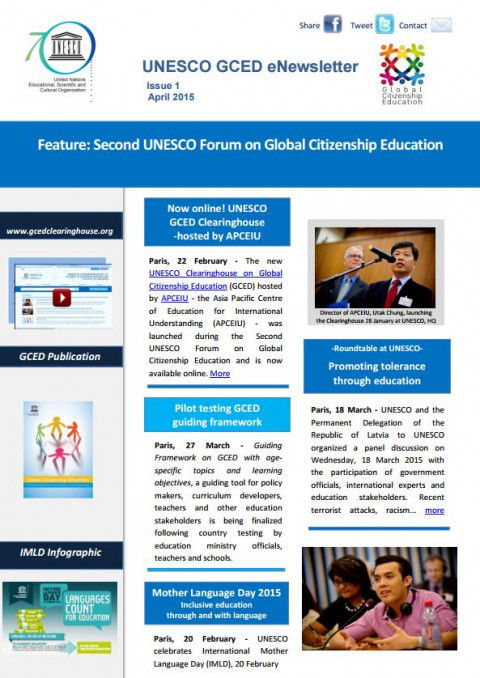 UNESCO GCED eNewsletter Issue 1 Год публикации: 2015 Организация-автор: UNESCO Feature: Second UNESCO Forum on Global Citizenship EducationNow online! UNESCO GCED Clearinghouse hosted by APCEIUPilot testing GCED guiding framework(Roundtable at UNESCO) Promoting tolerance through educationMother Tongue Day 2015: inclusive education through and with language(Interview) Roland Villamero speaks on GCED at the community levelHIghlights: Second UNESCO Forum on Global Citizenship Education, 28-30 January 2015, Paris HQSecond UNESCO Forum on GCED puts spotlight on Post-2015 developmentGlobal citizenship must be placed in the centre of education systemsAmira Yahyaoui's feature presentation at the Second UNESCO GCED ForumJoint Youth Statement2nd GCED Forum photo gallery UNESCO ECM e Bulletin Bulletin Numéro 1 Год публикации: 2015 Организация-автор: Organisation des Nations Unies pour l'éducation, la science et la culture (UNESCO) Caractéristique: Deuxième Forum de l'UNESCO sur l'éducation sur la citoyenneté mondialeMaintenant en ligne! UNESCO ECM Centre hébergé par APCECIcadre d'orientation Piolot test ECM(Table ronde à l'UNESCO) Tolérance Promouvoir par l'éducationLangue maternelle Jour 2015: l'éducation inclusive à travers et avec la langue(Interview) Roland Villamero parle sur ECM au niveau communautaireHighlights: Deuxième Forum de l'UNESCO sur l'éducation sur la citoyenneté mondiale, 28-30 Janvier 2015, HQ ParisDeuxième Forum de l'UNESCO sur ECM met les projecteurs sur L'après 2015 le développementLa citoyenneté mondiale doit être placé au centre des systèmes éducatifsfonction de la présentation de Amira Yahyaoui lors du deuxième Forum ECM UNESCODéclaration des jeunes mixte2ème Forum ECM galerie photo
  Informe de las Naciones Unidas sobre el desarrollo de los recursos hídricos en el mundo 2016: agua y empleo Год публикации: 2016 Организация-автор: Organización de las Naciones Unidas para la Educación, la Ciencia y la Cultura (UNESCO) Three out of four jobs worldwide rely on water. As such, water shortages and lack of access may limit economic growth in the years to come, according to the World Water Development Report 2016. From its collection, through various uses, to its ultimate return to the natural environment, water is a key factor in the development of job opportunities either directly related to its management (supply, infrastructure, wastewater treatment, etc.) or in economic sectors that are heavily water-dependent such as agriculture, fishing, power, industry and health. In its analysis of the economic impact of access to water, the report cites numerous studies that show a positive correlation between investments in the water sector and economic growth. It also highlights the key role of water in the transition to a green economy.
  Second UNESCO Forum on Global Citizenship Education: building peaceful and sustainable societies: final report Год публикации: 2015 Организация-автор: UNESCO The Second UNESCO Forum on Global Citizenship Education (GCED) was organized in Paris from 28 to 30 January 2015 under the overall theme 'Building peaceful and sustainable societies: preparing for post-2015'. The Forum was organized in support of the UN Secretary General's Global Education First Initiative (GEFI) and on the occasion of UNESCO's 70th Anniversary. The Forum was organized by the Division for Teaching, Learning and Content, Educatio Sector, UNESCO, with the support of Austria, the Sultanate of Oman and the Republic of Korea. Other partners also included the United Nations Secretary-General's Global Education First Initiative (GEFI), UNESCO's Mahatma Gandhi Institute of Education for Peace and Sustainable Development (MGIEP), UNESCO's Asia-Pacific Centre of Education for International Understanding (APCEIU), the King Abdullah Bin Abdulaziz International Centre for Interreligious and Intercultural Dialogue (KAICIID) and the Learning Matrix Task Force. Some 250 participants from 61 countries from all regions of the world attended the Forum. These included decision-and policy-makers, practitioners, teachers, development partners, academics, the private sector, civil society representatives (national, regional and international level) as well as learners and youth representatives. The Forum was organized around three plenary sessions and 20 concurrent sessions. Topics under consideration included, among others, GCED in the post-2015 education agenda, measuring GCED learning outcomes, teaching practices, peace and human rights education, respect for diversity and inter-religious education, tackling discrimination and violence, education for sustainable development, youth involvement, the use of ICT and social media, and others. For an overview of the programme, please see Annex I. Second UNESCO Forum on Global Citizenship Education: building peaceful and sustainable societies: final report Год публикации: 2015 Организация-автор: Organisation des Nations Unies pour l'éducation, la science et la culture (UNESCO) Le deuxième Forum de l'UNESCO sur l'éducation à la citoyenneté mondiale (ECM) a été organisé à Paris du 28 au 30 Janvier 2015 sous le thème général «Construire des sociétés pacifiques et durables: préparer l'après-2015». Le Forum a été organisé à l'appui d’Éducation Globale Première Initiative du Secrétaire général de l'ONU (EGPI) et à l'occasion du 70e anniversaire de l'UNESCO. Le Forum a été organisé par la Division de l'enseignement, l'apprentissage et du contenu, Secteur Educatio, l'UNESCO, avec le soutien de l'Autriche, le Sultanat d'Oman et la République de Corée. D'autres partenaires comprenaient également ’Éducation Globale Première Initiative du Secrétaire général du Secrétaire général de l’ONU (EGPI), Mahatma Gandhi Institute de l'UNESCO de l'éducation pour la paix et le développement durable (MGIEP), Asie-Pacifique Centre de l'UNESCO de l'éducation pour la compréhension internationale (APCEIU), le roi Abdallah Bin Abdulaziz Centre international pour le dialogue interreligieux et interculturel (KAICIID) et le Groupe de travail Matrice d'apprentissage. Quelque 250 participants de 61 pays de toutes les régions du monde ont participé au Forum. ceci inclut décisions et les décideurs politiques, les praticiens, les enseignants, les partenaires de développement, des universitaires, le secteur privé, les représentants de la société civile (niveau national, régional et international), ainsi que les apprenants et les représentants de la jeunesse.Le Forum a été organisé autour de trois sessions plénières et 20 sessions simultanées. Sujets à l'étude comprenaient, entre autres, ECM dans l'agenda de l'éducation post-2015, la mesure des résultats ECM d'apprentissage, les pratiques d'enseignement, éducation à la paix et les droits de l'homme, le respect de la diversité et de l'éducation inter-religieux, la lutte contre la discrimination et la violence, l'éducation pour le développement durable, la participation des jeunes, l'utilisation des TIC et des médias sociaux, et d'autres. Pour un aperçu du programme, s'il vous plaît voir l'annexe I.