
Ресурсы
Изучайте широкий спектр ценных ресурсов ВГГ, чтобы углубить своё понимание и повысить эффективность исследований, просветительской деятельности, преподавания и обучения.
Найдено: 1,300
 Молодежь Центральной Азии: Таджикистан Год публикации: 2017 Автор: Muzaffar Olimov | Shavkat Sakhibov Организация-автор: Фонд имени Фридриха Эберта в Казахстане Фондом им. Фридриха Эберта был инициирован проект «Молодежь Центральной Азии». Его цель – изучение ценностей и взглядов молодых таджикистанцев, образа жизни, идентификации, политических взглядов и внешнеполитических ориентаций. По итогам проведенной работы независимым экономистом Шавкатом Сахибовым и доктором исторических наук, профессором Музаффаром Олимовым был подготовлен исследовательский аналитический отчет.
  Why Is Music So Important in Our Life? Год публикации: 2019 Автор: José Manuel Zapata Организация-автор: BBVA Aprendemos Juntos The tenor José Manuel Zapata talks about the importance of music in people's lives, emphasizing the first years of life, the effects of teaching music on children, on the development of empathy and language. ¿Por qué la música es tan importante en nuestra vida? Год публикации: 2019 Автор: José Manuel Zapata Организация-автор: BBVA Aprendemos Juntos El tenor José Manuel Zapata habla sobre la importancia de la música en la vida las personas, poniendo énfasis en los primeros años de vida, los efectos de la enseñanza de la música en los niños, en el desarrollo de la empatía y el lenguaje.
  Dialogue on Quebec Food Autonomy Год публикации: 2020 Организация-автор: Institut du Nouveau Monde (INM) Food autonomy is more than ever a crucial subject for Quebec society. The COVID-19 pandemic has revealed the fragility of our food system and has created a new opportunity to talk about this strategic issue. Several players are saying it: it It is time to bring agricultural producers closer to citizens, and to create new forms of solidarity between them.To do this, the Union des producteurs agricoles (UPA) wishes to set up a real opportunity for dialogue between the two ends of the production chain food, that is to say producers and citizens.The Dialogue on food autonomy is an opportunity for citizens to participate in the development of a social contract on issues related to food autonomy and to facilitate a dialogue between them and producers, who are an essential link. of this strategic issue. It provides opportunities for open and constructive exchanges between agricultural producers and citizens, first separately and then in a common group. It will then be offered to all of Quebec. Dialogue sur l’autonomie alimentaire du Québec Год публикации: 2020 Организация-автор: Institut du Nouveau Monde (INM) L’autonomie alimentaire est plus que jamais un sujet crucial pour la société québécoise. La pandémie de COVID-19 a révélé la fragilité de notre système alimentaire et a créé une nouvelle occasion de parler de cet enjeu stratégique. Plusieurs acteurs le disent : il est temps de rapprocher les producteurs agricoles des citoyens, et de créer de nouvelles solidarités entre eux. Pour ce faire, l’Union des producteurs agricoles (UPA) souhaite mettre en place une occasion réelle de dialogue entre les deux extrémités de la chaîne de production alimentaire, soit les producteurs et les citoyens.Le Dialogue sur l’autonomie alimentaire est l’occasion pour les citoyens de participer à l’élaboration d’un contrat social sur les enjeux liés à l’autonomie alimentaire et de faciliter un dialogue entre eux et les producteurs, qui sont un maillon essentiel de cet enjeu stratégique. Il prévoit des occasions d’échanges ouverts et constructifs entre les producteurs agricoles et les citoyens, d’abord séparément puis dans un groupe commun. Il sera par la suite proposé à l’ensemble du Québec.
 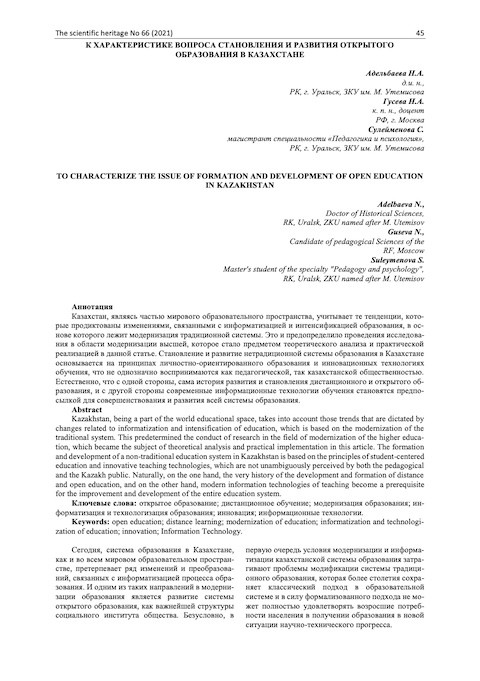 Сharacterizing the Formation and Development of Open Education in Kazakhstan (The Scientific Heritage; no. 66) Год публикации: 2021 Автор: N. Adelbaeva | N. Guseva | S. Suleymenova Kazakhstan, being a part of the world educational space, takes into account those trends that are dictated by changes related to informatization and intensification of education, which is based on the modernization of the traditional system. This predetermined the conduct of research in the field of modernization of the higher education, which became the subject of theoretical analysis and practical implementation in this article. The formation and development of a non-traditional education system in Kazakhstan is based on the principles of student-centered education and innovative teaching technologies, which are not unambiguously perceived by both the pedagogical and the Kazakh public. Naturally, on the one hand, the very history of the development and formation of distance and open education, and on the other hand, modern information technologies of teaching become a prerequisite for the improvement and development of the entire education system. К характеристике вопроса становления и развития открытого образования в Казахстане (The Scientific Heritage; no. 66) Год публикации: 2021 Автор: N. Adelbaeva | N. Guseva | S. Suleymenova Казахстан, являясь частью мирового образовательного пространства, учитывает те тенденции, которые продиктованы изменениями, связанными с информатизацией и интенсификацией образования, в основе которого лежит модернизация традиционной системы. Это и предопределило проведения исследования в области модернизации высшей, которое стало предметом теоретического анализа и практической реализацией в данной статье. Становление и развитие нетрадиционной системы образования в Казахстане основывается на принципах личностно-ориентированного образования и инновационных технологиях обучения, что не однозначно воспринимаются как педагогической, так казахстанской общественностью.Естественно, что с одной стороны, сама история развития и становления дистанционного и открытого образования, и с другой стороны современные информационные технологии обучения становятся предпосылкой для совершенствования и развития всей системы образования.
 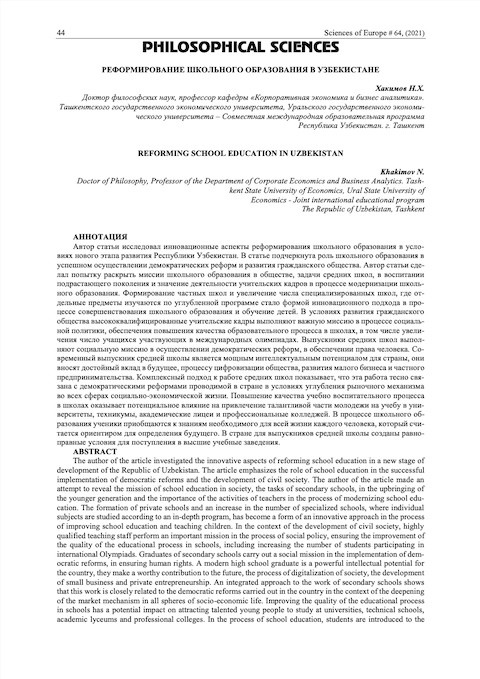 Reforming School Education in Uzbekistan (Sciences of Europe; no.64) Год публикации: 2021 Автор: N. Khakimov The author of the article investigated the innovative aspects of reforming school education in a new stage of development of the Republic of Uzbekistan. The article emphasizes the role of school education in the successful implementation of democratic reforms and the development of civil society. The author of the article made an attempt to reveal the mission of school education in society, the tasks of secondary schools, in the upbringing of the younger generation and the importance of the activities of teachers in the process of modernizing school education.
 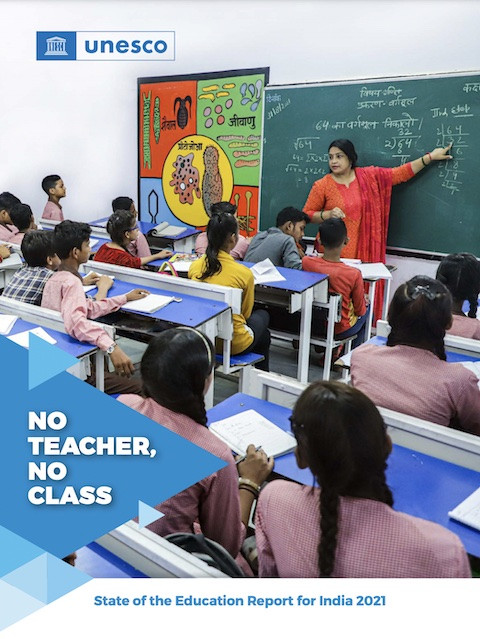 No Teacher, No Class: State of the Education Report for India, 2021 Год публикации: 2021 Автор: Padma M. Sarangapani | Bindu Thirumalai | Anusha Ramanathan | Ruchi Kumar | Mythili Ramchand Организация-автор: UNESCO New Delhi This report attempts to provide an understanding of key aspects of the teaching profession and workforce in India – nearly 9.7 million teachers in 2019/20 – the complex work that they do, and their professional development, through the filters of policy debates, choices, pushes and pulls. It looks at the questions that create core tensions in the sector and affect teacher quality and availability. It presents evidence wherever possible, and identifies gaps. The analytical framework of this report draws from important contextual and sectoral aspects including India’s social and political context — especially its federal structure – and social characteristics of gender, caste, rural-urban divide and the government-private divide. This report, prepared during the ongoing COVID-19 pandemic, and constrained by prevailing conditions, is primarily based on analysis of secondary data and review of policies, reports and research literature. Chapters explore specific themes and present key findings.
  دور البيئة المدرسية في تحفيز الإبداع لدى الطلبة في مدارس شمال فلسطين من وجهة المعلمين والمعلمات فيها Год публикации: 2017 Автор: Khalid Qarwani | Husam HarzAllah Организация-автор: World Islamic Sciences and Education University تهدف هذه الدراسة إلى التعرف على دور البيئة المدرسية في تحفيز الابتكار لدى طلاب المرحلة الثانوية في شمال فلسطين من وجهة نظر المعلمين. ولتحقيق أهداف الدراسة واختبار فرضية الدراسة استخدم الباحث المنهج الوصفي التحليلي مع استبانة وزعت على عينة الدراسة المكونة من (250) معلماً. تشكل (20٪) من مجتمع الدراسة. بعد تحليل البيانات التي تم جمعها ، كشفت الدراسة ما يلي. أولاً ، تلعب بيئة المدرسة دورًا كبيرًا على المستوى الإحصائي (α = 0.05) في تحفيز الابتكار لدى طلاب ذلك المستوى في المكان المحدد على الرغم من متغيرات مكان الإقامة. ثانيًا ، لا يوجد دور لبيئة المدرسة على المستوى الإحصائي (α = 0.05) في تحفيز الابتكار لدى طلاب ذلك المستوى في المكان المحدد من وجهة نظر المعلمين بسبب متغيرات الجنس ، والتخصص في درجة البكالوريوس ، والخبرة ، والحالة الاجتماعية.