
Ресурсы
Изучайте широкий спектр ценных ресурсов ВГГ, чтобы углубить своё понимание и повысить эффективность исследований, просветительской деятельности, преподавания и обучения.
Найдено: 3,435
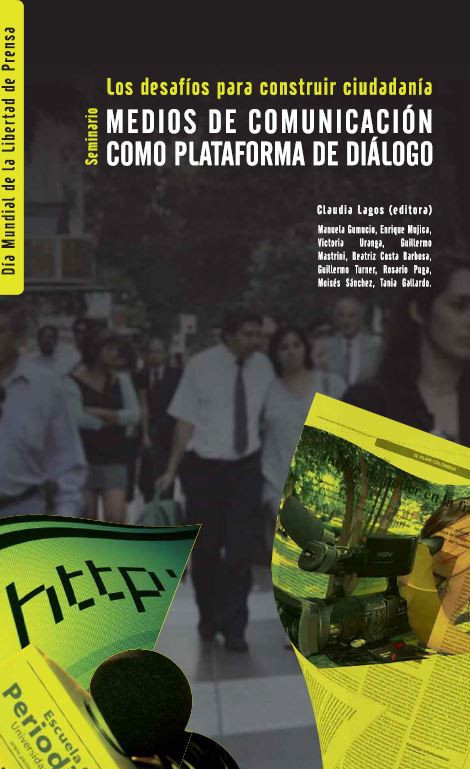 Seminario Los Desafíos para Construir Ciudadanía: Medios de Comunicación como Plataforma de Diálogo Год публикации: 2010 Автор: Claudia Lagos Организация-автор: Universidad de Chile La OREALC/UNESCO Santiago y la Comisión Nacional UNESCO, la Delegación Regional de Cooperación para el Cono Sur y Brasil, de la Embajada de Francia en Chile, el Programa de Libertad de Expresión del Instituto de la Comunicación e Imagen de la Universidad de Chile y la Cátedra UNESCO “Medios de comunicación y participación ciudadana” de la Universidad Diego Portales, conmemoraron el Día Mundial por la Libertad de Prensa 2009 con el seminario “Los desafíos para construir ciudadanía. Medios de comunicación como plataforma de diálogo”, realizado el 5 de mayo de 2009 en la Casa Central de la Universidad de Chile. El encuentro, con invitados nacionales e internacionales, permitió reflexionar y discutir sobre los principales -aunque no los únicos- problemas que hoy están en carpeta en cuestiones referidas al fomento del pluralismo y la diversidad; los desafíos para el periodismo y los medios en un contexto de alta renovación tecnológica y crisis económica; las líneas de trabajo en la materia para el diseño y ejecución de políticas públicas, y la investigación en comunicación. Esta publicación recoge las presentaciones de los expositores durante el Seminario, así como también deja testimonio de los compromisos asumidos por los candidatos presidenciales que esperamos se transforme en una agenda no sólo para la administración 2010-2014, sino que también para los sectores políticos que representa cada uno de quienes suscribieron el documento.
  The Right to Education of Migrants and Refugees Год публикации: 2014 Автор: Vernor Muñoz Villalobos The focus of this report is on those who have crossed national borders, who generally are at risk of marginalization and specifically to discrimination in the provision of education. The research addresses six core issues, the consideration of which follows an analysis of the contextual background. Attention to these issues is viewed as indispensable in meeting the educational challenges and opportunities related to migration. These core, but inevitably interrelated themes are: the legal and normative framework; social and cultural issues; language and curriculum; teachers; accreditation and lifelong learning. The preparation of the report has benefitted greatly from the active and constructive engagement of many relevant actors including Governments, international organizations, academics, non-governmental organizations and concerned individuals. Together they have offered a wealth of different perspectives and which form the basis of a number of recommendations ending the text. El Derecho a la Educación de las Personas Migrantes y Refugiadas Год публикации: 2014 Автор: Vernor Muñoz Villalobos El objetivo de este artículo es sobre las personas que han cruzado las fronteras nacionales, quienes generalmente se encuentran en riesgo de exclusión social y se enfrentan a la discriminación en el acceso y las oportunidades educativas. El texto aborda seis temas principales, seguido de un análisis del marco contextual. La atención a estas cuestiones es indispensable para enfrentar los desafíos y las oportunidades educativas relacionadas con la migración. Los temas tratados están inevitablemente interrelacionados son el marco legal y normativo, las cuestiones sociales y culturales, el lenguaje y el currículo, los maestros, acreditación y el aprendizaje a lo largo de la vida. La elaboración de la investigación que nutre este artículo se ha beneficiado en gran medida de la participación activa y constructiva de muchas partes interesadas, incluidos los gobiernos, organizaciones internacionales, académicos, organizaciones no gubernamentales y personas interesadas. Juntos han ofrecido una gran cantidad de diferentes perspectivas y que forman la base de una serie de recomendaciones con las que termina el texto.
  Building Intercultural Citizenship through Education: A Human Rights Approach Год публикации: 2008 Автор: Rodolfo Stavenhagen This article analyses the challenges posed by traditional ethnic and linguistic minorities in multicultural states and more specifically the problems faced by indigenous peoples and communities. Their educational and cultural needs and demands are increasingly being framed in the language of human rights, based on the expanding international legal and institutional human rights system. The United Nations World Conference on Human Rights, held in Vienna in 1993, endorsed a rights-based approach to development, human rights education is a growing field in educational practice, respect for cultural diversity is now enshrined in international and domestic laws, and the right of every person to education and to culture has become a mainstay of international human rights principles to which a majority of the world's states has subscribed.
  Discours de M. Koïchiro Matsuura, Directeur général de l'UNESCO, à l'occasion de la cérémonie de remise du Prix UNESCO 2004 de l'éducation aux droits de l'homme; Bangkok, Thaïlande, le 23 Mars 2005 Год публикации: 2005 Организация-автор: UNESCO. Director-General, 1999-2009 (Matsuura, K.) Ce discours a été prononcé par M. Koïchiro Matsuura, Directeur général de l'Organisation des Nations Unies pour l'éducation, la science et la culture (UNESCO) à l'occasion de la cérémonie de remise du Prix UNESCO 2004 de l'éducation aux droits de l'homme. Plano de ação: Programa Mundial para Educação em Direitos Humanos Год публикации: 2012 Организация-автор: UN Office of the High Commissioner for Human Rights The Plan of Action for the first phase (2005-2007) of the World Programme was adopted by all United Nations Member States in July 2005. It proposes a concrete strategy and practical guidance for implementing human rights education in primary and secondary schools. On 10 December 2004, the General Assembly of the United Nations proclaimed the World Programme for Human Rights Education (2005-ongoing) to advance the implementation of human rights education programmes in all sectors. Building on the foundations laid during the United Nations Decade for Human Rights Education (1995-2004), this new initiative reflects the international community’s increasing recognition that human rights education produces far-reaching results. By promoting respect for human dignity and equality and participation in democratic decision-making, human rights education contributes to the long-term prevention of abuses and violent conflicts. To help make human rights a reality in every community, the World Programme seeks to promote a common understanding of the basic principles and methodologies of human rights education, to provide a concrete framework for action and to strengthen partnerships and cooperation from the international level down to the grass roots. 行动计划世界人权教育方案 : 第一阶段 Год публикации: 2006 Организация-автор: UN Office of the High Commissioner for Human Rights The Plan of Action for the first phase (2005-2007) of the World Programme was adopted by all United Nations Member States in July 2005. It proposes a concrete strategy and practical guidance for implementing human rights education in primary and secondary schools. On 10 December 2004, the General Assembly of the United Nations proclaimed the World Programme for Human Rights Education (2005-ongoing) to advance the implementation of human rights education programmes in all sectors. Building on the foundations laid during the United Nations Decade for Human Rights Education (1995-2004), this new initiative reflects the international community’s increasing recognition that human rights education produces far-reaching results. By promoting respect for human dignity and equality and participation in democratic decision-making, human rights education contributes to the long-term prevention of abuses and violent conflicts. To help make human rights a reality in every community, the World Programme seeks to promote a common understanding of the basic principles and methodologies of human rights education, to provide a concrete framework for action and to strengthen partnerships and cooperation from the international level down to the grass roots.
  Input for Report on Disinformation Год публикации: 2021 Организация-автор: International Federation of Library Associations and Institutions (IFLA) IFLA responded to a call for inputs about human rights impacts of measures against disinformation, issued by the United Nations Special Rapporteur on the promotion and protection of the right to freedom of opinion and expression. Concerns over – and dialogue about ways to address – the negative impacts of false and misleading information online have remained high on the agenda over the past months, particularly in light of prominent examples of health and electoral dis- and mis-information.Disinformation, uniquely challenging in the increasingly dense and complex digital information environment, interferes with individuals’ ability to make informed decisions and realise their essential human rights. However, the new call for inputs by the UN Special Rapporteur also draws attention to the concerns about human rights impacts of measures which different stakeholders – from states to online platforms, human rights organisations and others – take to combat disinformation.These include, of course, the impacts of broadly- or vaguely-defined “fake news” laws on freedom of expression and opinion; or internet shutdowns that bear a heavy cost on people’s access to information as a driver of development and rights.In light of this, IFLA’s submission highlights the potential of media and information literacy interventions to help address the challenges of mis- and dis-information. Drawing on the global library field’s experiences, it points to some possible good practices and insights from the ongoing work and research in this field – from targeted and tailored outreach initiatives that can help reach those who are not currently in formal education, to scalability and replicability of interventions.Of course, this is an emerging field. Our understanding of how media and information literacy interventions can be effectively leveraged against disinformation, pitfalls to avoid and ways to maximise impact, continues to evolve. That’s why the submission emphasises the need for more research and cross-stakeholder collaboration – and libraries can and do offer valuable practical and theoretical insights for this ongoing discussion.
  Engaging Girls, Boys and Youth as Active Citizens: Plan International’s Position Paper Год публикации: 2020 Организация-автор: Plan International Plan International believes that every child and young person has the right to express their views freely and safely; influence decisions and take action on issues that matter to them. However, around the world children and young people – particularly girls and young women – face significant challenges in realising this right. They tend to be wrongly dismissed as insufficiently mature to participate in political and civic processes. They also tend to be stigmatised as potential perpetrators of disruption, not as valued citizens and contributors to society who can lead and drive positive change. Plan International is calling for a paradigm shift in the way the international community talks about, engages and partners with children and young people. Children and young people are not just the future. They are the present. Young people constitute almost half of the world’s population, yet they are dramatically underrepresented – even excluded – in political decision-making. It is critical that their views and needs are taken into account politically, socially, legally and economically. Promoting the voices and views of children and young people – especially girls and women – in all their diversity and supporting them to actively engage in decision-making on issues that affect their lives must be an urgent priority for the world’s power holders. Realising children and young people’s civil and political rights is a prerequisite for building sustainable and peaceful societies, and a gender just world envisioned in international human rights frameworks and the 2030 Agenda’s Sustainable Development Goals (SGDs).Across the 75+ countries Plan International works in, young people have consistently identified the denial of their political and civil rights as a priority issue. In March 2017, Plan International conducted consultations with young women and men aged 14 to 30 from 14 countries. In every country, young people reported a sense of “citizen responsibility” and an interest in public life, yet identified the lack of platforms to meaningfully engage with decision-makers and inability to ensure their opinions are taken seriously as key barriers. Girls and young women in particular have called for the removal of gendered norms that increase those barriers, silence their voices and disproportionately hold them back from leadership and active citizenship. Impliquer les filles, garçons et jeunes en tant que citoyens actifs : Prise de position de Plan International Год публикации: 2020 Организация-автор: Plan International Ce rapport expose la position de Plan International sur le droit à la participation à la vie publique, ainsi qu’une analyse : du cadre juridique et politique ; de l’impact des normes sociales et genrées sur la participation ; et des problèmes spécifiques relatifs à l’émancipation politique et à la citoyenneté active. Ce rapport appuie 100 Millions de Raisons, la Stratégie Mondiale 2017-2022 de Plan International, dont la priorité principale est le soutien des filles, des garçons et des jeunes en tant qu’acteurs actifs du changement. Il défend notre travail en relation avec l’Agenda 2030 et les Objectifs de Développement Durable – plus spécifiquement les objectifs 5, 10 et 16. Un certain nombre de recommandations importantes sont incluses afin de guider le plaidoyer.