
Ресурсы
Изучайте широкий спектр ценных ресурсов ВГГ, чтобы углубить своё понимание и повысить эффективность исследований, просветительской деятельности, преподавания и обучения.
Найдено: 875
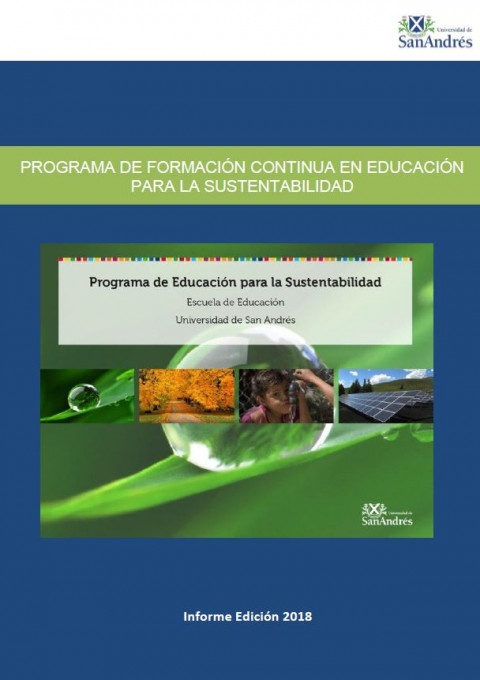 Programa de formación continua en educación para la sustentabilidad; Informe Edición 2018 Год публикации: 2018 Организация-автор: Universidad de San Andrés El programa(Programa de Educación para la Sustentabilidad) se propuso trabajar en la promoción de la Educación para la Susten-tabilidad en las escuelas, a fin de generar en toda la comunidad educativa una cultu-ra sustentable. Este trabajo se basó en un enfoque holístico orientado al desarrollo de una mirada crítica y transformadora, y en la promoción de la participación ciuda-dana.Nuestro planteo fue que cada participante diseñe una propuesta pedagógica innova-dora en Educación para la Sustentabilidad, que responda a las particularidades de su institución de pertenencia, pero que a la vez pueda ser replicada por otras institu-ciones y actores. De esta forma, se deja capacidad instalada para la planificación e implementación de proyectos educativos orientados a la promoción de la Educación para la Sustentabilidad. Mediante las suce-sivas ediciones del programa, buscamos fortalecer una masa crítica de especialistas en Educación para la Sustentabilidad como apoyo a la calidad del sistema educativo en Argentina, conformando una Comunidad Profesional de Aprendizaje que reconozca a nuestro programa como un espacio de encuentro y referencia.
  International Education Course Год публикации: 2019 Автор: Juan Ignacio Martínez de Morentin | Concepción Medrano Организация-автор: UNESCO Chair in Communication and Educational Values UNESCO understands international education as a process resulting from international understanding, cooperation, peace and global citizenship education. This results from combining three perspectives: the first, human rights--in a strict sense--the second, fundamental liberties--stressing its possibilities and requirements--and the third, the United Nations system--understanding the way in which it is committed to achieving peace.International education is education for international understanding. This understanding must impregnate all of its educational systems, actions and materials. It is not a separate course. Instead, it must be present in all courses. International education or education for international understanding is the entire programme, the motivation behind any teaching & learning process. This course explains ideas and models that UNESCO has worked with in order to clarify what it aims for in education. This is seen through the resolutions of the general conferences and the Executive Board decisions, which are UNESCO´s framework in defining international education. Curso de Educación Internacional Год публикации: 2019 Автор: Juan Ignacio Martínez de Morentin | Concepción Medrano Организация-автор: UNESCO Chair in Communication and Educational Values Para la UNESCO, la educación internacional es un proceso que desemboca en comprensión, educación para la ciudadanía, cooperación y paz internacionales.Este resultado depende de conjugar tres perspectivas: derechos humanos -sumergiéndose en su significado-, libertades fundamentales -ejercitando sus posibilidades y exigencias- y sistema de las Naciones Unidas -conociendo esa forma de comprometerse en el logro de la paz. La educación internacional es educación para la comprensión internacional.Y ha de impregnar todas las acciones y materias del sistema educativo. No es una asignatura aparte; ha de articularse con todas ellas. La educación internacional o educación para la comprensión internacional es el programa, la motivación de cualquier proceso de enseñanza/aprendizaje.Este curso muestra ideas y diseños que la UNESCO ha ido trabajando para llegar a clarificar lo que persigue en el ámbito educativo. Las resoluciones de las conferencias generales y las decisiones del Consejo Ejecutivo son mimbres utilizados por la UNESCO para definir la educación internacional.
 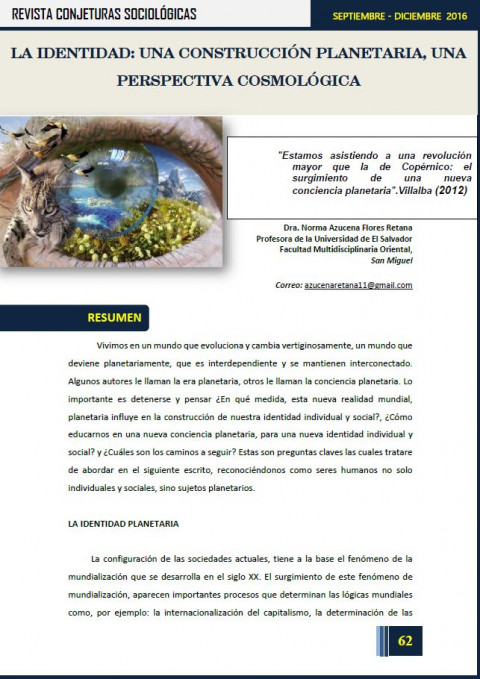 Identity: A Planetary Construction, a Cosmological Perspective Год публикации: 2016 Автор: Norma Azucena Flores Retana In the article the author asks herself what a planetary citizenship is and how it should be promoted. She starts by questioning econocimic perspectives and ends by focusing on an ideal based on solidarity. In the article summary she states: "We live in a world that evolves and changes at a very high speed, a world that is become planetary, that is interdependant and interconnected. Some authors call it the planetary era, others a planetary consciousness. The important thing is to stop and think. Up to what extent, this new world reality, planetary, influences our individual and social identities? How can we educate ourselves in a new planetary conciousness, for a new individual and social identity?, and, which are the paths that we should follow? These are key questions which I will try to analyse in the article, recognizing ourselves not only as human beings that are individual and social, but also planetary." In the article the author provides broad answers and perspectives to the questions stated in the summary. La identidad : una construcción planetaria, una perspectiva cosmológica Год публикации: 2016 Автор: Norma Azucena Flores Retana En el artículo la autora se pregunta qué es una ciudadanía planetaria y cómo debería fomentarse esta. Comienza haciendo una critica a las perspectivas econocimicistas para luego centrarse en un ideal basado en la solidaridad. En su resumen del artículo dice: "Vivimos en un mundo que evoluciona y cambia vertiginosamente, un mundo que deviene planetariamente, que es interdependiente y se mantienen interconectado. Algunos autores le llaman la era planetaria, otros le llaman la conciencia planetaria. Lo importante es detenerse y pensar ¿En qué medida, esta nueva realidad mundial, planetaria influye en la construcción de nuestra identidad individual y social?, ¿Cómo educarnos en una nueva conciencia planetaria, para una nueva identidad individual y social? y ¿Cuáles son los caminos a seguir? Estas son preguntas claves las cuales tratare de abordar en el siguiente escrito, reconociéndonos como seres humanos no solo individuales y sociales, sino sujetos planetarios. " En el artículo la autora da respuestas y perspectivas amplias a las preguntas que plantea en el resumen.
  Universal Citizenship and Free Human Mobility: A Look from the Thematic Profile of International Scientific Production Год публикации: 2019 Автор: Leonardo Vicente Vera Viteri, Jimmy Manuel Zambrano Acosta | Dania Deroy Dominguez In the summary the author explains that: "The present article makes an approach to the concept of citizenship as endowing and at the same time denying rights, and how it was extended to all people, including migrants. At the same way, a chronological analysis of the scientific production about Free Citizenship and Human Mobility in Scopus is carried out." In the article the author analyzes these aspects and ends by concluding that the academy may promote universal citizenship. Ciudadanía Universal y Libre Movilidad Humana: una mirada desde el perfil temático de la producción científica internaciona Год публикации: 2019 Автор: Leonardo Vicente Vera Viteri, Jimmy Manuel Zambrano Acosta | Dania Deroy Dominguez En el resumen el autor explica que: "El presente artículo realiza una aproximación al concepto de ciudadanía como dotadora y a la vez negadora de derechos y la manera en la que se ha ampliado a todas las personas, entre ellos a los migrantes. Igualmente hace un análisis a la producción de conocimiento sobre el tema de Ciudadanía Libre y Movilidad Humana tomando como punto de partida el análisis cronológico de la producción científica indizada en Scopus." En el artículo el autor realiza este análisis y termina concluyendo que la academia puede fomentar la ciudadanía universal.
 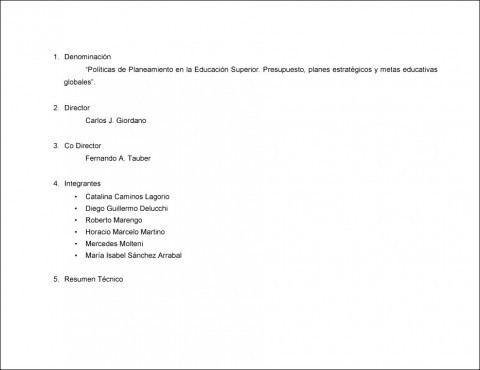 Policies in Higher Education Planning: Budget, Strategic Plans and Global Educative Goals Год публикации: 2016 Автор: Carlos José Giordano | Fernando Tauber | Catalina Caminos Lagorio | Diego Guillermo Delucchi | Roberto Marengo | Horacio Marcelo Martino | Mercedes Molteni | María Isabel Sánchez Arrabal The document is a report from the Universidad Nacional de la Plata (UNLP), Argentina, that tries to explain de development of the Higher education planning policies from an analysis of the budgets and the strategic plans regarding global educative goals that have been accepted to constitute the macroinstitutional ideals of the system. The report tries to promote the circulation of a complex reflection of the place of the Universidad Nacional de la Plata in the Argentinian Higher Education system and of the discussion of the integral development of public policy models in the context of international globalized and cooperative-interinstitutional intentions. Políticas de Planeamiento en la Educación Superior: presupuesto, planes estratégicos y metas educativas globales Год публикации: 2016 Автор: Carlos José Giordano | Fernando Tauber | Catalina Caminos Lagorio | Diego Guillermo Delucchi | Roberto Marengo | Horacio Marcelo Martino | Mercedes Molteni | María Isabel Sánchez Arrabal El documento es un reporte realizado por la Universidad Nacional de la Plata (UNLP), Argentina, que intenta explicar el desarrollo de políticas el desarrollo de políticas de planeamiento en la Educación Superior desde el análisis de los presupuestos y los planes estratégicos en función de metas educativas globales que han sido consensuadas y aceptadas para constituirse como guías macroinstitucional del sistema. El trabajo intenta poner en circulación una reflexión compleja acerca del lugar de la UNLP en el sistema de Educación Superior argentino y la discusión por los modelos de desarrollo integrales de las políticas públicas en el contexto de las intencionalidades internacionalistas, globalizadoras y cooperativo-interinstitucionalistas.
 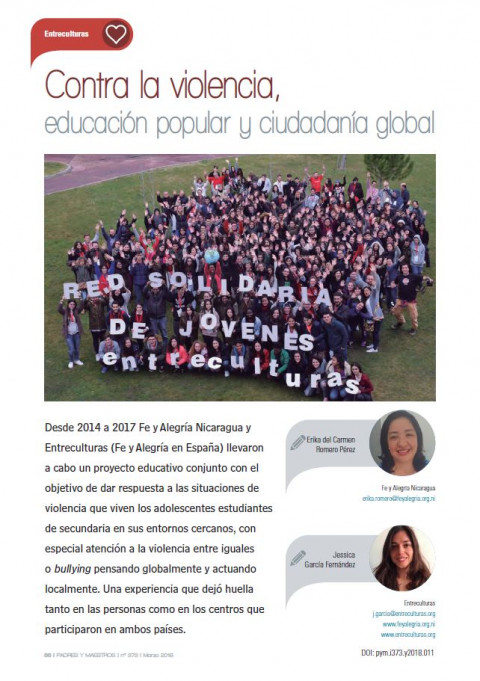 Against Violence, Popular Education and Global Citizenship Год публикации: 2018 Автор: Erika del Carmen Romero Pérez | Jessica García Fernández The article is about a project that was carried out between 2014 and 2017 by two countries: Nicaragua and Spain, on behalf of the organizations "Fe y alegría Nicaragua" and "Entreculturas (Fe y Alegría España)". It was an educative project among both nations that had two main objectives: promoting both local and global citizenship, and to give answer to violent situations that adolescent students hae to face in secondary education contexts, with special attention to the violence among equals or bullying.