
Ресурсы
Изучайте широкий спектр ценных ресурсов ВГГ, чтобы углубить своё понимание и повысить эффективность исследований, просветительской деятельности, преподавания и обучения.
Найдено: 1,300
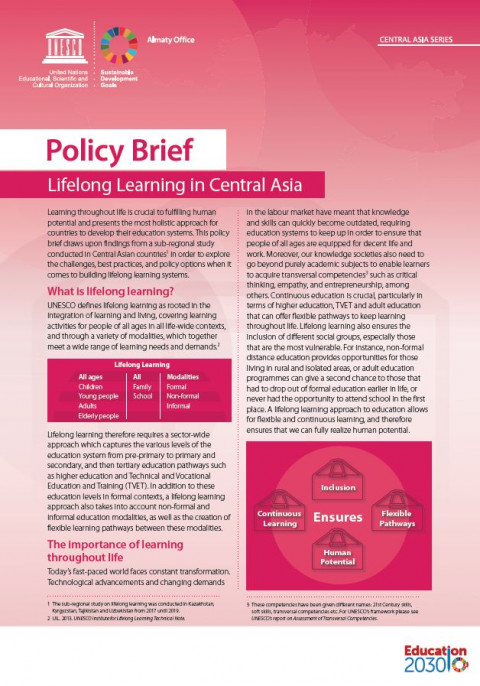 Policy brief: lifelong learning in Central Asia Год публикации: 2019 Организация-автор: UNESCO Almaty Lifelong learning stands at the very core of the global education agenda and SDG 4, with a commitment to ensure ‘inclusive and equitable quality education and lifelong learning opportunities for all.Central Asian education systems have been successful in ensuring near-universal literacy, including among adults, as well as the universal provision of education at the primary and secondary levels. However, the legacy of the Soviet Union has resulted in a certain inflexibility of education systems in the sub-region, as well as their inability to rapidly adapt to the diverse needs of learners—posing a significant challenge to ensuring lifelong learning.
  Measuring SDG 4: how PIRLS can help; how the Progress in International Reading Literacy Study (PIRLS) helps monitor Sustainable Development Goal 4 targets Год публикации: 2017 Организация-автор: International Association for the Evaluation of Educational Achievement (IEA) This booklet has been prepared for the international release of the 2016 Progress in International Reading Literacy Study (PIRLS) and ePIRLS at UNESCO. PIRLS is one of the International Association for the Evaluation of Educational Achievement’s (IEA) core largescale international assessment projects, successfully administered every five years since 2001. It provides internationally comparative data on how well children read by assessing grade 4 students’ reading achievement and offers policyrelevant information for improving teaching and learning. Initiated in 2016, ePIRLS is an extension of PIRLS that monitors how well grade 4 students read, interpret, and critique online information in an environment that looks and feels like the Internet.
  Partnering for prosperity: education for green and inclusive growth; Global education monitoring report, 2016; summary Год публикации: 2017 Автор: Sachs, Jeffrey D Организация-автор: UNESCO. Director-General, 2009-2017 (Bokova, I.G.) This Report makes three messages starkly clear. Firstly, the urgent need for new approaches. On current trends only 70% of children in low income countries will complete primary school in 2030, a goal that should have been achieved in 2015. We need the political will, the policies, the innovation and the resources to buck this trend. Secondly, if we are serious about SDG 4, we must act with a sense of heightened urgency, and with long-term commitment. Failure to do so will not only adversely affect education but will hamper progress towards each and every development goal: poverty reduction, hunger eradication, improved health, gender equality and women’s empowerment, sustainable production and consumption, resilient cities, and more equal and inclusive societies. Lastly, we must fundamentally change the way we think about education and its role in human well-being and global development. Now, more than ever, education has a responsibility to foster the right type of skills, attitudes and behavior that will lead to sustainable and inclusive growth. Mesurer l'ODD 4: la contribution du PIRLS, comment le Programme international de recherche en lecture scolaire (PIRLS) peut aider au suivi des cibles de l'Objectif de développement durable 4 Год публикации: 2017 Организация-автор: International Association for the Evaluation of Educational Achievement (IEA) Cette brochure a été préparée en vue de la présentation internationale du Programme international de recherche en lecture scolaire (PIRLS) et d’ePIRLS 2016 à l’UNESCO. Le PIRLS est l’un des principaux projets d’étude internationale à grande échelle de l’Association internationale pour l’évaluation des acquis scolaires (International Association for the Evaluation of Educational Achievement, IEA), mené avec succès tous les cinq ans depuis 2001. Cette étude fournit des données comparatives internationales sur le niveau d’alphabétisation des enfants en évaluant les performances en lecture des élèves en 4ème année de scolarité, et livre des informations d’intérêt politique destinées à améliorer l’enseignement et l’apprentissage. De plus, inaugurée en 2016, ePIRLS est une extension du PIRLS visant à déterminer la façon dont les élèves en 4ème année de scolarité lisent, interprètent, et critiquent les informations en ligne dans un environnement semblable à celui d’Internet.
 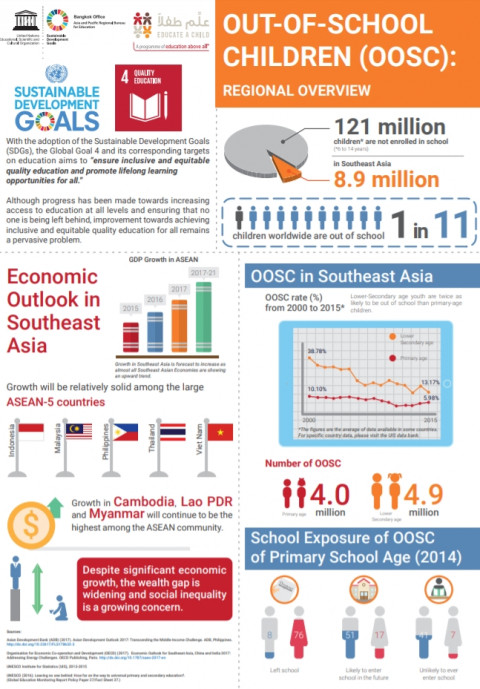 Out-of-School Children (OOSC): regional overview Год публикации: 2017 Организация-автор: UNESCO Bangkok This leaflet provides a regional overview of out-of-school children (OOSC) situation in Southeast Asia including school exposure of OOSC of primary school age. To provide learning opportunities for OOSC in the region, UNESCO Bangkok has launched the project titled “Strengthening Education Systems for Out of School Children” with the support of Educate a Child (EAC). Information on country activities implemented under the project is included in the leaflet.
  Intégrer le genre dans la coopération non gouvernementale Год публикации: 2019 Организация-автор: Solidarité mondiale Solidarité Mondiale place l’attention et la prise en compte du genre au cœur de ses pratiques et ses programmes. Ainsi, notre organisation s’emploie à créer une culture institutionnelle sensible au genre, tant au sein de notre équipe que dans la coopération avec nos partenaires d’ici et d’ailleurs. En effet, l’égalité des genres est essentielle pour garantir le caractère durable et inclusif de la coopération. Tant au niveau des droits du travail que de la protection sociale, les femmes se trouvent souvent dans les positions les plus précaires. C’est pourquoi Solidarité Mondiale s’est engagée pour l’égalité des genres au sein de la coopération non gouvernementale et a signé la "Charte Genre" le 29 novembre 2018. La "Charte Genre" a été signée par 56 organisations qui se sont engagées à soutenir un élan positif en leur sein autour de l’égalité et à mettre en place les actions nécessaires pour que les intentions se matérialisent. Elle inclut l’égalité des sexes (entre hommes et femmes) ainsi que la reconnaissance des droits des personnes LGBQTI (lesbiennes, gays, bisexuelles, queer, transgenres, intersexuées). Toutefois, comme nous vous l’expliquions en 2018, cette charte est issue d’un processus plus large, auquel Solidarité Mondiale a pris activement part, visant notamment à créer un guide d’inspiration. Bonne nouvelle, depuis peu, ce guide d’inspiration « Intégrer le genre dans la coopération non gouvernementale » est finalisé et accessible à tou.te.s ! Celui-ci regroupe des bonnes pratiques et des pistes d’intégration du genre dans les différentes activités propres à l’Éducation à la citoyenneté mondiale et solidaire (ECMS) en Belgique (communication, plaidoyer, mobilisation, etc.). Il a été conçu à l’aide d’un processus participatif et piloté par les 5 structures fédératives (11.11.11, ACODEV, CNCD-11.11.11, ngo-federatie et FIABEL) accompagnées du Monde selon les femmes.
  Guide for social advocates of domestic violence victims (guidebook) Год публикации: 2016 Автор: S. Korneychuk | N, Gladyr | A. Ilyasova Организация-автор: S. Korneychuk | N, Gladyr | A. Ilyasova This tutorial is aimed at strengthening the professional potential of specialists directly working with cases of domestic violence in order to maximize the needs of victims. Руководство для социальных защитников жертв бытового насилия (учебное пособие) Год публикации: 2016 Автор: S. Korneychuk | N, Gladyr | A. Ilyasova Данное учебное пособие направлено на укрепление профессионального потенциала специалистов, непосредственно работающих со случаями бытового насилия, с целью максимального удовлетворения потребностей пострадавших.
 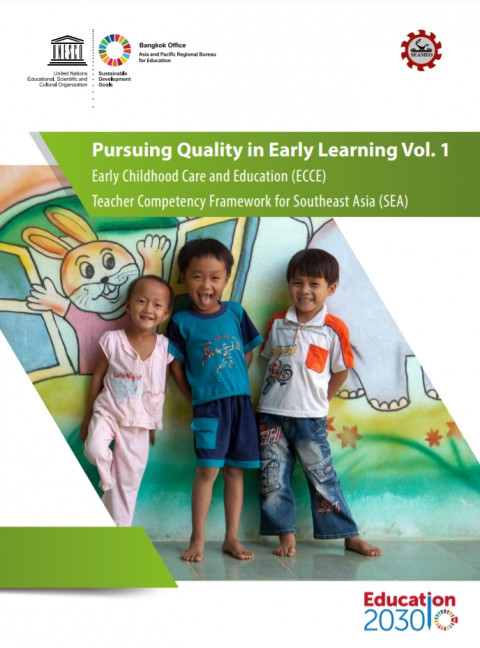 Pursuing quality in early learning, vol. 1: Early childhood care and education (ECCE) teacher competency framework for Southeast Asia (SEA) Год публикации: 2018 Организация-автор: Southeast Asian Ministers of Education Organization (SEAMEO) | UNESCO Bangkok With the United Nation’s (UN) Sustainable Development Goals (SDGs) as a platform for achieving quality early childhood care and education outcomes by 2030, ECCE policy-makers, practitioners, and academicians from Asia-Pacific countries gathered at the second Asia-Pacific Regional Policy Forum on Early Childhood Care and Education in Putrajaya, Malaysia in 2016 to share experiences, innovations, and lessons learned in developing and implementing ECCE policies and initiatives. This document first provides a brief background, and discusses the purposes and intended audience for which the framework was developed (Section I). A succeeding section reflects on the regional ECCE landscape (Section II), before proceeding to a discussion of the ECCE teacher competency framework for Southeast Asia (Section III). Section IV suggests possible uses of the ECCE teacher competency framework; a final section concludes with areas for future action.
 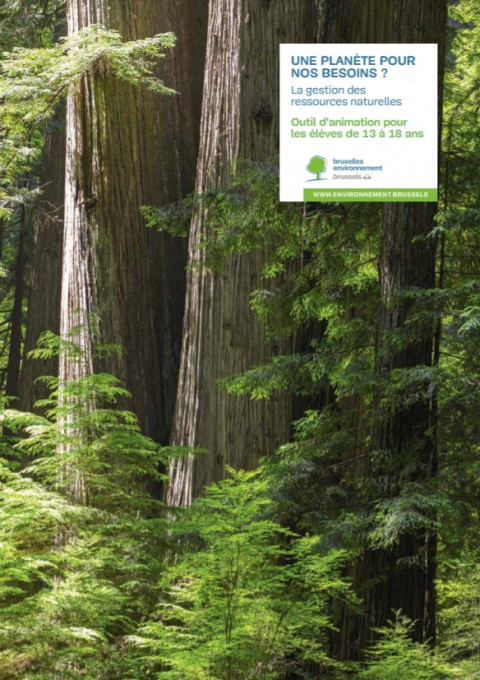 Une planète pour nos besoins Год публикации: 2017 Организация-автор: Bruxelles Environnement Ce jeu de rôle permet de comprendre notre dépendance à notre environnement et de réfléchir à la manière dont l’être humain exploite celui-ci pour sa survie et son bien-être. Les élèves devront coopérer pour espérer gagner!