
Ресурсы
Изучайте широкий спектр ценных ресурсов ВГГ, чтобы углубить своё понимание и повысить эффективность исследований, просветительской деятельности, преподавания и обучения.
Найдено: 730
 Second UNESCO Forum on Global Citizenship Education video Год публикации: 2015 Организация-автор: UNESCO Highlights of the Second UNESCO Forum on Global Citizenship Education (GCED) Building peaceful and sustainable societies: preparing for post-2015 (28-30 January 2015, UNESCO HQs, Paris). The Forum was organized by the Division for Teaching, Learning and Content, Education Sector, UNESCO, with the support of Austria, the Sultanate of Oman and the Republic of Korea, and the UN Secretary-General's Global Education First Initiative (GEFI). Second UNESCO Forum on Global Citizenship Education video Год публикации: 2015 Организация-автор: UNESCO Faits saillants du deuxième Forum de l'UNESCO sur l’éducation à la citoyenneté mondiale (ECM) Construire des sociétés pacifiques et durables: la préparation pour l'après-2015 (28-30 Janvier 2015, Siège de l'UNESCO, Paris). Le Forum a été organisé par la Division de l'enseignement, l'apprentissage et du contenu, Secteur de l'éducation, l'UNESCO, avec le soutien de l'Autriche, le Sultanat d'Oman et la République de Corée, et Première Éducation Mondiale Initiative du Secrétaire Général de l'ONU (PISG).
 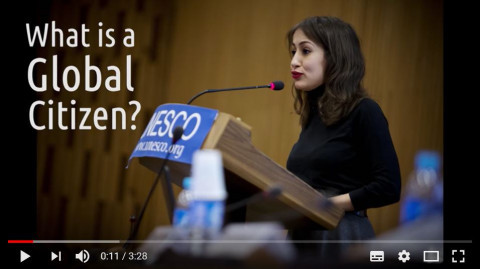 [Video] Global citizenship is ... Год публикации: 2015 Организация-автор: UNESCO Participants of the Second UNESCO Forum on Global Citizenship Education (GCED) Building peaceful and sustainable societies: preparing for post-2015 (28-30 January 2015,UNESCO HQ, Paris) reflect on what Global Citizenship is. The Forum was organized by the Division for Teaching, Learning and Content, Education Sector, UNESCO, with the support of Austria, the Sultanate of Oman and the Republic of Korea, and the UN Secretary-General’s Global Education First Initiative (GEFI). La citoyenneté mondiale est ... Год публикации: 2015 Организация-автор: UNESCO Les participants du deuxième Forum de l'UNESCO sur l’éducation à la citoyenneté mondiale (ECM) Construire des sociétés pacifiques et durables: la préparation pour l'après-2015 (28-30 Janvier 2015, Siège de l'UNESCO, Paris) à réfléchir sur ce que la citoyenneté mondiale est. Le Forum a été organisé par la Division de l'enseignement, l'apprentissage et du contenu, Secteur de l'éducation, l'UNESCO, avec le soutien de l'Autriche, le Sultanat d'Oman et la République de Corée, et First Éducation Mondiale Initiative du Secrétaire général de l'ONU (GEFI).
 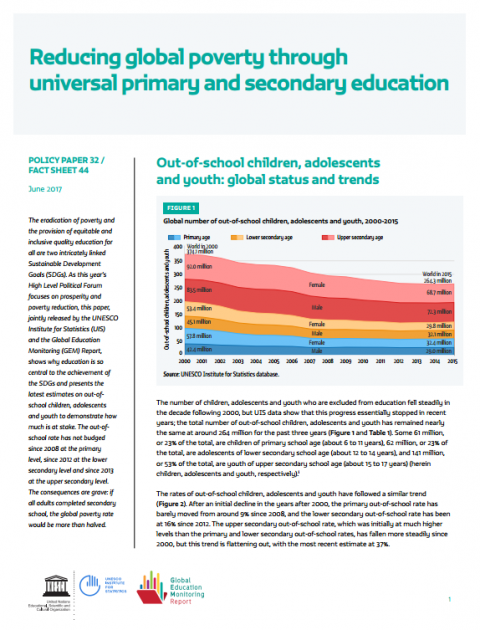 Reducing global poverty through universal primary and secondary education Год публикации: 2017 Организация-автор: UNESCO The eradication of poverty and the provision of equitable and inclusive quality education for all are two intricately linked Sustainable Development Goals (SDGs). As this year’s High Level Political Forum focuses on prosperity and poverty reduction, this paper, jointly released by the UNESCO Institute for Statistics (UIS) and the Global Education Monitoring (GEM) Report, shows why education is so central to the achievement of the SDGs and presents the latest estimates on out-ofschool children, adolescents and youth to demonstrate how much is at stake. The out-ofschool rate has not budged since 2008 at the primary level, since 2012 at the lower secondary level and since 2013 at the upper secondary level. The consequences are grave: if all adults completed secondary school, the global poverty rate would be more than halved.
 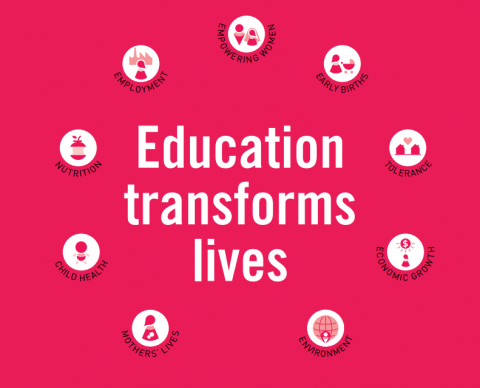 Education Transforms Lives Год публикации: 2013 Организация-автор: UNESCO Education lights every stage of the journey to a better life, especially for the poor and the most vulnerable. Education’s unique power to act as a catalyst for wider development goals can only be fully realized, however, if it is equitable. That means making special efforts to ensure that all children and young people – regardless of their family income, where they live, their gender, their ethnicity, whether they are disabled – can benefit equally from its transformative power. Education empowers girls and young women, in particular, by increasing their chances of getting jobs, staying healthy and participating fully in society – and it boosts their children’s chances of leading healthy lives. To unlock the wider benefits of education, all children need the chance to complete not only primary school but also lower secondary school. And access to schooling is not enough on its own: education needs to be of good quality so that children actually learn. Given education’s transformative power, it needs to be a central part of any post-2015 global development framework. L'Education transforme nos existences Год публикации: 2013 Организация-автор: UNESCO Education lights every stage of the journey to a better life, especially for the poor and the most vulnerable. Education’s unique power to act as a catalyst for wider development goals can only be fully realized, however, if it is equitable. That means making special efforts to ensure that all children and young people – regardless of their family income, where they live, their gender, their ethnicity, whether they are disabled – can benefit equally from its transformative power. Education empowers girls and young women, in particular, by increasing their chances of getting jobs, staying healthy and participating fully in society – and it boosts their children’s chances of leading healthy lives. To unlock the wider benefits of education, all children need the chance to complete not only primary school but also lower secondary school. And access to schooling is not enough on its own: education needs to be of good quality so that children actually learn. Given education’s transformative power, it needs to be a central part of any post-2015 global development framework. La Educación transforma la vida Год публикации: 2013 Организация-автор: Organización de las Naciones Unidas para la Educación, la Ciencia y la Cultura (UNESCO) Education lights every stage of the journey to a better life, especially for the poor and the most vulnerable. Education’s unique power to act as a catalyst for wider development goals can only be fully realized, however, if it is equitable. That means making special efforts to ensure that all children and young people – regardless of their family income, where they live, their gender, their ethnicity, whether they are disabled – can benefit equally from its transformative power. Education empowers girls and young women, in particular, by increasing their chances of getting jobs, staying healthy and participating fully in society – and it boosts their children’s chances of leading healthy lives. To unlock the wider benefits of education, all children need the chance to complete not only primary school but also lower secondary school. And access to schooling is not enough on its own: education needs to be of good quality so that children actually learn. Given education’s transformative power, it needs to be a central part of any post-2015 global development framework.
 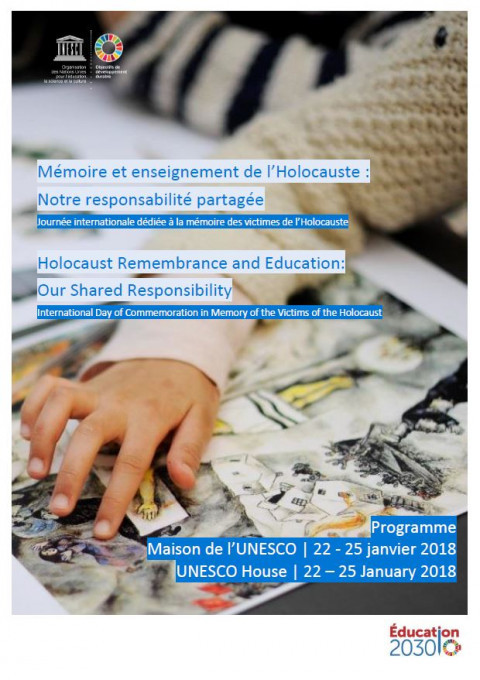 Holocaust Remembrance and Education: Our Shared Responsibility; International Day of Commemoration in Memory of the Victims of the Holocaust Год публикации: 2018 Организация-автор: 联合国教科文组织 (UNESCO) This brochure describes the occasion "International Day of Commemoration in Memory of the Victims of the Holocaust". For this occasion, from 22nd to 25th January, UNESCO, in partnership with the Shoah Memorial, has organised a series of events: a screening of Claude Lanzmann’s Four Sisters, a round table, an official ceremony, and exhibitions.
  Better Life, Better Future: UNESCO Global Partnership for Girl's and Women's Education Год публикации: 2015 Организация-автор: UNESCO Since its inception, UNESCO has been a strong advocate, promoter and defender of the right to quality education for all, especially for girls and women. Gender equality and education are fundamental human rights, which stand at the core of UNESCO’s mandate. UNESCO launched the Global Partnership for Girls’ and Women’s Education in 2011, guided by the conviction that by educating girls and women, we can break persistent cycles of poverty and in turn foster greater social justice. The Partnership aims to increase learning opportunities for adolescent girls and women and to find solutions to some of the biggest challenges and obstacles to their education. The partnership addresses two weakest links which are secondery education and literacy.