
Ресурсы
Изучайте широкий спектр ценных ресурсов ВГГ, чтобы углубить своё понимание и повысить эффективность исследований, просветительской деятельности, преподавания и обучения.
Найдено: 1,448
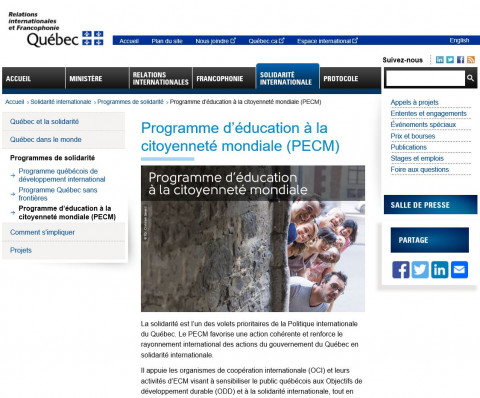 Programme d’éducation à la citoyenneté mondiale (PÉCM) Год публикации: 2018 Организация-автор: Ministère des Relations internationales et de la Francophonie La solidarité est l’un des volets prioritaires de la Politique internationale du Québec. Le PECM favorise une action cohérente et renforce le rayonnement international des actions du gouvernement du Québec en solidarité internationale.Il appuie les organismes de coopération internationale (OCI) et leurs activités d’ECM visant à sensibiliser le public québécois aux Objectifs de développement durable (ODD) et à la solidarité internationale, tout en favorisant l’acquisition de connaissances, de valeurs et de comportements qui contribuent à la mise en place d’un monde plus juste, durable et équitable.
  Éducation à la citoyenneté et à la solidarité internationale en classe de seconde : Guide pédagogique à l’usage des enseignants de sciences économiques et sociales dans le cadre d’un enseignement d’exploration Год публикации: 2016 Автор: Denis Bousquet | Hugo Cassagnaud | Benjamin Leger | Agathe Procar Организация-автор: Bourgogne Coopération L’éducation met aujourd'hui de plus en plus l’accent sur les valeurs, les attitudes et les compétences des élèves, complétant ainsi une approche fondée sur l'acquisition de connaissances et le développement de capacités cognitives. Partout, dans les institutions, les collectivités locales, les établissements scolaires ou les associations, une attention grandissante est donnée à la compréhension et à la résolution des problèmes mondiaux, qu'ils soient sociopolitiques, économiques, environnementaux ou culturels.Dans ce contexte, l'éducation apparaît comme l'un des piliers du développement des sociétés contemporaines, globalisées et interdépendantes, garant de la promotion des droits de l'homme, de la cohésion sociale ou encore du succès de la lutte contre le réchauffement climatique.Ce guide pédagogique présente le contenu détaillé d'un enseignement dédié à l'éducation à citoyenneté et à la solidarité internationale (ECSI) proposé initialement au lycée Hilaire de Chardonnet de Chalon-sur-Saône.Il s'appuie sur le programme national de l'enseignement d'exploration de sciences économiques et sociales proposé en classe de seconde. Enseigné aux moyens de méthodes spécifiques, il est enrichi par de nombreux outils, ressources et témoignages de chercheurs, de professionnels, de responsables associatifs et d'enseignants.Principalement à destination des enseignants en sciences économiques et sociales, ce guide s'adresse également à tous les enseignants du secondaire qui souhaitent aborder de nouvelles thématiques. Acteurs associatifs, responsables institutionnels ou élus locaux y trouveront une initiative inspirante pour promouvoir l'ouverture au monde et à la citoyenneté.
  Didactique de l’éducation à la citoyenneté Год публикации: 2016 Организация-автор: Haute école pédagogique Vaud L’UER Didactiques des sciences humaines de la HEP Vaud assure l’enseignement et la recherche liés à la didactique de l’éducation à la citoyenneté.Comment concevoir une éducation à la citoyenneté pour tous les élèves, quelles que soient leurs origines et leurs nationalités ? Longtemps limitée à la connaissance des institutions politiques et de leur fonctionnement, l’éducation à la citoyenneté invite aujourd’hui également à former les élèves aux pratiques participatives et délibératives constitutives d’une démocratie. Introduite à l’origine sous le terme d’instruction civique et centrée sur la connaissance des institutions politiques comme principal moteur d’insertion dans la collectivité nationale, l’éducation à la citoyenneté est aujourd’hui bien plus conçue, dans les plans d’études, comme une éducation au pouvoir (son fonctionnement, son exercice) et aux pratiques délibératives. Dans le contexte politique et économique actuel, il semble en effet de moins en moins pertinent d’enseigner une citoyenneté figée autour de règles préétablies et visant l’insertion dans une seule communauté d’appartenance.
  Éducation à la citoyenneté 3e année (Ressources pour l’éducation à la citoyenneté : L’enseignement intentionnel et direct des compétences essentielles à la citoyenneté) Организация-автор: Concentus Fondation pour L'education a la citoyennete Les citoyens engagés remettent en question, examinent de manière critique, soutiennent et défendent les droits et responsabilités d’une démocratie sur des plans multiples. Ils travaillent à comprendre les problèmes, dissimulés ou manifestes, qui relèvent des enjeux de la citoyenneté et d’élaborer les plans d’action appropriés pour y apporter des solutions. Ils développent aussi leur compréhension des avantages et de la richesse que la diversité et le multiculturalisme apportent aux Canadiens.Les citoyens engagés s’efforcent d’aborder les questions depuis une variété de points de vue. Les élèves vont commencer à explorer les méthodes de résolution des conflits et à examiner et à pratiquer les actions qui contribuent à la paix et à l’ordre. L’exploration du raisonnement critique dans ce domaine de la citoyenneté encourage les élèves à essayer de comprendre un point de vue différent du leur.
 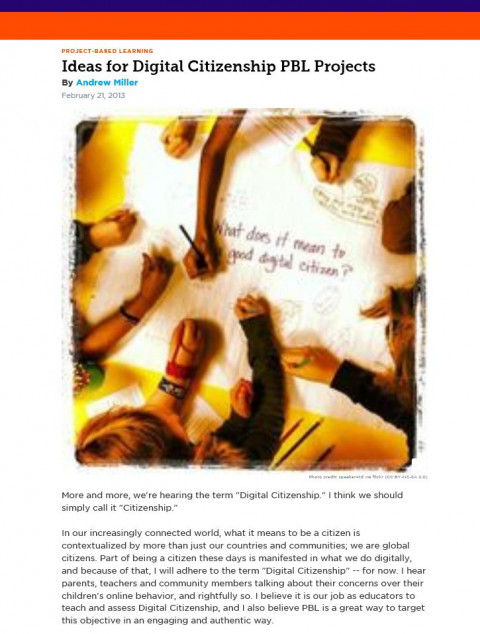 Ideas for Digital Citizenship PBL Projects Год публикации: 2013 Автор: Andrew Miller In our increasingly connected world, what it means to be a citizen is contextualized by more than just our countries and communities; we are global citizens. Part of being a citizen these days is manifested in what we do digitally, and because of that, I will adhere to the term "Digital Citizenship" -- for now. I hear parents, teachers and community members talking about their concerns over their children's online behavior, and rightfully so. I believe it is our job as educators to teach and assess Digital Citizenship, and I also believe PBL is a great way to target this objective in an engaging and authentic way.
 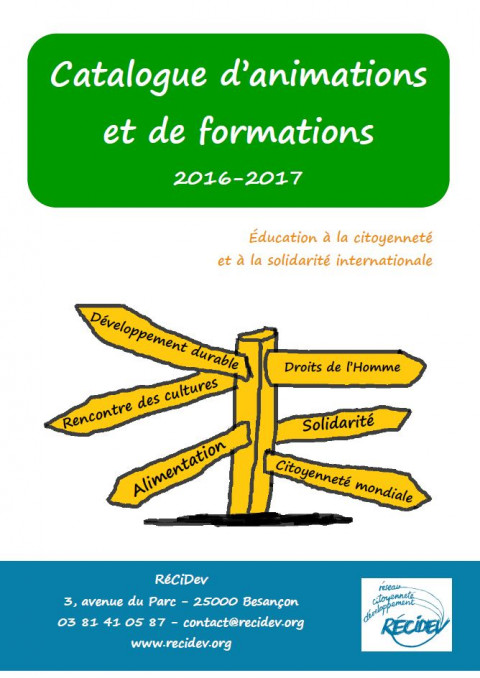 Catalogue d’animations et de formations 2016-2017 : Éducation à la citoyenneté et à la solidarité internationale Год публикации: 2016 Организация-автор: Réseau Citoyenneté Développement (RéCiDev) « L’éducation à la citoyenneté et à la solidarité internationale (ECSI) est une démarche sociale et politique dont la finalité est de favoriser la contribution individuelle et collective à la construction d’un monde juste, solidaire et durable. Elle s’appuie sur un processus pédagogique qui se déroule tout au long de la vie.Son objectif est de permettre à chacun de comprendre les mécanismes d’interdépendance et d’exclusion dans le monde ; de prendre conscience de l’importance d’une démarche citoyenne ayant pour but de favoriser une solidarité entre les territoires, les générations, les groupes sociaux… et d’agir pour la construction d’un monde solidaire. L’ECSI contribue à donner à tous des clés pour développer un esprit critique face à un modèle de développement dominant producteur d’inégalités et d’exclusions. Elle vise à une transformation sociale et à la construction collective d’autres modes de développement, respectueux des droits humains et de l’environnement. Elle valorise des alternatives en cours partout dans le monde. Elle favorise le vivre ensemble et l’épanouissement personnel.Parce qu’elle bénéficie au plus grand nombre et qu’elle répond aux enjeux du monde actuel, l’ECSI sert l’intérêt général. À ce titre, la promouvoir et la garantir est un devoir des Etats en cohérence avec l’ensemble des politiques publiques. »
  Intelligence, Global Terrorism and Higher Education: Neutralising Threats or Alienating Allies? Год публикации: 2016 Автор: Tania Saeed, David Johnson This article draws on narratives of Muslim students, their experiences of existing counterterrorism policies, to examine the effects of the new security framework. It asks whether there is another way – a broader framework in which intelligence agencies and academic institutions can pool resources, not to improve statecraft, but to respond more effectively to threats, both known and unknown. Intelligence, Global Terrorism and Higher Education: Neutralising Threats or Alienating Allies? Год публикации: 2016 Автор: Tania Saeed, David Johnson Fondé sur les récits des étudiants musulmans et leurs expériences des politiques antiterroristes existantes, cet article a pour objectif d’examiner les impacts du nouveau cadre de sécurité. Selon l’article, il faudrait envisager un cadre élargi dans lequel les agences de renseignement et les institutions académiques peuvent mettre en commun des ressources non pas pour améliorer l'art de gouverner, mais plutôt pour répondre plus efficacement aux menaces, à la fois connues et inconnues.
  Global Citizenship in a Digital World (The MILID Yearbook, 2014) Год публикации: 2014 Автор: Sherri Hope Culver | Paulette Kerr Организация-автор: International Clearinghouse on Children, Youth and Media (Sweden) | NORDICOM | University of Gothenburg The theme of the 2014 Yearbook is Global Citizenship in a Digital World. Global citizenship assumes ease of participation in global spaces in which persons are media and information literate and are equipped with competencies and attitudes to deal with the multi-faceted nature of a mediated world in which information is no longer bound by space or time. The unprecedented access to and use of media and Internet technologies for communication and collaboration especially among youth, suggest that effective strategies must be found to enable active critical inquiry and effective media production. The proliferation of mediated spaces throughout education environments, as well as personal and professional environments, does not in itself guarantee that citizens will consider their role as global citizens as they create and consume media. This awareness must be cultivated, encouraged and taught.The 2014 MILID Yearbook brings together a range of reviewed articles, which articulate the theme of global citizenship from varied perspectives and regions of the world. The articles represent different expressions on media and information literacy from researchers and practitioners who offer bold new strategies, share research findings and best practices, and share musings and reflections.
  Global Citizenship Education: How Much Do We Care? Год публикации: 2018 Организация-автор: European confederation of Relief and Development NGOs (CONCORD) While Global Citizenship Education is recognised by many as a powerful tool to resolve the current global challenges our world is facing, the level of investment by national governments remains limited. Why is that? To answer this situation, CONCORD launches its new report “Global Citizenship Education – How much do we care?“. Based on a research across all EU Member States (+ Norway), this publication reveals the level of funding dedicated to Global Citizenship Education (GCE) in Europe between 2011 and 2015. Analysing the quantitative sources of investments by national governments as well as the qualitative narrative around GCE (How is GCE named? What is its framework of action?), this report digs into the complex world of GCE and provides a full picture of its current states in Europe. The report is composed of 2 parts:– a general overview and analysis– a comparative part made of an analysis per country of all EU member states (+ Norway), including interesting details on GCE definitions, concepts, funding trends.Strong of these analysis, the report draws conclusions and recommendations on where possible improvements at policy and advocacy level can be made.