
Ресурсы
Изучайте широкий спектр ценных ресурсов ВГГ, чтобы углубить своё понимание и повысить эффективность исследований, просветительской деятельности, преподавания и обучения.
Найдено: 3,378
 Le casse-tête de la citoyenneté par droit de naissance (The Ethics Forum; vol. 7, no. 2) Год публикации: 2012 Автор: Ayelet Shachar Организация-автор: University of Montreal Cet article est la traduction française de l’introduction du livre d’Ayelet Shachar, «The Puzzle of Birthright Citizenship», avec la permission de l’éditeur, tirée de The Birthright Lottery : Citizenship and Global Inequality, Cambridge, Mass.: Harvard University Press, pp.1-18. © 2009 President and Fellows of Harvard College. Traduction de Martin Provencher.
 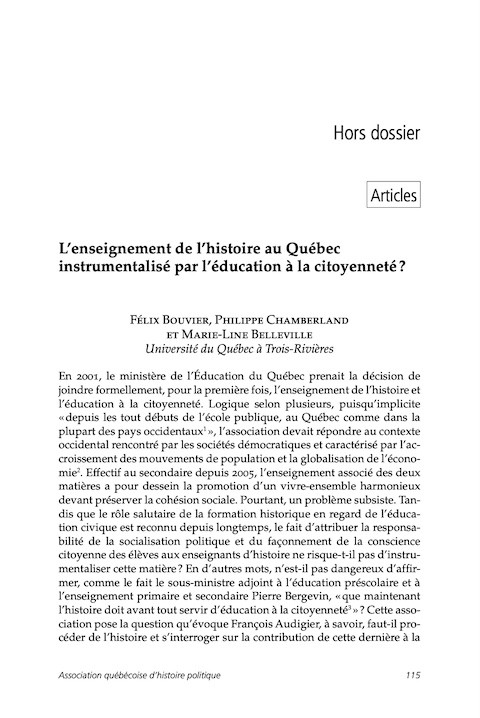 Is History Teaching in Quebec Instrumentalized by Citizenship Education? (Bulletin d'histoire politique; vol. 21, no. 3) Год публикации: 2013 Автор: Félix Bouvier | Philippe Chamberland | Marie-Line Belleville Организация-автор: Association québécoise d'histoire politique | VLB Éditeur In 2001, the Quebec Ministry of Education made the decision to formally join, for the first time, the teaching of history and education to citizenship. Logical according to many, since implicit" since the very beginning. beginnings of public schools, in Quebec as in most Western countries”, the association had to respond to the Western context encountered by democratic societies and characterized by the increase in population movements and the globalization of the economy. In secondary school since 2005, the associated teaching of the two subjects aims to promote a harmonious living together to preserve social cohesion. However, a problem remains. history with regard to civic education has long been recognized, the attribution of responsibility for political socialization and the shaping of consciousness citizen of students to history teachers risk instrumentalizing this subject? In other words, is it not dangerous to assert, as the Assistant Deputy Minister for Preschool, Elementary and Secondary Education Pierre Bergevin does, “that now history must above all serve as education for citizenship”? This association poses the question that François Audigier evokes, namely, should we proceed from history and question the latter's contribution to citizen consciousness, or proceed from the aspects of citizen consciousness that one wishes to construct and then determine the historical objects which should be studied? The experience of comparable nations on a planetary scale makes us doubt the relevance of the association of the two disciplines. In fact, some Western democracies are worried about the quality of the civic education of their young people since the waves of industrialization and the great wars of the XIXth and XXth centuries which changed manners forever: intensification of migrations, upheavals social roles, loss of influence of religions, etc. Thus, although Great Britain has for some time taken the path taken by Quebec, France clearly dissociates the teaching of history from that of civic education. In order to understand all the ins and outs of the issue, we first provide a portrait of the context at the origin of the association of history and education for citizenship. Then, we will discuss the arguments in favor of combining the two subjects, especially in Great Britain, France and Australia. Finally, our gaze will focus on the case of Quebec and the type of privileged citizenship, in order to determine whether the teaching of history is not instrumentalised for the benefit of a citizenship education valuing the concealment of conflicts and divergences and if, to use the writings of Robert Martineau, the Ministry of Education has sacrificed the history class on the altar of citizenship education. L’enseignement de l’histoire au Québec instrumentalisé par l’éducation à la citoyenneté? (Bulletin d'histoire politique; vol. 21, no. 3) Год публикации: 2013 Автор: Félix Bouvier | Philippe Chamberland | Marie-Line Belleville Организация-автор: Association québécoise d'histoire politique | VLB Éditeur En 2001, le ministère de l’Éducation du Québec prenait la décision de joindre formellement, pour la première fois, l’enseignement de l’histoire et l’éducation à la citoyenneté. Logique selon plusieurs, puisqu’implicite « depuis les tout débuts de l’école publique, au Québec comme dans la plupart des pays occidentaux », l’association devait répondre au contexte occidental rencontré par les sociétés démocratiques et caractérisé par l’ac-croissement des mouvements de population et la globalisation de l’économie. Effectif au secondaire depuis 2005, l’enseignement associé des deux matières a pour dessein la promotion d’un vivre-ensemble harmonieux devant préserver la cohésion sociale. Pourtant, un problème subsiste. Tan-dis que le rôle salutaire de la formation historique en regard de l’éducation civique est reconnu depuis longtemps, le fait d’attribuer la responsabilité de la socialisation politique et du façonnement de la conscience citoyenne des élèves aux enseignants d’histoire ne risque-t-il pas d’instrumentaliser cette matière ? En d’autres mots, n’est-il pas dangereux d’affirmer, comme le fait le sous-ministre adjoint à l’éducation préscolaire et à l’enseignement primaire et secondaire Pierre Bergevin, « que maintenant l’histoire doit avant tout servir d’éducation à la citoyenneté » ? Cette association pose la question qu’évoque François Audigier, à savoir, faut-il pro-céder de l’histoire et s’interroger sur la contribution de cette dernière à la conscience citoyenne, ou procéder des aspects de la conscience citoyenne que l’on souhaite construire et déterminer alors les objets historiques dont il faut privilégier l’étude ? L’expérience de nations comparables à l’échelle planétaire nous fait douter de la pertinence de l’association des deux dis-ciplines. En fait, certaines démocraties occidentales s’inquiètent de la qualité de la formation citoyenne de leurs jeunes depuis les vagues d’industriali-sation et les grandes guerres des XIXe et XXe siècles qui ont bouleversé à jamais les mœurs : intensifi cation des migrations, bouleversements des rôles sociaux, perte d’infl uence des religions, etc. Ainsi, bien que la Grande-Bretagne prenne depuis un moment le chemin pris par le Québec, la France dissocie clairement l’enseignement de l’histoire et celui de l’édu-cation civique. Afi n de saisir l’ensemble des tenants et aboutissants de la question, nous dressons d’abord le portrait du contexte à l’origine de l’as-sociation de l’histoire et de l’éducation à la citoyenneté. Ensuite, nous aborderons les arguments en faveur de l’association des deux matières, notamment en la Grande-Bretagne, en France et en Australie. Finalement, notre regard se portera sur le cas québécois et le type de citoyenneté privi-légié, afi n de déterminer si l’enseignement de l’histoire n’est pas instru-mentalisé au profi t d’une éducation à la citoyenneté valorisant l’occulta-tion des confl its et des divergences et si, pour reprendre des écrits de Robert Martineau, le ministère de l’Éducation a sacrifi é la classe d’histoire sur l’autel de l’éducation à la citoyenneté.
  Analysis (Didactic) of a Historical Video Game: Democracy and Citizenship Education in Civilization VI (Revue de recherches en littératie médiatique multimodale; no. 9) Год публикации: 2019 Автор: Vincent Boutonnet Организация-автор: Groupe de recherche en littératie médiatique multimodale Civilization VI, published in 2016, is a turn-based strategy game allowing the player to go through historical eras by leading a civilisation toward cultural, economic, military or technological sophistication. This new entry introduces a civic tree presenting new gameplay with government systems and civics policies. This research is descriptive and aims at a formal analysis of the gameplay. We examine the various components and the principles of design as well as the conceptual and civics limits of such a game. We believe this game is an opportunity to analyse and talk about these limits with pupils to foster critical thinking about democracy and citizenship. Analyse (Didactique) d’un jeu vidéo historique: Démocratie et éducation à la citoyenneté dans civilization VI (Revue de recherches en littératie médiatique multimodale; no. 9) Год публикации: 2019 Автор: Vincent Boutonnet Организация-автор: Groupe de recherche en littératie médiatique multimodale Civilization VI, publié en 2016, est un jeu de stratégie tour par tour qui permet de traverser les ères historiques à la tête d’une nation grâce au développement culturel, économique, militaire et technologique. Ce nouvel opus introduit l’arbre des dogmes qui permet de nouvelles mécaniques en lien avec les modes de gouvernement et la citoyenneté. La recherche est de nature descriptive et vise une analyse formelle des mécaniques du jeu. Nous examinons les éléments constitutifs du jeu, les principes qui le régissent ainsi que les limites conceptuelles et civiques d’une telle ressource. Cependant, nous y voyons aussi une occasion de discuter de ces lacunes avec des élèves afin de les engager authentiquement dans une réflexion critique sur la démocratie et la citoyenneté.
  L'introduction de services-learnings dans l'enseignement universitaire de Belgique francophone, un instrument d'éducation à la citoyenneté mondiale et solidaire? Год публикации: 2019 Автор: Frédérique Marsin Организация-автор: Université de Liège Née d’une remise en question de l’éducation à la citoyenneté mondiale et solidaire (ECMS) dans les universités belges francophones, l’ambition de ce travail était de déceler l’influence que pourrait avoir sur celles-ci l’instauration des services-learnings comme pédagogie universitaire. Une telle interrogation nous a amené à nous questionner sur l’universalité de l’ECMS. Considérant qu’elle devrait être accessible à tous au regard de son essence même, cela n’est pourtant pas le cas, notamment du fait qu’elle est réservée à un public limité, à savoir aux élèves de l’enseignement fondamental et du secondaire ainsi qu’une portion infime d’étudiants universitaires, déjà sensibilisés aux thématiques de l’ECMS (SONECOM, 2018 ; cfr. annexe). Dès lors, nous questionnons l’efficacité des activités actuelles d’ECMS, organisées à l’université, grâce à une grille d’analyse adaptée des travaux de GÉRARD, psychopédagogue. Cette dernière nous permet de dresser l’état des lieux de l’ECMS, pouvant être résumé de la sorte : les activités d’ECMS actuelles à l’Université sont réservées, presqu’exclusivement, à des étudiants de master, sensibilisés par les enjeux globaux, issus de filières plutôt humanistes, comme les sciences sociales (SONECOM, 2018 ; Pirotte et Fettweis, 2018). Pourtant, le large pourcentage des étudiants restants n’est pas contre l’expression d’une citoyenneté plus active ; beaucoup y sont même très favorables mais expliquent leur inaction par un manque d’opportunités (SONECOM, 2018 ; cfr. annexe). Ne doutant pas pour autant de la qualité des activités d’ECMS, nous nous demandons quelle est la capacité pour ces acteurs de capter de nouveaux publics. Afin de pallier à ce manque de visibilité, nous proposons aux étudiants de s’essayer à l’ECMS, grâce à une application contraignante de la pédagogie des services-learnings.
  Le jeu de rôle en éducation à la citoyenneté mondiale, entre expérience et empathie Год публикации: 2017 Автор: Clémentine Tasiaux Организация-автор: Université de Liège L’éducation à la citoyenneté mondiale (ECM) est un secteur de la coopération au développement en Belgique. En un mot, ce type d’éducation vaste et complexe présente la particularité d’avoir pour objectif l'éveil des consciences aux interdépendances existant dans notre monde. L’ECM a la caractéristique de prendre forme dans l’oeil de celui qui la pratique et sa mise en pratique dépend donc de celui qui la met en place. En Belgique, l’ECM est majoritairement mise en pratique par la société civile qui voit en cette dernière un moyen de susciter un changement social. Pour ce faire, le monde associatif développe diverses stratégies dont un processus de sensibilisation qui repose, entre-autres, sur des ressources ou des outils pédagogiques. Ceux-ci présentent des formes variées et sont généralement basés sur des approches pédagogiques participatives. Au cours d’un stage de pratique professionnelle effectué en première année de Master en Sciences de la population et du développement, j’ai eu l’occasion de me familiariser avec le monde ludique et participatif de l’éducation à la citoyenneté mondiale. L’hôte de mon stage, l’Organisation Non Gouvernementale (ONG), le Service Civil International - Projets Internationaux (SCI est spécialisée dans l’animation et la réalisation d’outils pédagogiques mettant en oeuvre des techniques du jeu de rôle. D’abord un peu sceptique, je regardais d’un oeil curieux ces outils pédagogiques sous forme de jeux de rôle. Sensibiliser un public adulte en jouant? Voilà quelque chose qui m’était étranger.
 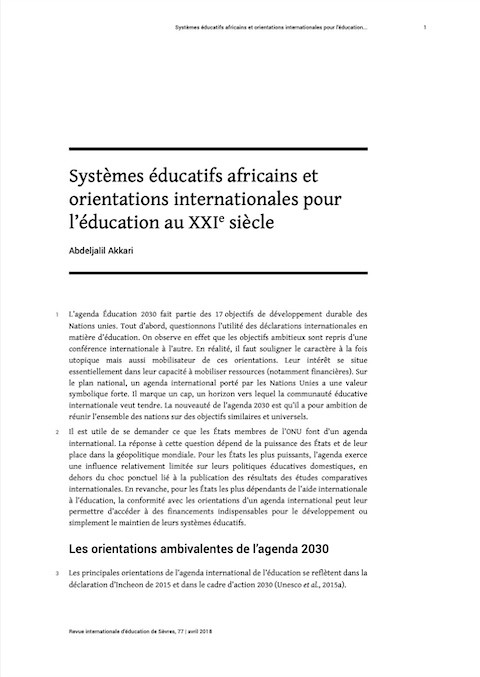 Systèmes éducatifs africains et orientations internationales pour l’éducation au XXIe siècle (Revue internationale d’éducation de Sèvres; no. 77) Год публикации: 2018 Автор: Abdeljalil Akkari Организация-автор: France Education International L’agenda Éducation 2030 fait partie des 17 objectifs de développement durable des Nations unies. Tout d’abord, questionnons l’utilité des déclarations internationales en matière d’éducation. On observe en effet que les objectifs ambitieux sont repris d’une conférence internationale à l’autre. En réalité, il faut souligner le caractère à la fois utopique mais aussi mobilisateur de ces orientations. Leur intérêt se situe essentiellement dans leur capacité à mobiliser ressources (notamment financières). Sur le plan national, un agenda international porté par les Nations Unies a une valeur symbolique forte. Il marque un cap, un horizon vers lequel la communauté éducative internationale veut tendre. La nouveauté de l’agenda 2030 est qu’il a pour ambition de réunir l’ensemble des nations sur des objectifs similaires et universels.2Il est utile de se demander ce que les États membres de l’ONU font d’un agenda international. La réponse à cette question dépend de la puissance des États et de leur place dans la géopolitique mondiale. Pour les États les plus puissants, l’agenda exerce une influence relativement limitée sur leurs politiques éducatives domestiques, en dehors du choc ponctuel lié à la publication des résultats des études comparatives internationales. En revanche, pour les États les plus dépendants de l’aide internationale à l’éducation, la conformité avec les orientations d’un agenda international peut leur permettre d’accéder à des financements indispensables pour le développement ou simplement le maintien de leurs systèmes éducatifs.
  فاعلية برنامج مقترح قائم على التعلم الخدمي لتدريس القضايا المعاصرة لطلاب شعبة التأريخ بكليات التربية في تنمية التحصيل المعرفي والمسؤولة الاجتماعية لديهم Год публикации: 2016 Автор: Salwa Ammar | Yahya Sulaiman | Mahmoud Ahmed | Salah Juma Организация-автор: Fayoum University تسعى هذه الدراسة لتقييم فاعلية برنامج قائم على التعلم الخدمي لتدريس القضايا المعاصرة لطلاب شعبة التأريخ. وتبحث في تأثير هذا البرنامج في تنمية التحصيل المعرفي والمسؤولية الاجتماعية. وتبدأ الدراسة بوصف أسس ومكونات البرنامج التدريبي. The Effectiveness of a Proposed Program Based on Service Learning for Teaching Contemporary Issues to Students of the History Division in the Faculties of Education in Developing Their Cognitive Achievement and Social Responsibility Год публикации: 2016 Автор: Salwa Ammar | Yahya Sulaiman | Mahmoud Ahmed | Salah Juma Организация-автор: Fayoum University This study seeks to evaluate the effectiveness of a service-based learning program for teaching contemporary issues to students of the history department. It examines the impact of this program on the development of cognitive achievement and social responsibility. The study begins with a description of the foundations and components of the training program.