
Ресурсы
Изучайте широкий спектр ценных ресурсов ВГГ, чтобы углубить своё понимание и повысить эффективность исследований, просветительской деятельности, преподавания и обучения.
Найдено: 1,477
 Competencias Ciudadanas: De los Estándares al Aulas; Una propuesta de integración a las áreas académicas Год публикации: 2004 Автор: Enrique Chaux | Juanita Lleras | Ana María Velásquez Организация-автор: Colombia. Ministerio de Educación Nacional | Universidad de los Andes Este libro presenta una propuesta sobre cómo puede promoverse la formación ciudadana en la escuela. Ofrece ideas sobre cómo integrar la formación ciudadana con la vida cotidiana de las instituciones educativas y, en particular, con la formación en las áreas académicas tradicionales, con ejemplos concretos de actividades que pueden implementarse en las aulas.
  Achieving and Monitoring Education for Sustainable Development and Global Citizenship: A Systematic Review of the Literature (Sustainability 2020; Vol. 12, No. 4) Год публикации: 2020 Автор: Brent Edwards | Manca Sustarsic | Mina Chiba | Mark McCormick | Melissa Goo | Sara Perriton Организация-автор: Multidisciplinary Digital Publishing Institute (MDPI) This paper presents the results of a systematic review of literature (56 studies) related to Sustainable Development Goal 4.7. The goal of the research reported on here is to contribute to the discussion around strategies for working towards and monitoring SDG4.7 at the institutional level. Within this overarching focus, our review of the literature was designed to identify studies that have looked at both student learning and teacher education related to SDG4.7. This twin focus stems from the recognition that achieving the SDGs will be particularly difficult if policymakers are not attentive to both sides of the learning equation—that is, first, to the ways that teachers learn to teach about issues related to SDG4.7 and, then, the ways that students acquire this knowledge and are assessed. The five findings sections of this review correspond to the five areas of emphasis embedded in the language of SDG4.7, namely, education for (a) sustainable development, (b) human rights, (c) gender equality, (d) promoting of a culture of peace and non-violence, and (e) appreciation of cultural diversity. In accordance with the purpose of this review, the synthesis for each area of emphasis digs into the details of the educational interventions, monitoring and evaluation strategies, and results that are documented in the publications analyzed. Thus, this review can be useful for informing educational or pedagogical approaches related to SDG4.7, as well as for designing monitoring and evaluation tools for the SDGs.
  Transitional Justice and Education: Learning Peace (Advancing Transitional Justice Series) Год публикации: 2017 Автор: Clara Ramírez-Barat | Roger Duthie Организация-автор: Social Science Research Council (SSRC) | United Nations Children's Fund (UNICEF) After periods of conflict and authoritarianism, education institutions often need to be reformed or rebuilt. But in settings where education has been used to support repressive policies and human rights violations, or where conflict and abuses have resulted in lost educational opportunities, legacies of injustice may pose significant challenges to effective reform. Peacebuilding and development perspectives, which normally drive the reconstruction agenda, pay little attention to the violent past. Transitional Justice and Education: Learning Peace presents the findings of a collaborative research project of the International Center for Transitional Justice and UNICEF on the relationship between transitional justice and education in peacebuilding contexts. The book examines how transitional justice can shape the reform of education systems by ensuring programs are sensitive to the legacies of the past, how it can facilitate the reintegration of children and youth into society, and how education can engage younger generations in the work of transitional justice.
  La migration et le Programme 2030 : Un guide à l’usage des praticiens Год публикации: 2018 Автор: Elisa Mosler Vidal Организация-автор: International Organization for Migration (IOM) Ce guide est destiné aux acteurs gouvernementaux, à la fois nationaux et locaux, qui sont impliqués dans des activités de mise en œuvre des Objectifs de développement durable, y compris ceux qui travaillent spécifiquement dans le domaine de la migration et ceux d’autres secteurs qui souhaitent intégrer la question de la migration. Il s’adresse également aux acteurs gouvernementaux qui travaillent dans le domaine de la migration et souhaitent intégrer les ODD dans leur travail.L’objectif de ce guide est d’aider les responsables politiques à mettre en œuvre les aspects des ODD qui touchent à la migration. Les responsables politiques peuvent utiliser ce guide pour intégrer la migration dans les activités de développement à l’échelle locale ou nationale, par l’élaboration et la mise en œuvre d’interventions qui portent sur la migration dans le cadre des ODD. Ces interventions peuvent se présenter sous forme de lois, de politiques, de programmes, de projets ou d’autres activités et peuvent être liées à des thèmes de base de la migration ou intégrer la migration dans les activités d’un autre secteur. Par exemple, les responsables politiques peuvent utiliser ce guide pour élaborer des interventions qui sont directement consacrées à la traite des personnes, ainsi que des interventions dans le secteur de la santé qui permettent de protéger les victimes de la traite des personnes.Pour les acteurs disposant d’une expérience de l’intégration de la migration, ce guide offre une nouvelle approche qui repose sur le Programme 2030. Pour ceux qui ne possèdent aucune expérience de l’intégration de la migration, il présente les liens entre la migration et le développement dans le cadre des ODD, et les mesures à prendre compte tenu de ces liens. 移民与《2030 年可持续发展议程》 Год публикации: 2018 Автор: Elisa Mosler Vidal Организация-автор: International Organization for Migration (IOM) 本指南旨在为参与可持续发展目标实施过程的国家和地方政府行为体提供指导,对象包括专门从事移民工作的人员以及有兴趣将移民事物纳入工作活动中的其他部门人员。这也适用于希望将可持续发展目标纳入其移民领域工作的政府行为体。本指南的重点是帮助决策者实施可持续发展目标中与移民相关的部分。政策制定者可以使用该指南,通过设计和实施与可持续发展目标相关的与移民有关的干预措施,将移民纳入地方或国家发展计划。这些干预措施可以采取立法、政策制定、方案、项目或其他活动的形式,并可能涉及核心移民问题,或在其他部门的活动里将移民问题纳入其中。例如,决策者可以使用本指南来设计直接针对人口贩运的干预措施以及有助于保护人口贩运受害者的卫生部门的干预措施。对于在移民主流化方面有经验的行为体,本指南提供了一种基于2030年议程的新方法。对于那些没有移民主流化相关经验的人,它介绍了如何在可持续发展目标的背景下将移民和发展联系在一起,以及如何针对这些联系采取行动。它附有两个辅助工具,用以说明移民与可持续发展目标之间的联系:(i)一本全方位阐述移民与每个可持续发展目标之间关系的手册,以及(ii)一张概括这些关系的导图。
 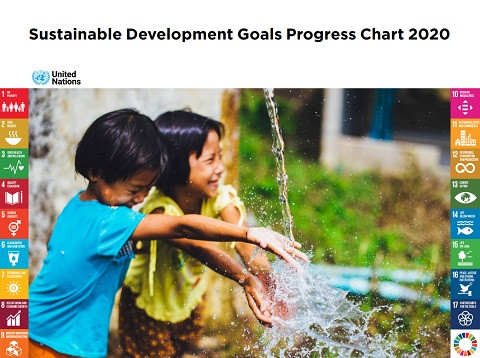 График хода достижения целей в области устойчивого развития к 2020 году Год публикации: 2020 Организация-автор: United Nations (UN) График хода достижения целей в области устойчивого развития к 2020 году отражает прогресс, достигнутый на конец 2019 года на глобальном и региональном уровнях в решении отдельных конкретных задач в рамках 17 целей Повестки дня в области устойчивого развития на период до 2030 года. В начале 2020 года Генеральный секретарь Организации Объединенных Наций объявил о Десятилетии действий, призвав национальные и местные органы власти, организации гражданского общества и частный сектор ускорить реализацию мер, направленных на достижение целей в области устойчивого развития к 2030 году. График хода достижения целей демонстрирует, как далеко мы продвинулись в выполнении наших обязательств и какие направления требуют неотложного внимания. Он также показывает, что для достижения большинства целей нынешних темпов прогресса недостаточно и требуется существенное ускорение. 2020年可持续发展目标进度表 Год публикации: 2020 Организация-автор: United Nations (UN) 《2020年可持续发展目标进度表》展现了到2019年底全球和地区进展的概况。它涵盖《2030年可持续发展议程》17个目标下选定的具体目标。2020年初,联合国秘书长启动了“行动十年”,呼 吁国家和地方政府、民间社会组织和私营部门采取加速的方案,以在2030年实现可持续发展目标。进度表显示了我们在兑现承诺方面已取得的进展以及哪些领域还亟待关注。它还显示出,对于 大多数目标而言,进展速度不够,需要大幅加快。 Migration and the 2030 Agenda: A Guide for Practitioners Год публикации: 2018 Автор: Elisa Mosler Vidal Организация-автор: International Organization for Migration (IOM) This guide is designed to serve government actors, both national and local, involved in any process of Sustainable Development Goal implementation, including those working specifically in migration, and those working in other sectors who are interested in integrating migration. It is also for government actors working in the migration field who wish to integrate the SDGs into their work.The focus of this guide is to help policymakers implement the migration aspects of the SDGs. Policymakers can use this guide to integrate migration into local or national development planning, by designing and implementing interventions that relate to migration in the context of the SDGs. These interventions may take the form of legislation, policies, programmes, projects or other activities, and may relate to core migration topics or integrate migration into activities in another sector. For example, policymakers may use this guide to design interventions that directly address human trafficking, as well as interventions in the health sector that help protect victims of trafficking.For actors with experience in migration mainstreaming, this guide offers a new approach that is based on the 2030 Agenda. For those with no experience in migration mainstreaming, it offers an introduction on how migration and development are linked in the context of the SDGs, and how to take action around these connections. La migración en la Agenda 2030: Guía para profesionales Год публикации: 2018 Автор: Elisa Mosler Vidal Организация-автор: International Organization for Migration (IOM) La presente guía va dirigida a los actores gubernamentales, tanto nacionales como locales, participantes en cualquier proceso de implementación de los ODS, incluidos aquellos que trabajan específicamente en la migración y aquellos que lo hacen en otros sectores interesados en integrar la migración. Asimismo, va dirigida a los actores gubernamentales que trabajan en el campo de la migración y que deseen integrar los ODS en su trabajo. El objetivo de esta guía es ayudar a los legisladores a implementar los aspectos de migración de los ODS. Los formuladores de políticas pueden utilizar esta guía para integrar la migración en la planificación del desarrollo local o nacional, diseñando e implementando intervenciones relacionadas con la migración en el contexto de los ODS. Estas intervenciones pueden tomar la forma de legislación, políticas, programas, proyectos u otras actividades, y pueden relacionarse con temas centrales de migración o integrar la migración en actividades en otro sector. Por ejemplo, los formuladores de políticas pueden usar esta guía para diseñar intervenciones que aborden directamente la trata de personas, así como intervenciones en el sector de la salud que ayuden a proteger a las víctimas de la trata. Para los actores con experiencia en la integración transversal de la migración de la migración, esta guía ofrece un nuevo enfoque basado en la Agenda 2030. Para quienes no tienen experiencia en dicha integración transversal de la migración, ofrece una introducción sobre cómo se vinculan la migración y el desarrollo en el contexto de los ODS, y cómo actuar en torno a estas conexiones.
 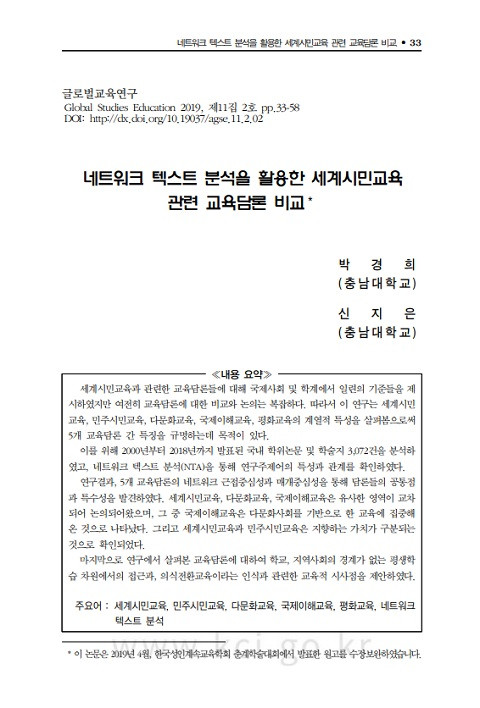 Comparison on Educational Discourses About Global Citizenship Education Using Network Text Analysis (Global Studies Education; Vol. 11, No. 2) Год публикации: 2019 Автор: Kyunghee Park | JiEun Shin Организация-автор: Association of | Global Studies Education The purpose of this study is to analyze the differences between ‘global citizenship education’, ‘democratic civic education’, ‘multicultural education’, ‘education for international understanding’, and ‘peace education’. For this, 3,072 research papers from 2000 to 2018 selected, and network text analysis(NTA) was conducted to confirm the characteristics and changes of the five educational discourses. As a result, the commonness and specificities of them were derived through the ‘closeness centrality’ and ‘betweenness centrality’ on the NTA. ‘Global citizenship education’, ‘multicultural education’, and ‘education for international understanding’ have crossed the content area. And ‘education for international understanding’ was based on a multicultural society. The values-oriented between ‘global citizenship education’ and ‘democratic civic education’ were distinguished. Finally, it is suggested that the five educational discourses need to be on the approach of lifelong learning, and they are education oriented toward change in consciousness.