
Ресурсы
Изучайте широкий спектр ценных ресурсов ВГГ, чтобы углубить своё понимание и повысить эффективность исследований, просветительской деятельности, преподавания и обучения.
Найдено: 1,727
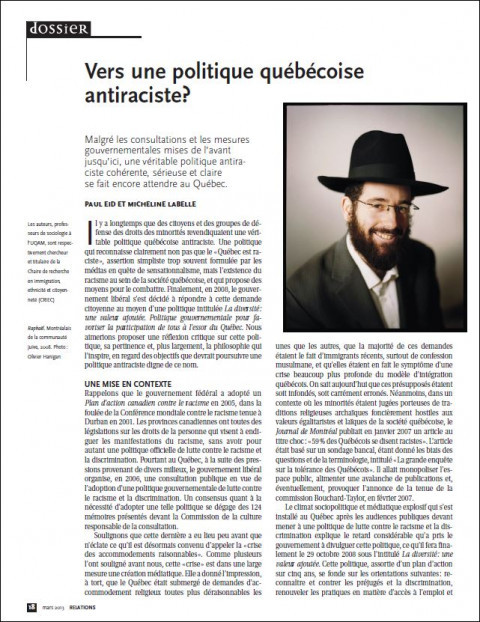 Vers une politique québécoise antiraciste? Год публикации: 2013 Автор: Paul Eid | Micheline Labelle Организация-автор: Relations Malgré les consultations et les mesures gouvernementales mises de l’avant jusqu’ici, une véritable politique antiraciste cohérente, sérieuse et claire se fait encore attendre au Québec.
 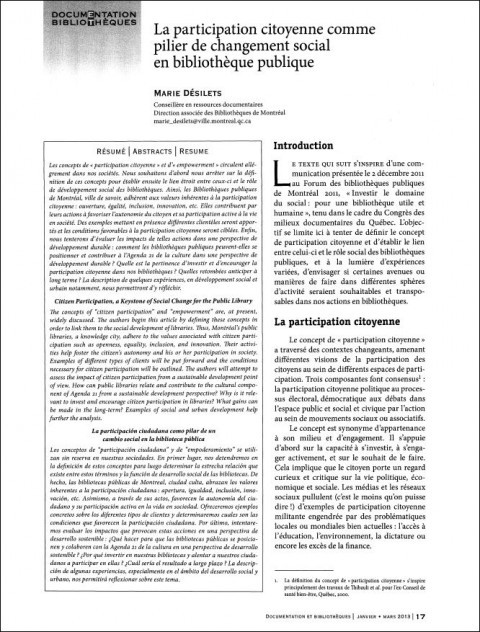 Citizen Participation, a Keystone of Social Change for the Public Library Год публикации: 2013 Автор: Marie Désilets Организация-автор: Revue Documentation et bibliothèques The concepts of "citizen participation" and "empowerment" are, at present, widely discussed. The authors begin this article by defining these concepts in order to link them to the social development of libraries. Thus, Montréal's public libraries, a knowledge city, adhere to the values associated with citizen participation such as openness, equality, inclusion, and innovation. Their activities help foster the citizen's autonomy and his or her participation in society. Examples of different types of clients will be put forward and the conditions necessary for citizen participation will be outlined. The authors will attempt to assess the impact of citizen participation from a sustainable development point of view. How can public libraries relate and contribute to the cultural component of Agenda 21 from a sustainable development perspective? Why is it relevant to invest and encourage citizen participation in libraries? What gains can be made in the long-term? Examples of social and urban development help further the analysis. La participación ciudadana como pilar de un cambio social en la biblioteca pública Год публикации: 2013 Автор: Marie Désilets Организация-автор: Revue Documentation et bibliothèques Los conceptos de "participación ciudadana" y de "empoderamiento" se utilizan sin reserva en nuestras sociedades. En primer lugar, nos detendremos en la definición de estos conceptos para luego determinar la estrecha relación que existe entre estos términos y la función de desarrollo social de las bibliotecas. De hecho, las bibliotecas públicas de Montreal, ciudad culta, abrazan los valores inherentes a la participación ciudadana: apertura, igualdad, inclusión, innovación, etc. Asimismo, a través de sus actos, favorecen la autonomía del ciudadano y su participación activa en la vida en sociedad. Ofreceremos ejemplos concretos sobre los diferentes tipos de clientes y determinaremos cuales son las condiciones que favorecen la participación ciudadana. Por último, intentaremos evaluar los impactos que provocan estas acciones en una perspectiva de desarrollo sostenible: ¿Qué hacer para que las bibliotecas públicas se posicionen y colaboren con la Agenda 21 de la cultura en una perspectiva de desarrollo sostenible? ¿Por qué invertir en nuestras bibliotecas y alentar a nuestros ciudadanos a participar en ellas? ¿Cuál sería el resultado a largo plazo? La descripción de algunas experiencias, especialmente en el ámbito del desarrollo social y urbano, nos permitirá reflexionar sobre este tema. La participation citoyenne comme pilier de changement social en bibliothèque publique Год публикации: 2013 Автор: Marie Désilets Организация-автор: Revue Documentation et bibliothèques Les concepts de « participation citoyenne » et d’« empowerment » circulent allègrement dans nos sociétés. Nous souhaitons d’abord nous arrêter sur la définition de ces concepts pour établir ensuite le lien étroit entre ceux-ci et le rôle de développement social des bibliothèques. Ainsi, les Bibliothèques publiques de Montréal, ville de savoir, adhèrent aux valeurs inhérentes à la participation citoyenne : ouverture, égalité, inclusion, innovation, etc. Elles contribuent par leurs actions à favoriser l’autonomie du citoyen et sa participation active à la vie en société. Des exemples mettant en présence différentes clientèles seront apportés et les conditions favorables à la participation citoyenne seront ciblées. Enfin, nous tenterons d’évaluer les impacts de telles actions dans une perspective de développement durable : comment les bibliothèques publiques peuvent-elles se positionner et contribuer à l’Agenda 21 de la culture dans une perspective de développement durable ? Quelle est la pertinence d’investir et d’encourager la participation citoyenne dans nos bibliothèques ? Quelles retombées anticiper à long terme ? La description de quelques expériences, en développement social et urbain notamment, nous permettront d’y réfléchir.
 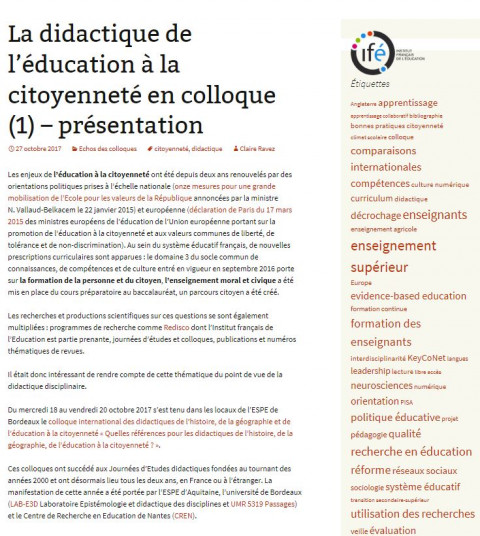 La didactique de l’éducation à la citoyenneté en colloque Год публикации: 2017 Автор: Claire Ravez Организация-автор: Institut Français de l'Education (IFÉ) Les enjeux de l’éducation à la citoyenneté ont été depuis deux ans renouvelés par des orientations politiques prises à l’échelle nationale (onze mesures pour une grande mobilisation de l’Ecole pour les valeurs de la République annoncées par la ministre N. Vallaud-Belkacem le 22 janvier 2015) et européenne (déclaration de Paris du 17 mars 2015 des ministres européens de l’éducation de l’Union européenne portant sur la promotion de l’éducation à la citoyenneté et aux valeurs communes de liberté, de tolérance et de non-discrimination). Au sein du système éducatif français, de nouvelles prescriptions curriculaires sont apparues : le domaine 3 du socle commun de connaissances, de compétences et de culture entré en vigueur en septembre 2016 porte sur la formation de la personne et du citoyen, l’enseignement moral et civique a été mis en place du cours préparatoire au baccalauréat, un parcours citoyen a été créé.
 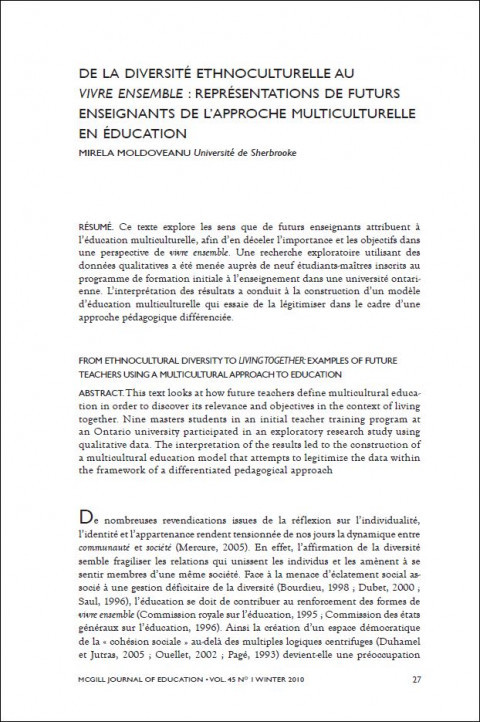 From Ethnocultural Diversity to Living Together: Examples of Future Teachers Using a Multicultural Approach to Education Год публикации: 2010 Автор: Mirela Moldoveanu Организация-автор: McGill University. Faculty of Education This text looks at how future teachers define multicultural education in order to discover its relevance and objectives in the context of living together. Nine masters students in an initial teacher training program at an Ontario university participated in an exploratory research study using qualitative data. The interpretation of the results led to the construction of a multicultural education model that attempts to legitimize the data within the framework of a differentiated pedagogical approach.
 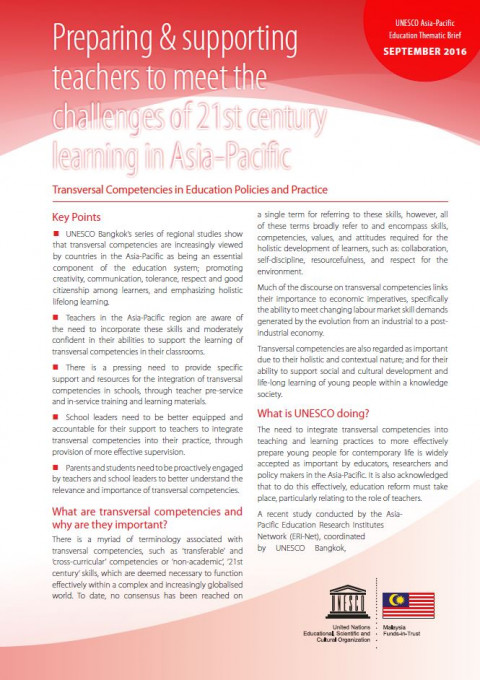 Подготовка и поддержка учителей для решения задач обучения 21-го века в Азиатско-Тихоокеанском регионе Год публикации: 2016 Организация-автор: Regional Bureau for Education in Asia and the Pacific | UNESCO Bangkok Подготовка и поддержка учителей для решения задач обучения 21-го века в Азиатско-Тихоокеанском регионе. Междисциплинарные компетенции в области политики и практики в области образования. Это итог исследований III фазы ERI-Net для междисциплинарных компетенций в области политики и практики в образовании.
  Education for Sustainable Development in Central Asia: Analysis of Achievements, Challenges and Outlook Год публикации: 2018 Автор: Tatiana Shakirova Организация-автор: Regional Environmental Centre for Central Asia (CAREC) The article of the manager of the CAREC programme "Education for Sustainable Development" (ESD), Dr of Biology Tatiana Shakirova is devoted to the review of ESD process from 2002 to 2018, analysis of experience, lessons learned and challenges and perspectives for ESD development in Central Asia. Taking into consideration all the global and regional challenges in ESD, today CAREC is reconsidering and rethinking its role in ESD process in Central Asia. The main objective of the ESD Programme today is to provide a regional platform for dialogue, exchange of knowledge, experience, innovations and best educational practices/tools implemented at local/national/regional levels, and support CAREC's inter-program activities on education and capacity building, as well as intersectoral, interagency, interregional cooperation on ESD in the region with the involvement of all stakeholders and international expertise. Образование в Интересах Устойчивого Развития в Центральной Азии: Анализ Достижений, Вызовы и Взгляд в Будущее Год публикации: 2018 Автор: Tatiana Shakirova Организация-автор: Regional Environmental Centre for Central Asia (CAREC) Статья менеджера программы «Образование для устойчивого развития» (ОУР) РЭЦЦА, кандидата биологических наук Татьяны Шакировой посвящена обзору процесса ОУР с 2002 по 2018 годы, анализу опыта, уроков, а также вызовам и перспективам развития ОУР в Центральной Азии.Принимая во внимание глобальные и региональные вызовы в ОУР, сегодня РЭЦЦА пересматривает и переосмысливает свою роль в процессе ОУР в Центральной Азии. Основная цель Программы ОУР сегодня – это предоставление региональной площадки для диалога, обмена знаниями, опытом, инновациями и наилучшими образовательными практиками/ инструментами, реализованными на местном/национальном/региональном уровнях, и поддержка межпрограммной деятельности РЭЦЦА по образованию и повышению потенциала, а также обеспечение межсекторального, межведомственного, межрегионального сотрудничества по ОУР в регионе с привлечением всех заинтересованных сторон и международной экспертизы.
 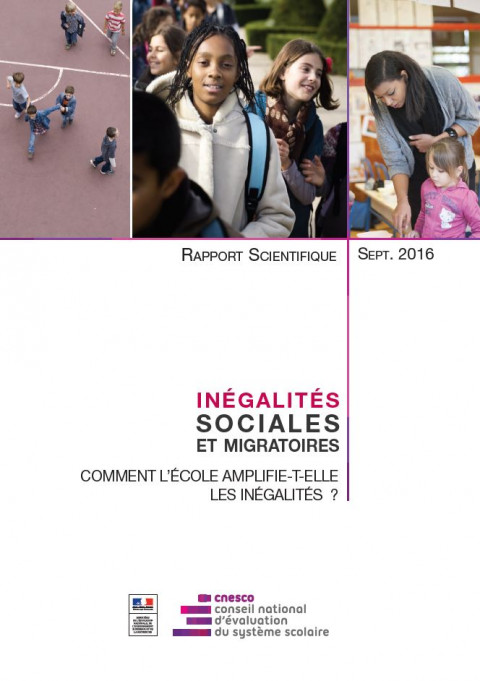 Inégalités sociales et migratoires : Comment l’école amplifie-t-elle les inégalités ? Год публикации: 2016 Организация-автор: Conseil natiional d'évaluation du système scolaire (CNESCO) En se fondant sur 22 contributions commandées pour l’occasion par le Cnesco à près de 40 chercheurs français et étrangers, ainsi que sur des enquêtes, des études et des articles publiés par des chercheurs ou des organismes, le Cnesco présente dans ce rapport un bilan global des inégalités scolaires d’origines sociale et migratoire en France aujourd’hui. Cette analyse à visée holistique se déroule en trois parties : tout d’abord, une définition conceptuelle des inégalités sociales à l’école et des approches de la justice scolaire ; ensuite, un état des lieux quantitatif présentant ces inégalités scolaires ; enfin, une présentation des politiques scolaires entreprises depuis quatre décennies dans l’objectif de combattre les injustices sociales à l’école tant au primaire qu’au secondaire, ainsi qu’un bilan sur leur efficacité.Qu’est-ce qu’une école juste ? Comment décrire, observer les inégalités ? Toutes les inégalités scolaires sont-elles illégitimes ? Dans une approche historique, les différences de parcours selon les niveaux scolaires ont longtemps eu lieu dès la fin de l’école primaire. L’avènement du collège unique en 1975 marque un tournant majeur dans la recherche de davantage d’égalité des chances à l’école.La massification de l’enseignement secondaire permet à davantage d’élèves d’accéder au baccalauréat, les inégalités sociales face à ce diplôme reculent plus encore avec la création du baccalauréat professionnel. Le socle commun de connaissances, de compétences et de culture, l’adaptation de l’école à l’élève, la différenciation pédagogique, la revalorisation des parcours individuels : autant de concepts plus récents, reflets d’une école du 21e siècle, qui ont pour objet un apprentissage minimum de certaines connaissances pour tous, et qui tendent donc à plus de justice.Mais si l’école française ségrégue moins les élèves de façon flagrante qu’il y a 50 ans, elle tend cependant à maintenir de nombreuses inégalités sociales et migratoires en son sein, plus cachées, moins observables, mais pourtant bien présentes. Ce sont ces inégalités que le Cnesco souhaite étudier.