
Ресурсы
Изучайте широкий спектр ценных ресурсов ВГГ, чтобы углубить своё понимание и повысить эффективность исследований, просветительской деятельности, преподавания и обучения.
Найдено: 1,477
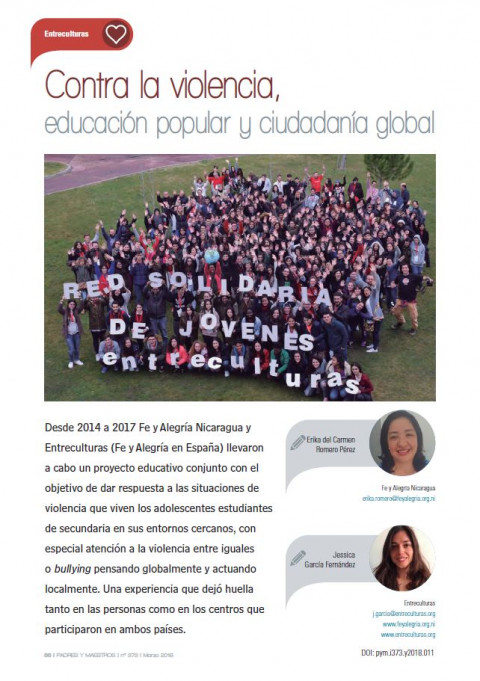 Against Violence, Popular Education and Global Citizenship Год публикации: 2018 Автор: Erika del Carmen Romero Pérez | Jessica García Fernández The article is about a project that was carried out between 2014 and 2017 by two countries: Nicaragua and Spain, on behalf of the organizations "Fe y alegría Nicaragua" and "Entreculturas (Fe y Alegría España)". It was an educative project among both nations that had two main objectives: promoting both local and global citizenship, and to give answer to violent situations that adolescent students hae to face in secondary education contexts, with special attention to the violence among equals or bullying. Contra la violencia, educación popular y ciudadanía global Год публикации: 2018 Автор: Erika del Carmen Romero Pérez | Jessica García Fernández El artículo habla sobre un proyecto que se llevó a cabo entre 2014 y 2017 por medio de dos países: Nicaragua y España, a través de las organizaciones "Fe y alegría Nicaragua" y "Entreculturas (Fe y Alegría España)". Fue un proyecto educativo conjunto entre los dos países, y tenía dos objetivos principales: el fomentar una ciudadanía tanto local como global, y el de dar respuesta a las situaciones de violencia que viven los adolescentes estudiantes de secundaria en sus entornos cercanos, con especial atención a la violencia entre iguales o bullying.
 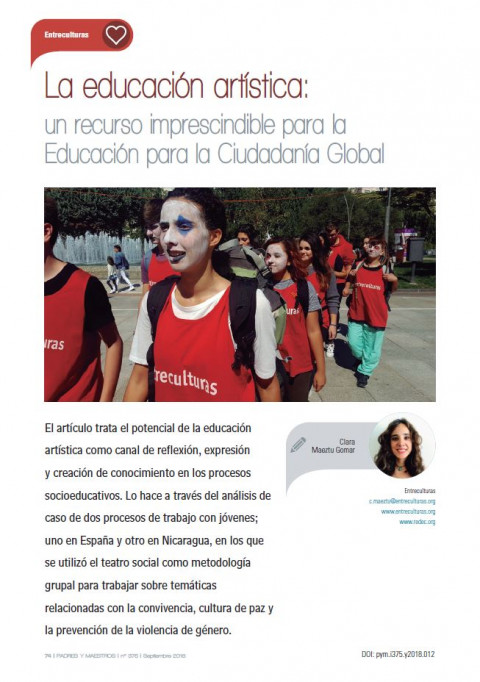 Artistic Education: An Essential Resource for Global Education Год публикации: 2018 Автор: Clara Maeztu Gomar The article is about the potential of artistic education as a means of reflection, expression and production of knowledge in socioeducative processes. It details a case study were two working processes with youth are explained: one in Spain and the other one in Nicaragua. In both cases social theatre was used as a group methodology to work on thematics related with coexistence, culture of peace, and prevention of gender violence. La educación artística: un recurso imprescindible para la Educación para la Ciudadanía Global Год публикации: 2018 Автор: Clara Maeztu Gomar El artículo trata el potencial de la educación artística como canal de reflexión, expresión y creación de conocimiento en los procesos socioeducativos. Lo hace a través del análisis de caso de dos procesos de trabajo con jóvenes; uno en España y otro en Nicaragua, en los que se utilizó el teatro social como metodología grupal para trabajar sobre temáticas relacionadas con la convivencia, cultura de paz y la prevención de la violencia de género.
 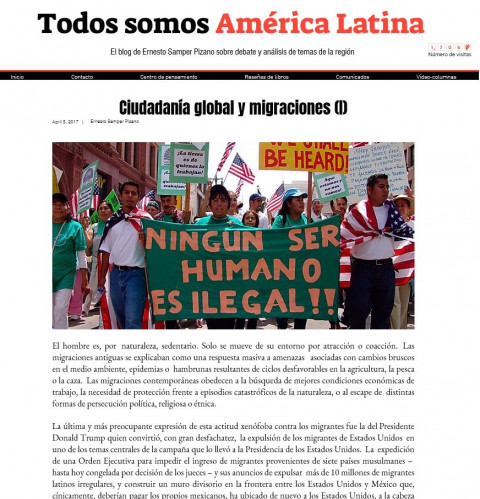 Global Citizenship and Migration Год публикации: 2017 Автор: Ernesto Samper Pizano The news is a conference proclame in defense of migrants at a global scale. It was elaborated for the World People's Conference that took place in Bolivia in 2017 and it describes, very briefly, the situation of many inmigrants around the world, especially latinamericans. Ciudadanía global y migraciones Год публикации: 2017 Автор: Ernesto Samper Pizano La noticia es una proclama a favor y defensa de los migrantes a nivel global. Esta fue elaborada para la Conferencia Mundial de los Pueblos que tuvo lugar en 2017 en Bolivia y describe muy brevemente la situación de los inmigrantes en el mundo, sobre todo de los latinoamericanos.
 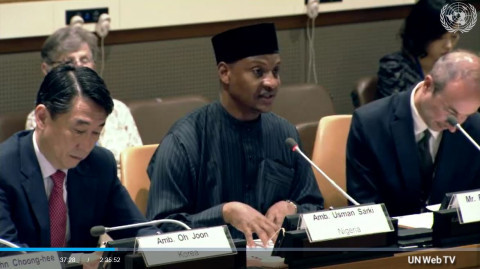 [Video] Global Citizenship Education for a just, peaceful, inclusive and sustainable world: a conceptual framework and its application in the field Год публикации: 2015 Организация-автор: United Nations (UN) The Seminar held at UN HQs entitled, "Global Citizenship Education for a Just, Peaceful, Inclusive, and Sustainable world: A Conceptual Framework and its Application in the Field" was co-organized by the Permanent Missions of France, Nigeria, Qatar and the Republic of Korea, the United States Mission and the United Nations Educational, Scientific and Cultural Organization (UNESCO), in support of the Secretary-General’s Global Education First Initiative (GEFI).The panel discussion was moderated by H.E. Ambassador Hahn Choong‐hee of Korea. Some of the speakers for this event included H.E. Ambassador Richard Erdman, Acting Representative to ECOSOC of the Permanent Mission of the United States of America to the United Nations; H.E. Ambassador Usman Sarki, Deputy Permanent Representative of the Permanent Mission of the Federal Republic of Nigeria to the United Nations; Yousef Laram, Deputy Permanent Representative of the State of Qatar to the United Nations; Mr. Francois Gave, Counsellor at the Permanent Mission of France to the United Nations; and Christopher Castle, Chief of UNESCO’s Section of Global Citizenship Education.This event was divided into two segments. In the first, GCED was discussed at the level of concept. How can it strengthen the three pillars of the United Nations and the three pillars of sustainable development in furtherance of a just, peaceful, inclusive and sustainable world. In the second, examples from the field – the local, national and international levels – were presented and discussed as were certain opportunities going forward including the important role of media. [vidéo] Éducation à la Citoyenneté mondiale pour un monde juste, pacifique, inclusive et durable: un cadre conceptuel et son application dans le domaine Год публикации: 2015 Организация-автор: United Nations (UN) Le séminaire a eu lieu au Siège de l'ONU intitulé «Éducation Mondiale Citoyenneté pour un monde juste, paisible, inclusive et durable: un cadre conceptuel et son application sur le terrain» a été co-organisée par les Missions permanentes de la France, le Nigeria, le Qatar et les République de Corée, la Mission des États-Unis et l'Organisation de l’ONU pour l'éducation, la science et la culture (UNESCO), à l'appui de First Éducation Mondiale Initiative du Secrétaire général (GEFI).Le débat a été animé par S.E. Ambassadeur Hahn Choong-hee de Corée. Certains des orateurs pour cet événement inclus S.E. Ambassadeur Richard Erdman, représentant par intérim à l'ECOSOC de la Mission permanente des États-Unis d'Amérique auprès de l'Organisation de l’ONU; IL. Ambassadeur Usman Sarki, Représentant permanent adjoint de la Mission permanente de la République fédérale du Nigéria auprès de l’ONU; Yousef LARAM, Représentant permanent adjoint de l'Etat du Qatar auprès de l'Organisation de l’ONU; M. François Gave, Conseiller à la Mission permanente de la France auprès de l’ONU; et Christopher Castle, la Section de l'éducation à la citoyenneté mondiale chef de l'UNESCO. Cet événement a été divisé en deux segments. Dans le premier, ECM a été discuté au niveau du concept. Comment peut-on renforcer les trois piliers de l'Organisation de l’ONU et les trois piliers du développement durable dans la poursuite d'un monde juste, pacifique, inclusif et durable. Dans le second, des exemples sur le terrain - aux niveaux local, national et international - ont été présentées et discutées de même que certaines opportunités à l'avenir, y compris le rôle important des médias.
  Citizenship education and coexistence: my body, my first territory; initial cycle (early education) Год публикации: 2014 Организация-автор: Secretaría de Educación del Distrito (SED) | Fe y Alegría These twelve modules make reference to a series of activities that focus on how children from all the educative grades understand and live citizenship, strengthening and facilitating the learning processes based on autonomy. This educative materials, which are aimed at being implemented inside the classrooms, attempt to serve as input resources for educators and other agents that work on or are interested in working with citizenship education and coexistence. The overall objective is to provide quality education. Educación para la ciudadanía y la convivencia: mi cuerpo, mi primer territorio; ciclo inicial (prejardín, jardín y transición) Год публикации: 2014 Организация-автор: Secretaría de Educación del Distrito (SED) | Fe y Alegría These twelve modules make reference to a series of activities that focus on how children from all the educative grades understand and live citizenship, strengthening and facilitating the learning processes based on autonomy. This educative materials, which are aimed at being implemented inside the classrooms, attempt to serve as input resources for educators and other agents that work on or are interested in working with citizenship education and coexistence. The overall objective is to provide quality education.