
Ресурсы
Изучайте широкий спектр ценных ресурсов ВГГ, чтобы углубить своё понимание и повысить эффективность исследований, просветительской деятельности, преподавания и обучения.
Найдено: 1,448
 L'engagement des jeunes Год публикации: 2015 Автор: Jeanne Lorrain Организация-автор: Educasol Le 9 juillet 2015, à l’initiative inédite de quatre collectifs et plateformes engagés sur les questions de citoyenneté active à l’international, le CLONG Volontariat, EDUCASOL, France Volontaires et le Cnajep, jeunes, associations et institutions se sont interrogés : « Quelle participation citoyenne à la construction des politiques de développement ? Et les jeunes dans tout ça ? » Au cours de la journée, la parole a été donnée aux jeunes pour qu’ils puissent exprimer ce que représente pour eux l’engagement et pour mettre en avant ceux qui n’ont généralement pas la parole. A travers un regard croisé Europe/International sur l’engagement citoyen et de nombreux témoignages sur leur parcours, les jeunes intervenants ont rappelé que ces questions ne sont pas réservées à une élite, que peu importe le niveau ou l’échelle d’engagement (international-national-quartier-région), ceux qui s’intéressent aux questions de développement peuvent avoir un impact sur les politiques publiques et faire que leur voix soit entendue. Cette journée a permis de développer deux outils de communication et d’information afin de promouvoir l’engagement citoyen et de faire de la sensibilisation auprès de différents publics en France et à l’international.
 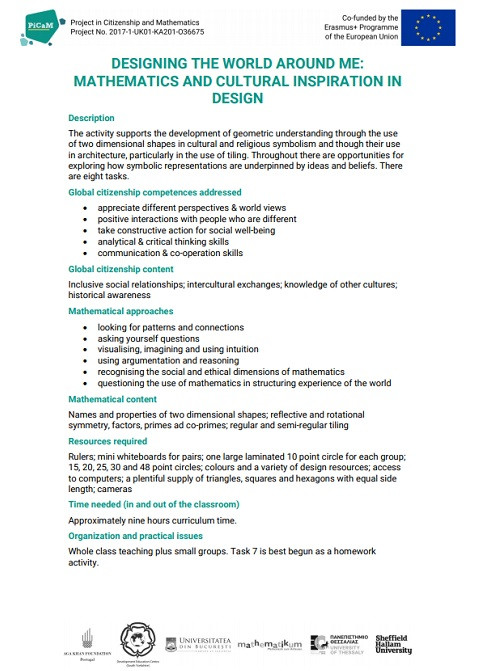 Designing the World Around Me: Mathematics and Cultural Inspiration in Design Год публикации: 2017 Организация-автор: Project in Citizenship and Mathematics(PiCaM) | Erasmus+ This activity supports the development of geometric understanding through the use of two dimensional shapes in cultural and religious symbolism and though their use in architecture, particularly in the use of tiling. Throughout there are opportunities for exploring how symbolic representations are underpinned by ideas and beliefs.
  Lignes directrices pour l'éducation mondiale: manuel pour les éducateurs à comprendre et à mettre en œuvre l'éducation globale Год публикации: 2008 Организация-автор: North-South Centre of the Council of Europe Ces lignes directrices Éducation de Globale sont le résultat d'un besoin exprimé par (NSC) Réseau d'éducation Globale praticiens du Centre Nord-Sud - le réseau de la semaine de l'éducation globale - d'avoir un outil commun, construit sur l'expérience acquise par le réseau et d'autres partenaires, à éducateurs de soutien pour comprendre et mettre en œuvre avec succès les initiatives de l’éducation globale. En offrant des perspectives sur l'éducation globale, ainsi que les méthodes et critères d'évaluation - y compris le partage des pratiques, des outils et des ressources - ces lignes directrices visent à renforcer l'ensemble des travaux pour l'éducation mondiale. Il vise à soutenir les praticiens Présent dans les formels et non formels paramètres général en introduisant des éléments qui peuvent être développés par eux aux besoins et selon en fonction de leurs propres expériences; les aider dans l'éducation globale Identifier les approches et pratiques existantes; les aider à réfléchir et à devenir plus conscients de leurs activités d'éducation globales propres; Augmenter le partage mondial de la pratique de l'éducation et de créer des synergies entre les parties prenantes; Contribuer aux politiques d'éducation au niveau local, régional, national et international. Les lignes directrices Éducation globalesont une initiative du Programme d’Éducation Globale du Centre Nord-Sud du Conseil de l'Europe, impliquant une équipe d'éducateurs du réseau Semaine de l'éducation mondiale qui a constitué l'équipe de rédaction avec le mandat de rédiger collectivement, les lignes directrices Education Mondiale. Le processus d'écriture a inclus une méthode participative à plusieurs niveaux de l'éducation conseil mondial parmi les éducateurs et les praticiens activement impliqués dans le Centre Nord-Sud de Éducation Globale et Jeunesse. En outre, un groupe de mentors a été identifié parmi les partenaires européens et internationaux de NSC, qui comprenait, entre autres, une équipe de formateurs de l'Université du NSC Jeunesse & Développement. Sujets présentés dans les lignes directrices visent à clarifier des questions clés liées à l'éducation globale; Il suggère à élaborer des stratégies sur la façon dont le contenu; mettre en avant AIMS, les compétences, les valeurs et les attitudes; offrir des conseils sur les méthodes, la conception des programmes et de l'évaluation et la liste des contacts, des liens utiles et bibliographie. Les lignes directrices doivent être considérées comme un processus continu de l'évolution, qui devrait être régulièrement revue avec de nouvelles idées, des intrants et des pratiques brought à partir d'une diversité de partenaires et de leurs expériences.
  Global Education Guidelines: A Handbook for Educators to Understand and Implement Global Education Год публикации: 2008 Автор: Alicia Cabezudo | Christos Christidis | Miguel Carvalho da Silva | Valentina Demetriadou-Saltet | Franz Halbartschlager | Georgeta-Paula Mihai Организация-автор: North-South Centre of the Council of Europe These Global Education Guidelines are the result of a need expressed by the North-South Centre’s (NSC) network of global education practitioners – the Global Education Week network - to have a common tool, built on experience gained by the network and other partners, to support educators to comprehend and successfully implement global education initiatives. By offering perspectives on global education as well as related methods and evaluation criteria – including sharing of practices, tools and resources - these Guidelines aim at strengthening the overall work for global education. It also aims at supporting practitioners in formal and non-formal education settings by introducing general elements which may be developed by them according to the needs and based on their own experiences; assist them in identifying existing global education approaches and practices; support them in reflecting on and becoming more aware of their own global education activities; increase global education practice sharing and create synergies between stakeholders; contribute to education policies at local, regional, national and international level.The Global Education Guidelines are an initiative of the Global Education Programme of the NorthSouth Centre of the Council of Europe, involving a team of educators from the Global Education Week network which constituted the drafting team with the mandate of drafting collectively the Global Education Guidelines. The writing process included a participatory method at several levels of consultancy amongst global education educators and practitioners actively involved with the North-South Centre global education and youth programmes. Moreover, a Group of Mentors was identified among NSC’s European and international partners, which included, inter alia, a team of trainers from the NSC’s University on Youth & Development.Topics presented in the Guidelines aim at clarifying fundamental questions related to global education; it suggest strategies on how to build contents; put forward aims, skills, values and attitudes; offer guidance on methods, curricular design and evaluation and list useful contacts, links and bibliography. The Guidelines should be regarded as an ongoing process of evolution, which should be regularly reviewed with new ideas, inputs and practices brought from a diversity of partners and their experiences. Pautas para una Educación Global : Manual para que los educadores comprendan e implementen la educación global Год публикации: 2008 Автор: Alicia Cabezudo | Christos Christidis | Miguel Carvalho da Silva | Valentina Demetriadou-Saltet | Franz Halbartschlager | Georgeta-Paula Mihai Организация-автор: North-South Centre of the Council of Europe Estas Pautas para la Educación Global son el resultado de (una) la necesidad expresada por la Red Norte-Sur-Centro (NSC – NSC sus siglas en inglés) de los partidarios de la educación global - la Red Semanal de Educación Global – quienes precisaban una herramienta común, basada en la experiencia adquirida por la red y otros compañeros, para asistir a los educadores en una mejor comprensión e implementación exitosa de iniciativas y acciones en el campo de la educación global.Las Pautas para una Educación Global son una iniciativa del Programa de Educación Global del Centro Norte-Sur del Consejo de Europa, que involucra a un equipo de educadores de la Red de la Semana de Educación Global con la misión de reunir colectivamente pautas para sus prácticas y actividades. El proceso de redacción del presente documento se realizó mediante un método participativo en varios niveles de consulta entre educadores y profesionales de la educación global activamente involucrados en programas para la juventud del Centro Norte-Sur. Además, se seleccionó un grupo de Asesores entre los socios europeos e internacionales del NSC que incluye, entre otros, a un grupo de instructores de la Universidad del NSC sobre Juventud y Desarrollo. Global education guidelines: a handbook for educators to understand and implement global education Год публикации: 2008 Организация-автор: North-South Centre of the Council of Europe These Global Education Guidelines are the result of a need expressed by the North-South Centre’s (NSC) network of global education practitioners – the Global Education Week network - to have a common tool, built on experience gained by the network and other partners, to support educators to comprehend and successfully implement global education initiatives. By offering perspectives on global education as well as related methods and evaluation criteria – including sharing of practices, tools and resources - these Guidelines aim at strengthening the overall work for global education. It also aims at supporting practitioners in formal and non-formal education settings by introducing general elements which may be developed by them according to the needs and based on their own experiences; assist them in identifying existing global education approaches and practices; support them in reflecting on and becoming more aware of their own global education activities; increase global education practice sharing and create synergies between stakeholders; contribute to education policies at local, regional, national and international level.The Global Education Guidelines are an initiative of the Global Education Programme of the NorthSouth Centre of the Council of Europe, involving a team of educators from the Global Education Week network which constituted the drafting team with the mandate of drafting collectively the Global Education Guidelines. The writing process included a participatory method at several levels of consultancy amongst global education educators and practitioners actively involved with the North-South Centre global education and youth programmes. Moreover, a Group of Mentors was identified among NSC’s European and international partners, which included, inter alia, a team of trainers from the NSC’s University on Youth & Development.Topics presented in the Guidelines aim at clarifying fundamental questions related to global education; it suggest strategies on how to build contents; put forward aims, skills, values and attitudes; offer guidance on methods, curricular design and evaluation and list useful contacts, links and bibliography. The Guidelines should be regarded as an ongoing process of evolution, which should be regularly reviewed with new ideas, inputs and practices brought from a diversity of partners and their experiences. Pautas para una educación global: manual para que los educadores comprendan e implementen la educación global Год публикации: 2008 Организация-автор: North-South Centre of the Council of Europe These Global Education Guidelines are the result of a need expressed by the North-South Centre’s (NSC) network of global education practitioners – the Global Education Week network - to have a common tool, built on experience gained by the network and other partners, to support educators to comprehend and successfully implement global education initiatives. By offering perspectives on global education as well as related methods and evaluation criteria – including sharing of practices, tools and resources - these Guidelines aim at strengthening the overall work for global education. It also aims at supporting practitioners in formal and non-formal education settings by introducing general elements which may be developed by them according to the needs and based on their own experiences; assist them in identifying existing global education approaches and practices; support them in reflecting on and becoming more aware of their own global education activities; increase global education practice sharing and create synergies between stakeholders; contribute to education policies at local, regional, national and international level.The Global Education Guidelines are an initiative of the Global Education Programme of the NorthSouth Centre of the Council of Europe, involving a team of educators from the Global Education Week network which constituted the drafting team with the mandate of drafting collectively the Global Education Guidelines. The writing process included a participatory method at several levels of consultancy amongst global education educators and practitioners actively involved with the North-South Centre global education and youth programmes. Moreover, a Group of Mentors was identified among NSC’s European and international partners, which included, inter alia, a team of trainers from the NSC’s University on Youth & Development.Topics presented in the Guidelines aim at clarifying fundamental questions related to global education; it suggest strategies on how to build contents; put forward aims, skills, values and attitudes; offer guidance on methods, curricular design and evaluation and list useful contacts, links and bibliography. The Guidelines should be regarded as an ongoing process of evolution, which should be regularly reviewed with new ideas, inputs and practices brought from a diversity of partners and their experiences.
  Teaching for Sustainable Development through Ethical Global Issues Pedagogy: A Resource for Secondary Teachers Год публикации: 2019 Автор: Karen Pashby | Louise Sund | Matthew Williams | Jennifer Maguire | Heidi Meltovuo | David Few | Nicole Sandler | Ruth Till | Ilona Taimela Организация-автор: Manchester Metropolitan University This resource aims to support teacher in their current practice rather than a direct ‘how-to’ guide. The activities offer some suggestions for practice before, during, and after students learn about a particular global issue. It offers some suggested global issues topics, but intend for teachers to adapt this resource to the different issues they explore with their students.
  Understanding the Return on Investment from TVET: A Practical Guide Год публикации: 2020 Автор: Jane Schueler | Phil Loveder Организация-автор: UNESCO International Centre for Technical and Vocational Education and Training (UNEVOC) | National Centre for Vocational Education Research(NCVER) This guide presents an analytic framework that summarizes some of the main elements and issues that need to be considered in measuring ROI. This includes establishing the scope, context and purpose for measuring ROI, adopting guiding principles, identifying costs, benefits and factors that impact on ROI, and approaches to data collection and analysis. The Guide then introduces a framework that looks at the ROI equation from a range of perspectives – including economic and social dimensions – and for different stakeholders, including individuals, businesses and societies. The Guide presents relevant ROI indicators and measures drawn from the existing international research. Finally, it provides guidelines to planning and collecting ROI data, along with a set of practical pro forma resources and case studies to assist the reader.
 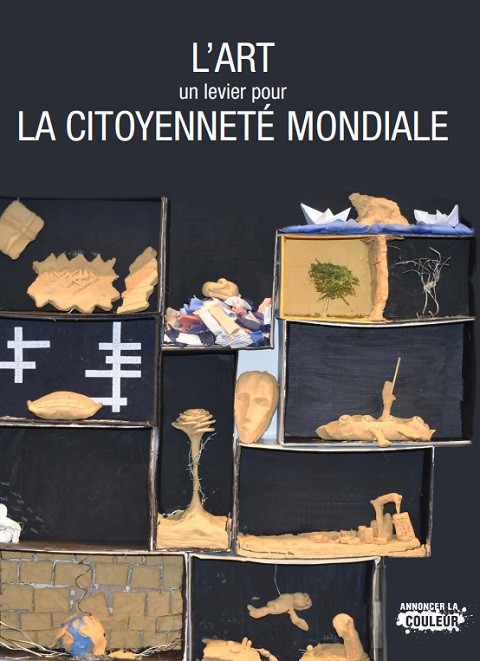 L’art: un levier pour la citoyenneté mondiale Год публикации: 2019 Организация-автор: Annoncer la Couleur (ALC) | Belgique Ce livre montre les avantages de proposer un moment de création artistique en ECM. L’art et la pédagogie du projet semblent être de très bons outils pour faire de l’ECM en milieu scolaire. Ce dossier s’appuie sur les expériences des enseignant∙e∙s qui ont mené un projet avec le soutien d’Annoncer la Couleur (ALC) et avec des artistes qui interviennent en milieu scolaire1.