
Ресурсы
Изучайте широкий спектр ценных ресурсов ВГГ, чтобы углубить своё понимание и повысить эффективность исследований, просветительской деятельности, преподавания и обучения.
Найдено: 1,477
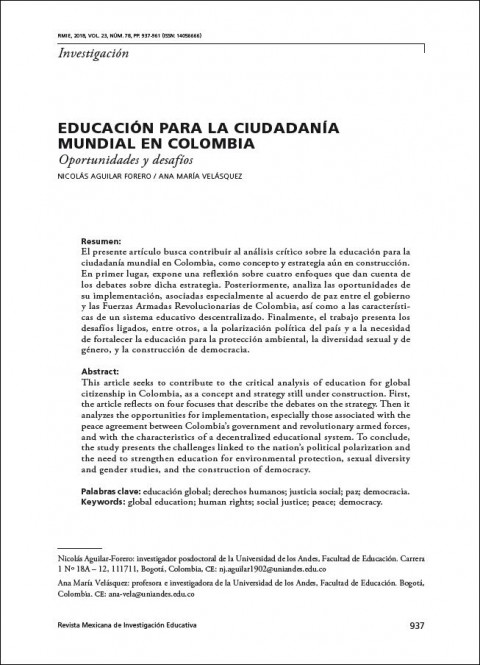 Education for Global Citizenship in Colombia: Opportunities and Challenges Год публикации: 2018 Автор: Nicolás AguilAr Forero | Ana María Velásquez This article seeks to contribute to the critical analysis of education for global citizenship in Colombia, as a concept and strategy still under construction. First, the article reflects on four focuses that describe the debates on the strategy. Then it analyzes the opportunities for implementation, especially those associated with the peace agreement between Colombia’s government and revolutionary armed forces, and with the characteristics of a decentralized educational system. To conclude, the study presents the challenges linked to the nation’s political polarization and the need to strengthen education for environmental protection, sexual diversity and gender studies, and the construction of democracy. Educación para la ciudadanía mundial en Colombia. Oportunidades y desafíos Год публикации: 2018 Автор: Nicolás AguilAr Forero | Ana María Velásquez El presente artículo busca contribuir al análisis crítico sobre la educación para la ciudadanía mundial en Colombia, como concepto y estrategia aún en construcción. En primer lugar, expone una reflexión sobre cuatro enfoques que dan cuenta de los debates sobre dicha estrategia. Posteriormente, analiza las oportunidades de su implementación, asociadas especialmente al acuerdo de paz entre el gobierno y las Fuerzas Armadas Revolucionarias de Colombia, así como a las característi- cas de un sistema educativo descentralizado. Finalmente, el trabajo presenta los desafíos ligados, entre otros, a la polarización política del país y a la necesidad de fortalecer la educación para la protección ambiental, la diversidad sexual y de género, y la construcción de democracia.
  NISSEM Global Briefs: Educating for the Social, the Emotional and the Sustainable Год публикации: 2019 Автор: Andy Smart | Margaret Sinclair | Aaron Benavot | Jean Bernard | Colette Chabbott | S. Garnett Russell | James Williams Организация-автор: Networking to Integrate SDG Target 4.7 and SEL skills into Educational Materials (NISSEM) The NISSEM global briefs are a collection of peer-reviewed essays from over 60 contributors with standing within the field of education. At the junction of SDG Target 4.7, SEL, and education in post conflict and low-resource settings, the NISSEM global briefs are a key resource for current research and practice.NISSEM is a Networking to Integrate SDG Target 4.7 and SEL(Social and emotional learning) into Educational Materials launched in March, 2018.
  Active citizens: globally connected, locally engaged; facilitator's toolkit Год публикации: 2014 Организация-автор: British Council This toolkit has been created to help facilitators to design and deliver the Active Citizens programme all over the world. Active Citizens is a social leadership programme which promotes intercultural dialogue and social responsibility as key leadership competencies in the 21st century. Active Citizens is run by the British Council working with civil society organisations all over the world. It began in 2009 and has been delivered in Europe, the Middle East, Africa and South Asia. It has reached more than 100,000 people to date through its training, conferences, social research and International Study Visits. The toolkit is in five sections - the introduction to the programme, preparing a workshop, delivering a workshop and post-workshop. There is also a large resource of workshop activity plans to support facilitators throughout the training cycle. The Active Citizens programme promotes community-led social development. It motivates members of communities to take responsibility for their social needs and gives them the knowledge, skills and experience to address them. The main audiences for the programme are community leaders working in, and with marginalised communities. They are people and institutions established, trusted and valued in the community - CSOs, NGOs, religious leaders, politicians, youth workers etc. They are influential and working to improve the lives of people living in their community. The programme develops skills and knowledge to identify and engage networks to help achieve goals as well as skills to plan and implement a project. The networks are between individuals at community level; institutions engaged in social action at community level; and institutions engaged in social policy dialogue at a national level. It includes cross-sectoral networking e.g. with the business community, media, etc. The building of these networks increases social inclusion, community resilience to conflict and increases social development in communities. See Diagram 1 on page 9. The programme is flexible and adaptable. It has been delivered to diverse groups, from rural communities in North-West Frontier Province Pakistan to urban communities in East London UK, to communities vulnerable to post-election violence in Kenya and internally displaced persons (IDPs) in Sri Lanka. Des Citoyens Actifs: connecté globalement recrutés sur place; la boîte à outils de l'animateur Год публикации: 2014 Организация-автор: British Council Cette boîte à outils a été créé pour aider les animateurs à concevoir et à exécuter le programme des citoyens actifs partout dans le monde. Citoyens actifs est un programme de leadership social qui favorise le dialogue interculturel et la responsabilité sociale comme compétences clés en leadership au 21e siècle. Citoyens actifs est géré par le British Council travaille avec des organisations de la société civile partout dans le monde. Il a commencé en 2009 et a été livré en Europe, au Moyen-Orient, en Afrique et en Asie du Sud. Il a atteint plus de 100.000 personnes à ce jour par le biais de sa formation, les conférences, la recherche sociale et visites d'étude internationaux. La boîte à outils est en cinq sections - l'introduction au programme, la préparation d'un atelier, offrant un atelier et post-atelier. Il y a aussi une ressource importante de l'activité de l'atelier prévoit de soutenir les animateurs tout au long du cycle de formation. Le programme des citoyens actifs favorise le développement social dirigé par la communauté. Il motive les membres des communautés à prendre en charge leurs besoins sociaux et leur donne les connaissances, les compétences et l'expérience nécessaires pour y remédier. Les principaux publics pour le programme sont des leaders communautaires qui travaillent dans et avec les communautés marginalisées. Ce sont des gens et des institutions établies, fiables et appréciés dans la communauté - OSC, les ONG, les chefs religieux, les politiciens, les travailleurs de la jeunesse, etc. Ils sont influents et travaille à améliorer la vie des personnes vivant dans leur communauté. Le programme développe les compétences et les connaissances pour identifier et engager des réseaux pour aider à atteindre les objectifs ainsi que les compétences nécessaires pour planifier et mettre en œuvre un projet. Les réseaux sont entre les individus au niveau de la communauté; les institutions engagées dans l'action sociale au niveau communautaire; et les institutions engagées dans un dialogue de politique sociale au niveau national. Il comprend la mise en réseau intersectoriel par exemple avec la communauté des affaires, des médias, etc. La construction de ces réseaux augmente l'inclusion sociale, la résilience des communautés aux conflits et augmente le développement social dans les communautés. Voir diagramme 1 à la page 9. Le programme est flexible et adaptable. Il a été remis à divers groupes, des communautés rurales en North-West Frontier Province du Pakistan aux communautés urbaines à East London au Royaume-Uni, aux communautés des personnes vulnérables à la violence post-électorale au Kenya et déplacées à l'intérieur (PDI) au Sri Lanka.
 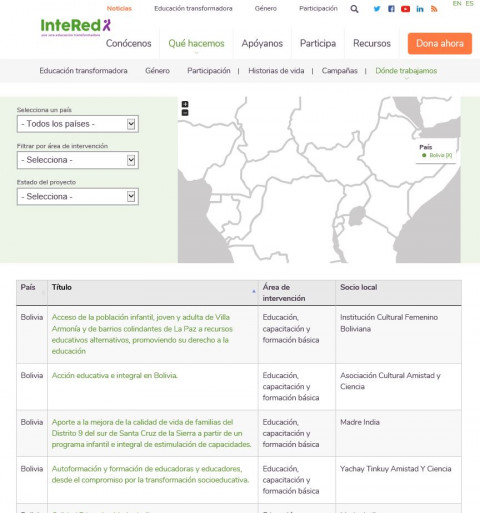 InteRed. Educational Projects in Bolivia Год публикации: 2019 Организация-автор: InteRed InteRed carries out educational projects to solve specific social problems around the planet. The projects tackle things such as poverty, health, access to education, Human Rights, access to food, among other things. InteRed. Proyectos educativos en Bolivia Год публикации: 2019 Организация-автор: InteRed InteRed lleva a cabo projectos educacionales intentando resolver problemas específicos en el planeta. Los proyectos abordan cuestiones como pobreza, salud, acceso a la educación, Derechos Humanos, acceso a alimentos, entre otras cosas.
  Peace Education and the Pandemic: Global Perspectives Год публикации: 2020 Организация-автор: International Institute on Peace Education (IIPE) This April 13 webinar, co-organized by the International Institute on Peace Education and Global Campaign for Peace Education, is an opportunity to learn, hear, and share with and from peace educators from around the world about how they are responding, adapting, and rethinking urgent agendas for peace education revealed by the global coronavirus pandemic.
  한반도의 평화를 말하다: 여섯 가지 주제로 살펴본 한반도 평화의 의미와 이해 Год публикации: 2019 Автор: 김병곤 | 서보혁 | 이동선 | 정재관 | 정성윤 | 정욱식 Организация-автор: 통일교육원 평화'라는 주제로 통일교육원에서 발간하는 첫 번째 평화 교재이다. 6명의 학자 및 평화활동가가 평화의 이해에서부터 시민사회의 평화운동에 이르기까지 살펴본 한반도의 평화 이야기이다.
  Claudio Keeps Calm Год публикации: 2020 Организация-автор: Aulas en Paz This animation presents the story of Claudio and how he managed to stay calm in the face of a conflict situation. It is part of the tools of the Aulas en Paz program for the socio-emotional development of boys and girls.