
Ресурсы
Изучайте широкий спектр ценных ресурсов ВГГ, чтобы углубить своё понимание и повысить эффективность исследований, просветительской деятельности, преподавания и обучения.
Найдено: 1,180
 Переосмысливая образование: Образование как всеобщее благо? Год публикации: 2015 Организация-автор: UNESCO The changes in the world today are characterized by new levels of complexity and contradiction. These changes generate tensions for which education is expected to prepare individuals and communities by giving them the capability to adapt and to respond. This publication contributes to rethinking education and learning in this context. It builds on one of UNESCO’s main tasks as a global observatory of social transformation with the objective of stimulating public policy debate.It is a call for dialogue among all stakeholders. It is inspired by a humanistic vision of education and development, based on respect for life and human dignity, equal rights, social justice, cultural diversity, international solidarity, and shared responsibility for a sustainable future. These are the fundamentals of our common humanity. This book enhances the vision provided by the two landmark UNESCO publications: Learning to Be: The world of education today and tomorrow (1972), the ‘Faure Report’, and Learning: The treasure within (1996), the ‘Delors Report’.
 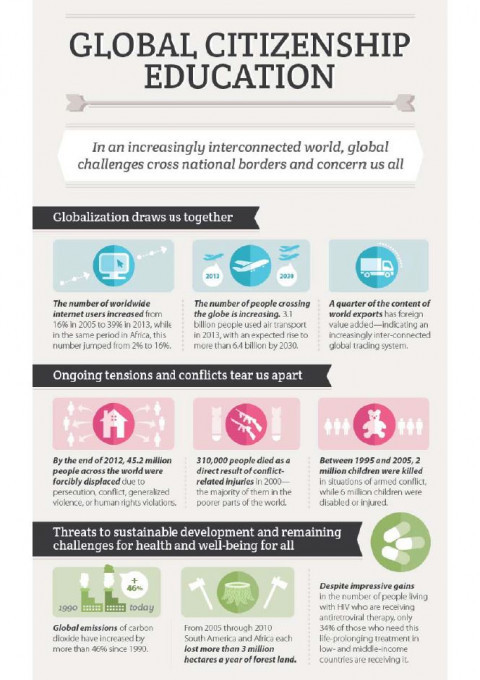 Global Citizenship Education infographic Год публикации: 2014 Организация-автор: UNESCO In an increasingly interconnected world, global challenges cross national borders and concern us all. With issues like these threatening human and environmental well-being, we need to re-think the role and relevance of education. We need Global Citizenship Education. Global Citizenship Education is transformative. What are the barriers to this kind of education? What needs to change in education? What is UNESCO doing? What can you do?
 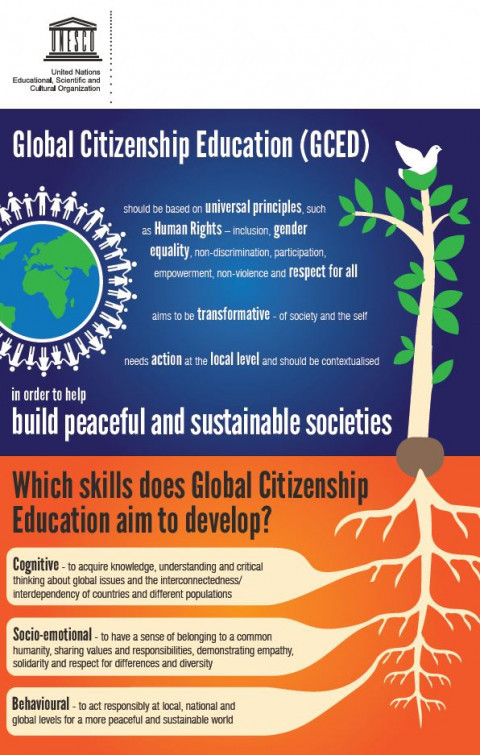 Global Citizenship Education (GCED) infographic Год публикации: 2015 Организация-автор: UNESCO Which skills does Global Citizenship Education aim to develop? How can effectively implement Global Citizenship Education? Who are the key players? Éducation à la citoyenneté mondiale infographique Год публикации: 2015 Организация-автор: UNESCO Quelles compétences pour l' Education citoyenneté mondiale visant à développer? Comment peut-on effectivement mettre en œuvre l'éducation à la citoyenneté mondiale? Quels sont les principaux acteurs?
 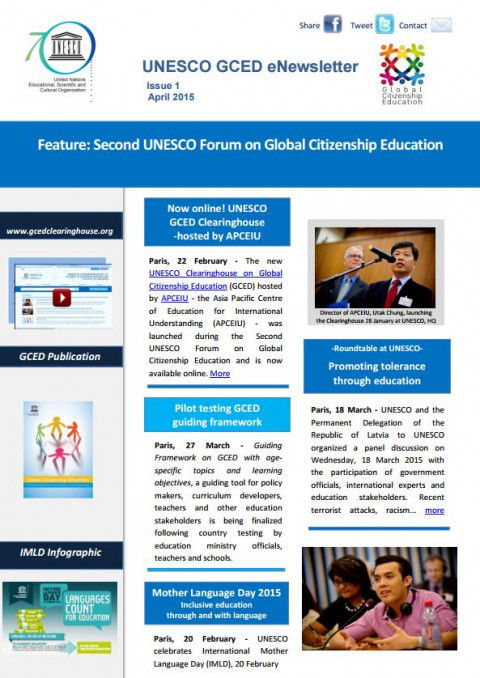 UNESCO GCED eNewsletter Issue 1 Год публикации: 2015 Организация-автор: UNESCO Feature: Second UNESCO Forum on Global Citizenship EducationNow online! UNESCO GCED Clearinghouse hosted by APCEIUPilot testing GCED guiding framework(Roundtable at UNESCO) Promoting tolerance through educationMother Tongue Day 2015: inclusive education through and with language(Interview) Roland Villamero speaks on GCED at the community levelHIghlights: Second UNESCO Forum on Global Citizenship Education, 28-30 January 2015, Paris HQSecond UNESCO Forum on GCED puts spotlight on Post-2015 developmentGlobal citizenship must be placed in the centre of education systemsAmira Yahyaoui's feature presentation at the Second UNESCO GCED ForumJoint Youth Statement2nd GCED Forum photo gallery UNESCO ECM e Bulletin Bulletin Numéro 1 Год публикации: 2015 Организация-автор: Organisation des Nations Unies pour l'éducation, la science et la culture (UNESCO) Caractéristique: Deuxième Forum de l'UNESCO sur l'éducation sur la citoyenneté mondialeMaintenant en ligne! UNESCO ECM Centre hébergé par APCECIcadre d'orientation Piolot test ECM(Table ronde à l'UNESCO) Tolérance Promouvoir par l'éducationLangue maternelle Jour 2015: l'éducation inclusive à travers et avec la langue(Interview) Roland Villamero parle sur ECM au niveau communautaireHighlights: Deuxième Forum de l'UNESCO sur l'éducation sur la citoyenneté mondiale, 28-30 Janvier 2015, HQ ParisDeuxième Forum de l'UNESCO sur ECM met les projecteurs sur L'après 2015 le développementLa citoyenneté mondiale doit être placé au centre des systèmes éducatifsfonction de la présentation de Amira Yahyaoui lors du deuxième Forum ECM UNESCODéclaration des jeunes mixte2ème Forum ECM galerie photo
  Second UNESCO Forum on Global Citizenship Education: building peaceful and sustainable societies: final report Год публикации: 2015 Организация-автор: UNESCO The Second UNESCO Forum on Global Citizenship Education (GCED) was organized in Paris from 28 to 30 January 2015 under the overall theme 'Building peaceful and sustainable societies: preparing for post-2015'. The Forum was organized in support of the UN Secretary General's Global Education First Initiative (GEFI) and on the occasion of UNESCO's 70th Anniversary. The Forum was organized by the Division for Teaching, Learning and Content, Educatio Sector, UNESCO, with the support of Austria, the Sultanate of Oman and the Republic of Korea. Other partners also included the United Nations Secretary-General's Global Education First Initiative (GEFI), UNESCO's Mahatma Gandhi Institute of Education for Peace and Sustainable Development (MGIEP), UNESCO's Asia-Pacific Centre of Education for International Understanding (APCEIU), the King Abdullah Bin Abdulaziz International Centre for Interreligious and Intercultural Dialogue (KAICIID) and the Learning Matrix Task Force. Some 250 participants from 61 countries from all regions of the world attended the Forum. These included decision-and policy-makers, practitioners, teachers, development partners, academics, the private sector, civil society representatives (national, regional and international level) as well as learners and youth representatives. The Forum was organized around three plenary sessions and 20 concurrent sessions. Topics under consideration included, among others, GCED in the post-2015 education agenda, measuring GCED learning outcomes, teaching practices, peace and human rights education, respect for diversity and inter-religious education, tackling discrimination and violence, education for sustainable development, youth involvement, the use of ICT and social media, and others. For an overview of the programme, please see Annex I. Second UNESCO Forum on Global Citizenship Education: building peaceful and sustainable societies: final report Год публикации: 2015 Организация-автор: Organisation des Nations Unies pour l'éducation, la science et la culture (UNESCO) Le deuxième Forum de l'UNESCO sur l'éducation à la citoyenneté mondiale (ECM) a été organisé à Paris du 28 au 30 Janvier 2015 sous le thème général «Construire des sociétés pacifiques et durables: préparer l'après-2015». Le Forum a été organisé à l'appui d’Éducation Globale Première Initiative du Secrétaire général de l'ONU (EGPI) et à l'occasion du 70e anniversaire de l'UNESCO. Le Forum a été organisé par la Division de l'enseignement, l'apprentissage et du contenu, Secteur Educatio, l'UNESCO, avec le soutien de l'Autriche, le Sultanat d'Oman et la République de Corée. D'autres partenaires comprenaient également ’Éducation Globale Première Initiative du Secrétaire général du Secrétaire général de l’ONU (EGPI), Mahatma Gandhi Institute de l'UNESCO de l'éducation pour la paix et le développement durable (MGIEP), Asie-Pacifique Centre de l'UNESCO de l'éducation pour la compréhension internationale (APCEIU), le roi Abdallah Bin Abdulaziz Centre international pour le dialogue interreligieux et interculturel (KAICIID) et le Groupe de travail Matrice d'apprentissage. Quelque 250 participants de 61 pays de toutes les régions du monde ont participé au Forum. ceci inclut décisions et les décideurs politiques, les praticiens, les enseignants, les partenaires de développement, des universitaires, le secteur privé, les représentants de la société civile (niveau national, régional et international), ainsi que les apprenants et les représentants de la jeunesse.Le Forum a été organisé autour de trois sessions plénières et 20 sessions simultanées. Sujets à l'étude comprenaient, entre autres, ECM dans l'agenda de l'éducation post-2015, la mesure des résultats ECM d'apprentissage, les pratiques d'enseignement, éducation à la paix et les droits de l'homme, le respect de la diversité et de l'éducation inter-religieux, la lutte contre la discrimination et la violence, l'éducation pour le développement durable, la participation des jeunes, l'utilisation des TIC et des médias sociaux, et d'autres. Pour un aperçu du programme, s'il vous plaît voir l'annexe I. Second UNESCO Forum on Global Citizenship Education video Год публикации: 2015 Организация-автор: UNESCO Highlights of the Second UNESCO Forum on Global Citizenship Education (GCED) Building peaceful and sustainable societies: preparing for post-2015 (28-30 January 2015, UNESCO HQs, Paris). The Forum was organized by the Division for Teaching, Learning and Content, Education Sector, UNESCO, with the support of Austria, the Sultanate of Oman and the Republic of Korea, and the UN Secretary-General's Global Education First Initiative (GEFI). Second UNESCO Forum on Global Citizenship Education video Год публикации: 2015 Организация-автор: UNESCO Faits saillants du deuxième Forum de l'UNESCO sur l’éducation à la citoyenneté mondiale (ECM) Construire des sociétés pacifiques et durables: la préparation pour l'après-2015 (28-30 Janvier 2015, Siège de l'UNESCO, Paris). Le Forum a été organisé par la Division de l'enseignement, l'apprentissage et du contenu, Secteur de l'éducation, l'UNESCO, avec le soutien de l'Autriche, le Sultanat d'Oman et la République de Corée, et Première Éducation Mondiale Initiative du Secrétaire Général de l'ONU (PISG).