
Ресурсы
Изучайте широкий спектр ценных ресурсов ВГГ, чтобы углубить своё понимание и повысить эффективность исследований, просветительской деятельности, преподавания и обучения.
Найдено: 1,448
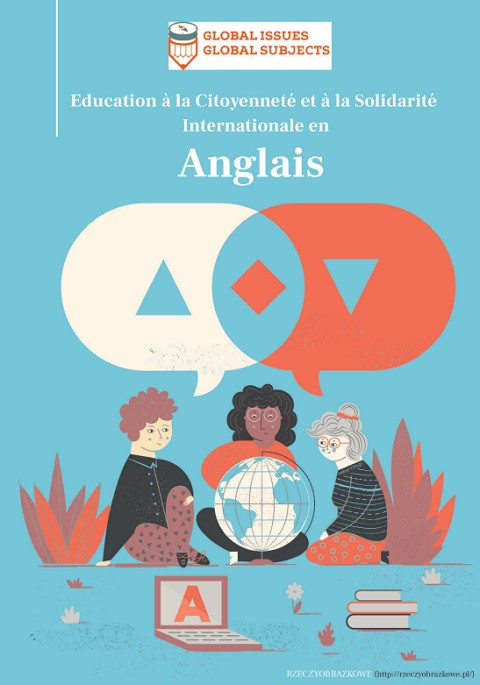 Education à la citoyenneté et à la solidarité internationale en anglais Год публикации: 2020 Автор: Morgane Boscher | Michael Lionne | Bénédicte Feys Организация-автор: Le Partenariat | Global Issues, Global Subjects (GIGS) | Union européenne Afin de promouvoir la démarche d'Education à la Citoyenneté et à la Solidarité Internationale et les Objectifs de Développement Durable dans l'enseignement secondaire, des groupes de travail d’enseignants ont conçu cette ressources pédagogique à destination de leurs collègues d’anglais.
 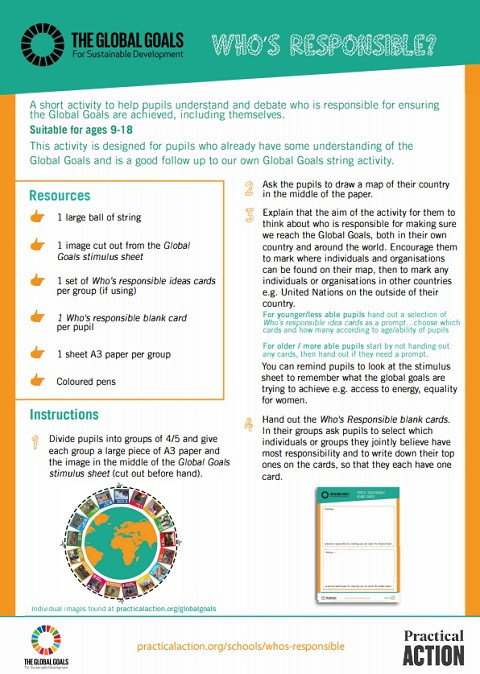 Who’s Responsible?: The Global Goals for Sustainable Development Год публикации: 2018 Организация-автор: Practical Action This 30 minute activity encourages pupils to consider who is responsible for ensuring we achieve the Global Goals (also known as the Sustainable Development Goals, SDGs). It is suitable for pupils 9-18 it stimulates discussion and debate, and help pupils recognize the role they themselves have to play.
  Creativity, Resilience and Global Citizenship: Activity Toolkit Год публикации: 2015 Организация-автор: CIT Crawford College of Art and Design | Youth Work Ireland This publication is a step by step guide to a range of activities exploring the themes of Creativity, Resilience & Global Citizenship through a wide range of workshops, sharing creative methods and tools. It has been co-developed by the Fast Forward training programme which brought together young people and youth workers from Ireland, Hungary, Italy and UK in Cork, Ireland in January 2015. It was developed with thirty young people: youth workers, artists and educators who are passionate about supporting young people to grow as global citizens. It is useful to provide a context for anyone engaging others in the creative activities presented in this toolkit.
 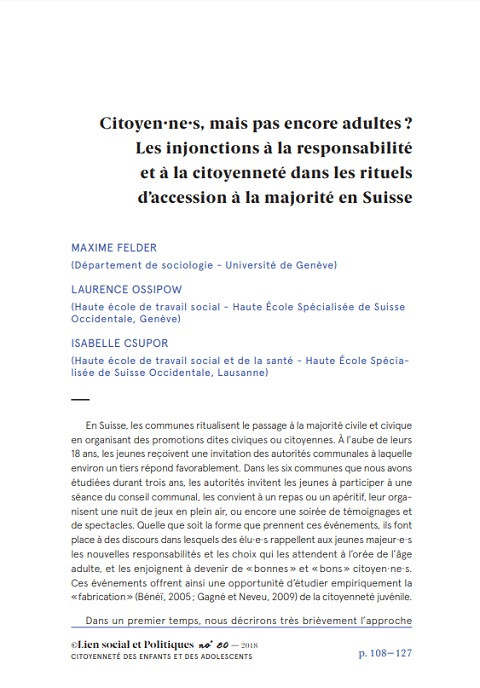 Citizens but Not Adults? Injunction to Be Responsible and Citizens in Official Coming of Age Rituals in Switzerland Год публикации: 2018 Автор: Maxime Felder | Laurence Ossipow | Isabelle Csupor Организация-автор: Lien social et Politiques Swiss municipalities organize ceremonies for their residents reaching the official age of full citizenship. In the six studied municipalities, local authorities invite them to a municipal council’s meeting, offer them a dinner or an aperitif, or organize them a show and a debate with role models. Speeches are central to these ceremonies, and authority representatives encourage their audience to be “good” citizens. Call to vote is the leitmotiv, but discourses reveal broader definitions of citizenship, insisting sometimes on a local commitment and volunteering, and sometimes on the necessity to fight climate change and inequalities. Comparing officials’ speeches to statements of young people participating in these events reveals “tensions”. Indeed, authority representatives address young citizens without considering them as fully adult, and they do not consider themselves as such neither. However, some of them are already involved in forms of vernacular citizenship, and are progressively leaving the municipality to study, work or travel. Ultimately, these ceremonies allow officials to stage their interest in the youth, which they consider as both uncompleted and essential to the renewal of democracy.
 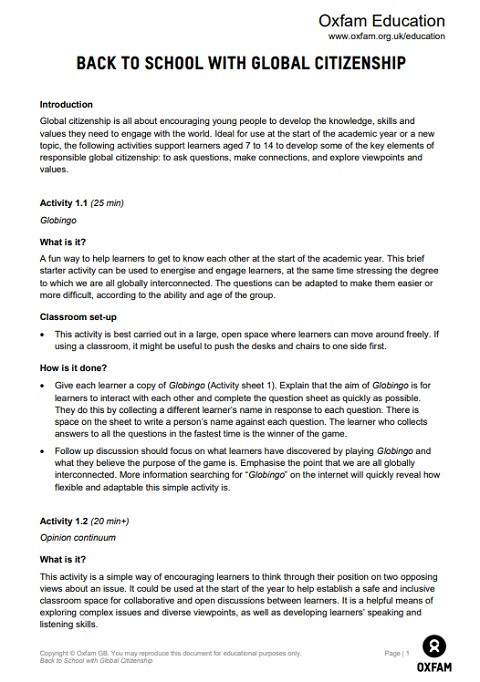 Back to School With Global Citizenship Организация-автор: Oxfam GB Global citizenship is all about encouraging young people to develop the knowledge, skills and values they need to engage with the world. Ideal for use at the start of the academic year or a new topic, the following activities support learners aged 7 to 14 to develop some of the key elements of responsible global citizenship: to ask questions, make connections, and explore viewpoints and values.
 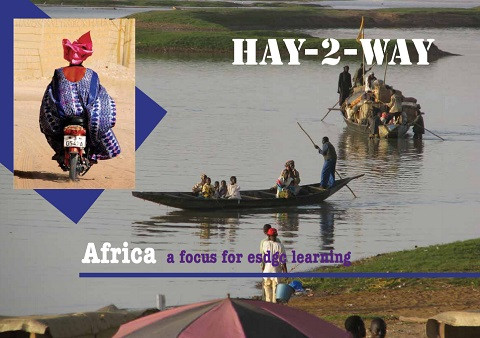 HAY-2-WAY: Africa; A Focus for ESDGC learning Год публикации: 2014 Автор: Scott Sinclair Организация-автор: Hay 2 Timbuktu This resource describes the education work that was part of the Two Towns One World project. It makes the case for an Africa focus as a significant theme in Education for Sustainable Development and global citizenship learning (ESDGC).The Two Towns One World project had two main strands: Locally in the Hay-on-Wye area with the Gwernfed cluster of schools and Nationally in Wales through a series of workshops and conferences.The scope of the work was enhanced through partnership with other initiatives on the themes ‘Unpacking Africa’ and ‘Debating Development’. A conference in Llandrindod Wells in November 2013 brought the strands of work together and provided the main narrative of this publication.
 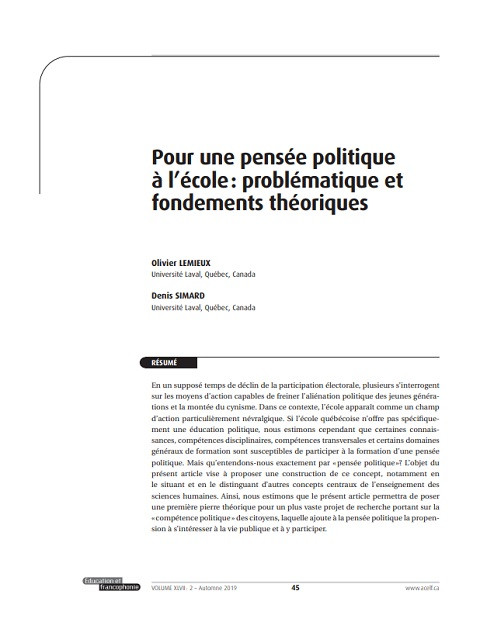 Political Thought at School: Problem and Theoretical Foundations Год публикации: 2019 Автор: Olivier Lemieux | Denis Simard Организация-автор: Éducation et francophonie At a time when voter turnout is apparently declining, many are wondering what actions to take to curb the political alienation and rise of cynicism among younger generations. In this context, the school seems to be an important nerve centre for action. Although Quebec schools do not specifically offer political education, we believe that some knowledge, subject-specific skills, cross-curricular competencies and general areas of training are likely to contribute to the formation of political thought. But what exactly do we mean by «political thought»? The purpose of this article is to propose a construction of this concept, notably by situating it and distinguishing it from other central concepts of human sciences. We therefore believe that this article will provide a theoretical foundation for a broader research project on citizens’ «political competence», which adds to political thought the tendency to take an interest in and participate in public life. Pour une pensée politique à l’école: Problématique et fondements théoriques Год публикации: 2019 Автор: Olivier Lemieux | Denis Simard Организация-автор: Éducation et francophonie En un supposé temps de déclin de la participation électorale, plusieurs s’interrogent sur les moyens d’action capables de freiner l’aliénation politique des jeunes générations et la montée du cynisme. Dans ce contexte, l’école apparaît comme un champ d’action particulièrement névralgique. Si l’école québécoise n’offre pas spécifiquement une éducation politique, nous estimons cependant que certaines connaissances, compétences disciplinaires, compétences transversales et certains domaines généraux de formation sont susceptibles de participer à la formation d’une pensée politique. Mais qu’entendons-nous exactement par «pensée politique»? L’objet du présent article vise à proposer une construction de ce concept, notamment en le situant et en le distinguant d’autres concepts centraux de l’enseignement des sciences humaines. Ainsi, nous estimons que le présent article permettra de poser une première pierre théorique pour un plus vaste projet de recherche portant sur la « compétence politique» des citoyens, laquelle ajoute à la pensée politique la propension à s’intéresser à la vie publique et à y participer.
 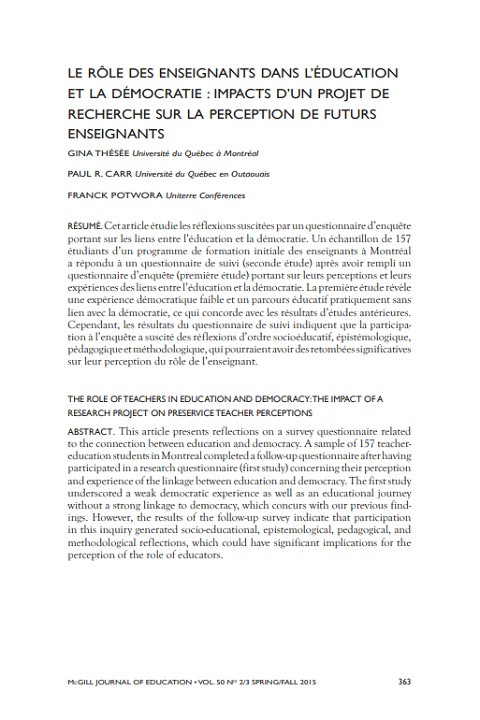 The Role of Teachers in Education and Democracy: The Impact of a Research Project on Preservice Teacher Perceptions Год публикации: 2015 Автор: Gina Thésée | Paul R. Carr | Franck Potwora Организация-автор: McGill University. Faculty of Education This article presents reflections on a survey questionnaire related to the connection between education and democracy. A sample of 157 teacher-education students in Montreal completed a follow-up questionnaire after having participated in a research questionnaire (first study) concerning their perception and experience of the linkage between education and democracy. The first study underscored a weak democratic experience as well as an educational journey without a strong linkage to democracy, which concurs with our previous findings. However, the results of the follow-up survey indicate that participation in this inquiry generated socio-educational, epistemological, pedagogical, and methodological reflections, which could have significant implications for the perception of the role of educators. Le rôle des enseignants dans l’éducation et la démocratie: Impacts d’un projet de recherche sur la perception de futurs enseignants Год публикации: 2015 Автор: Gina Thésée | Paul R. Carr | Franck Potwora Организация-автор: McGill University. Faculty of Education Cet article étudie les réflexions suscitées par un questionnaire d’enquête portant sur les liens entre l’éducation et la démocratie. Un échantillon de 157 étudiants d’un programme de formation initiale des enseignants à Montréal a répondu à un questionnaire de suivi (seconde étude) après avoir rempli un questionnaire d’enquête (première étude) portant sur leurs perceptions et leurs expériences des liens entre l’éducation et la démocratie. La première étude révèle une expérience démocratique faible et un parcours éducatif pratiquement sans lien avec la démocratie, ce qui concorde avec les résultats d’études antérieures. Cependant, les résultats du questionnaire de suivi indiquent que la participation à l’enquête a suscité des réflexions d’ordre socioéducatif, épistémologique, pédagogique et méthodologique, qui pourraient avoir des retombées significatives sur leur perception du rôle de l’enseignant.