
Ресурсы
Изучайте широкий спектр ценных ресурсов ВГГ, чтобы углубить своё понимание и повысить эффективность исследований, просветительской деятельности, преподавания и обучения.
Найдено: 661
 The 1994 Genocide as Taught in Rwanda’s Classrooms Год публикации: 2017 This blog looks at how textbook and curricula reforms in Rwanda have worked to cover the 1994 Genocide and instill the ideals of tolerance, unity and reconciliation in students. It is part of a series of blogs on this site published to encourage debates around a new GEM Report Policy Paper: Between the Lines, which looks at the content of textbooks and how it reflects some of the key concepts in Target 4.7 in the UN Sustainable Development Goals (SDGs).by Jean-Damascene Gasanabo, PhD, Director-General, Research and Documentation Center on Genocide, National Commission for the Fight against Genocide (CNLG), Kigali, Rwanda. The 1994 Genocide against the Tutsi saw the slaughter of more than one million people over the span of three months, and placed Rwanda at the forefront of the world’s political consciousness. Almost 23 years later, Rwanda has rebuilt and become a modern hub of progress and development, putting in place social, political and economic systems that are grounded in national unity and reconciliation – with education reforms playing a central role.The large-scale participation of children and adolescents in perpetrating acts of genocide made it clear that an education system that fails to integrate basic human values, will also inevitably fail the nation. Education was used prior to the Genocide to inculcate fear, intolerance and hatred; and so too is it being utilized by the current Government to foster peace and inclusivity, and combat genocide ideology. Post-genocide Rwanda has used education as a main tool to correct biased perceptions of its socio-political history, and to provide accurate representations of the root causes of the genocide, and preventative measures.With over 60% of Rwandans under the age of 24, the formal education system needs to instill the ideals of tolerance, unity and reconciliation in the next generation. With this realization, the Rwanda Education Board and the Ministry of Education have integrated genocide studies in the curricula of its primary, secondary and higher education institutions so that they are better able to lead a nation that is cognizant of its past. Instead of highlighting difference, the national curriculum of post-genocide Rwanda has been reconfigured to emphasize the politics of inclusion and to encourage a spirit of critical thinking that pursues peace, social cohesion and harmony above all else.Prior to the Genocide, educational resources were used as a tool by the genocidal regime to promote ethnic division, discrimination and propaganda. The biased curricula and teaching methods cemented ethnic segregation within classrooms and fostered genocide ideology. The students who were not expelled from primary and secondary school due to the ethnic and regional quota system were forced to identify themselves as being Tutsi – inherently separate to those who were Hutu or Twa. The pre-1994 curriculum lacked “the essentials of human emotion, attitudes, values and skills” as it continued to promote discriminatory and divisive ideologies that were “imparted through formalized rote learning in history, civic education, religious and moral education and languages.”Post-Genocide Rwanda faced the herculean task of rebuilding its dismantled institutions. With a profound lack of qualified teachers, a huge pool of orphaned children, insufficient funds and inaccurate textbooks following the genocide, many education challenges lay ahead. In early 1995, a moratorium was placed on history textbooks which disseminated biased information, as the country grappled with how and to what extent the nation’s past could be incorporated constructively in the education system, without causing pain or resurfacing conflicts.Rwanda chose a gradual, yet comprehensive, approach. In the years immediately following the Genocide, the history curriculum lightly touched on the subject so as to protect students from their recent past, and prevent division in classrooms based on differing family experiences. Classrooms promoted knowledge based on the essential ideas of unity, peace, tolerance and justice. In 2008 the National Curriculum Development Centre within the Ministry of Education published the new history curriculum which incorporated the Genocide against the Tutsi, coinciding with the renewed emphasis on the unifying and inclusive qualities of nationality, citizenship and patriotism, instead of ethnicity.The current national curriculum was formulated by the Rwanda Education Board in conjunction with varying public institutions, UN agencies and nongovernmental organizations. It incorporates the Genocide into the curriculum of every grade level, and discusses it in various contexts suited to the student’s particular stage in learning. Eyewitness accounts and the presence of elders in the classroom allow for a “multi-generational opportunity” for learning. In understanding how violent conflict erupts in society, it is possible to prevent future atrocities from beginning. Teaching the Genocide in present-day Rwanda aims to provide a more nuanced understanding of the event by using primary sources, encouraging class discussions on genocide denial, the persistence of genocide ideology, and the reconciliation efforts embarked on after the Genocide.Moreover, this change in the curriculum has been supplemented by a shift to transform learning from one based on standard rote memorization to one that encourages discussion and a spirit of critical thinking and analysis. This approach identifies the student as an active participant in the learning experience, not merely a silent recipient of history as “evangelical speech.” By promoting an environment that encourages spirited, objective discussions, the Ministry of Education seeks to redress the biases taught by the genocidal regime, as well as prepare young people to thoughtfully and constructively enter the workforce.Genocide education nevertheless faces some challenges ahead. With genocide denial still present, not only are ongoing revisions of educational resources required, but teacher training is also necessary to ensure that revisions to the curriculum are well presented by teachers.The way conflict and genocide has been taught through textbooks in Rwanda has evolved over time. For Rwandans, learning about the 1994 Genocide is not only vital in understanding the history of their country, but also in developing critical thinking skills that help young people become informed citizens in today’s globalized society. Peace education, as well as tools for conflict resolution and genocide prevention, are now heavily featured. Indeed the initiatives embarked on by the education sector signal a promising start to the continuous pursuit of truth through knowledge of the past.In comprehensively integrating the study of genocide into the national curriculum and by empowering students to become agents of their own learning process, Rwanda offers an ambitious recipe for successfully teaching one’s own history for the better.
 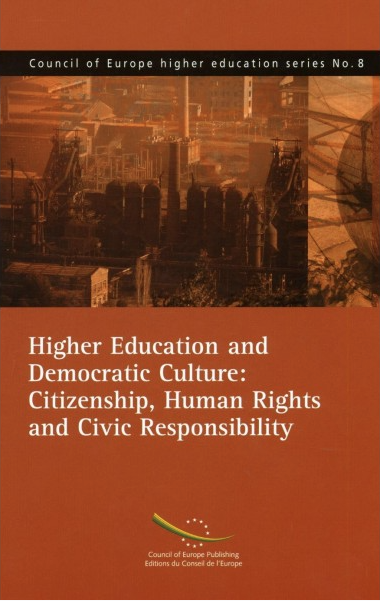 Higher Education and Democratic Culture: Citizenship, Human Rights and Civic Responsibility (Council of Europe Higher Education Series No.8) Год публикации: 2008 Автор: Josef Huber | Ira Harkavy Организация-автор: Council of Europe This book on the responsibility of higher education for a democratic culture is the 8th volume in the Council of Europe's Higher Education series. It is the direct result of a Higher Education Forum held in June 2006 on the responsibility of higher education for citizenship, human rights and sustainability. This forum was a part of the Council of Europe's long-standing commitment to work in the area of education for democratic citizenship and human rights. It complements earlier work on the public responsibility for higher education and research which led to a recommendation of the Committee of Minister to the member states of the Council of Europe in 2007. If our aim is to work for sustainable democratic societies, the responsibility of public authorities for a high-quality higher education system must go hand in hand with the responsibility of higher education institutions towards the advancement of society.
  Discours de Mme Irina Bokova, Directrice générale de l'UNESCO, à l'occasion de l'ouverture de laconférenceinternationale sur l'enseignement supérieur pour le développement durable: Au-delà de l'enseignement supérieur 2014 Год публикации: 2014 Организация-автор: UNESCO. Director-General, 2009-2017 (Bokova, I.G.) Cette adresse a été faite par Irina Bokova, Directrice générale de l'UNESCO, à l'occasion de l'ouverture de la conférence internationale sur l'enseignement supérieur pour le développement durable: Au-delà de l'enseignement supérieur 2014. Address by Irina Bokova, Director-General of UNESCO, on the occasion of the Opening of the International Conference on Higher Education for Sustainable Development: Higher Education Beyond 2014; Nagoya University, Aichi, Japan, 9 November 2014 Год публикации: 2014 Организация-автор: UNESCO. Director-General, 2009-2017 (Bokova, I.G.) This address had been made by Irina Bokova, Director-General of UNESCO, on the occasion of the opening of the International Conference on Higher Education for Sustainable Development: Higher Education Beyond 2014.
 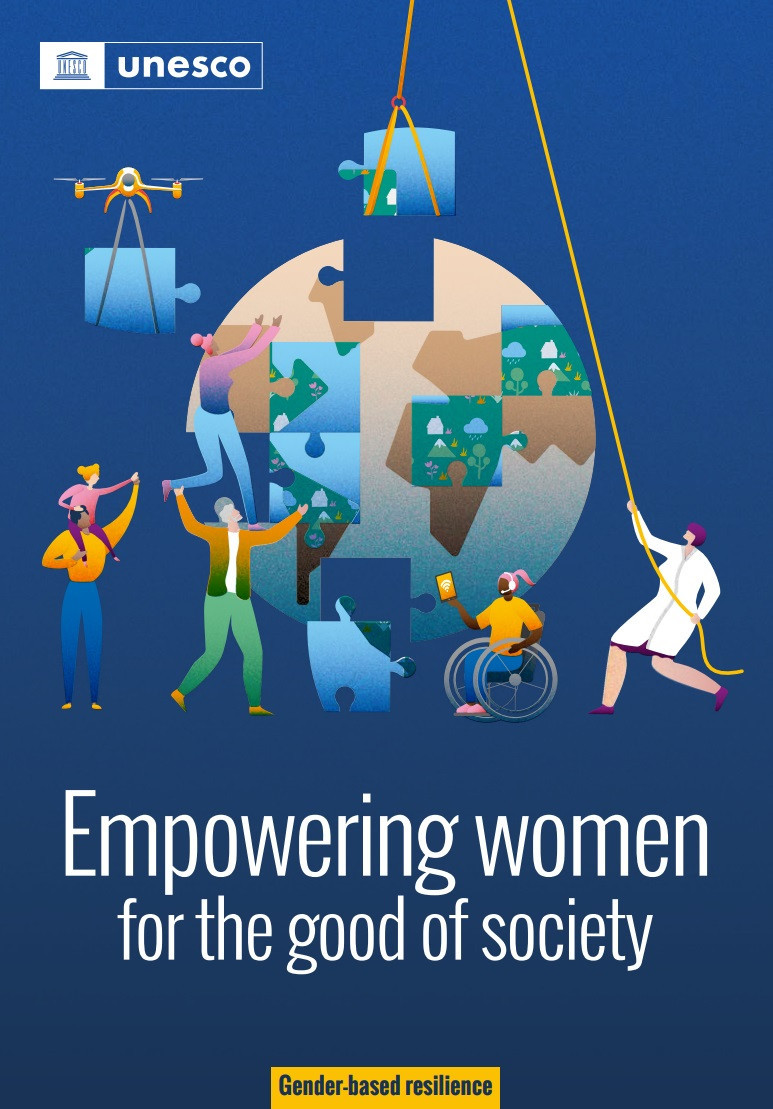 Empowering women for the good of society: gender-based resilience Год публикации: 2023 Автор: Squicciarini, Mariagrazia | Sarlat, Garance | Manca, Anna Rita Организация-автор: UNESCO <Short Summary> Let’s change the resilience paradigmWhat are the root causes and drivers of resilience? Societal resilience is shaped by the unique roles that individuals play and their ability to respond to shocks, gender-based expectations and discriminations hinder women’s and girls’ ability to participate in, and contribute to, society. In times of crises, their vulnerability intensifies resulting in a weakened response that ripples throughout society.In response, UNESCO designed the first Gender-Based Resilience Framework. As a compass for inclusive policymaking, this report analyzes how differences in opportunities, needs and constraints impact resilience and proposes a measurement Framework based on: (1) fundamental human rights; (2) socioeconomic characteristics, such as health, education, work, political engagement, and climate justice; (3) contextual factors, such as values and perceptions.Moving beyond the standard approach of coping with and recovering from shocks; UNESCO calls for a gender-transformative resilience, which leverages the interrelations between individuals and institutions. Decision- and policy-makers, researchers, and gender equality advocates are invited to use and add to this Framework to effectively navigate through current and future crises.It is only by empowering all women and girls, and people of all genders, that we will be able to face the challenges ahead.
 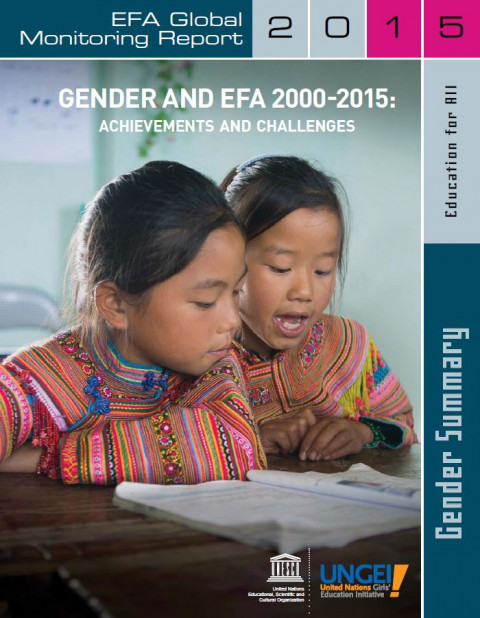 [Summary] Gender and EFA 2000-2015: Achievements and Challenges; EFA Global Monitoring Report 2015; Gender Summary Год публикации: 2015 Организация-автор: Global Education Monitoring Report Team This report describes an array of country efforts, some quite effective, to achieve and go beyond gender parity in education. Many of these policies and programmes focus on the immediate school environment in which girls learn. Others focus on the informal and formal laws, social norms and practices that deny girls their right of access to, and completion of, a full cycle of quality basic education. The analyses and key messages in Gender and EFA 2000–2015: Achievements and Challenges deserve careful scrutiny as the world embarks on a universal, integrated and even more ambitious sustainable development agenda in the years to come.
 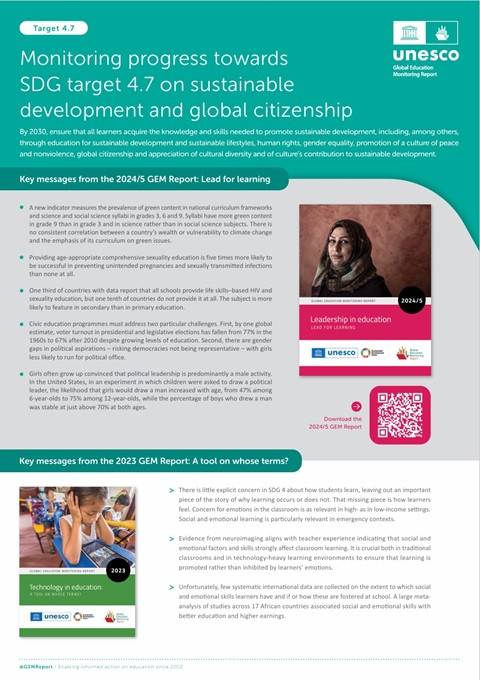 Monitoring Progress towards SDG Target 4.7 on Sustainable Development and Global Citizenship Год публикации: 2024 Организация-автор: UNESCO | Global Education Monitoring Report Team This document introduces key messages from the GEM Reports and other related publications and online resources regarding the progress towards SDG Target 4.7.
 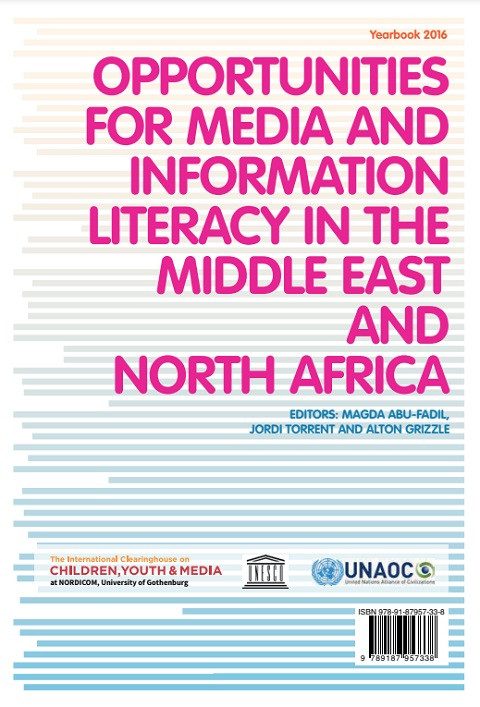 Opportunities for Media and Information Literacy in the Middle East and North Africa: Yearbook 2016 Год публикации: 2016 Автор: Magda Abu-Fadil | Jordi Torrent | Alton Grizzle Организация-автор: International Clearinghouse on Children, Youth and Media (Sweden) Opportunities for Media and Information Literacy in the Middle East and North Africa is the seventeenth Yearbook published by the Clearinghouse and fills a gap in the existing body of literature about the progress of media and information literacy work in different parts of the world. This book also helps educators in the Middle East and North Africa region looking for opportunities to bring to their classrooms elements of MIL education.
 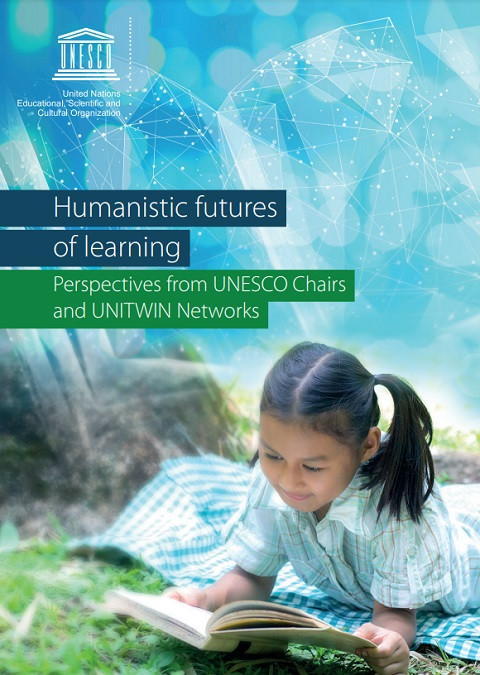 Humanistic Futures of Learning: Perspectives from UNESCO Chairs and UNITWIN Networks Год публикации: 2020 Организация-автор: UNESCO UNESCO’s Futures of Education initiative aims to rethink education and shape the future. The initiative is catalyzing a global debate on how knowledge, education and learning need to be reimagined in a world of increasing complexity, uncertainty and precarity. This publication presents the first curated input to the Futures of Education initiative from the UNITWIN/UNESCO Chairs Programme, which now represents an extensive global network of more than 800 higher education institutions in over 115 countries. It features think pieces that highlight key dimensions to be considered in re-visioning and re-purposing education for the future of humanity and the planet. The collection of the pieces calls for greater focus on a number of critical areas such as: The role of culture in strengthening social and environmental sustainability; the values and attitudes that are needed to shape future generations; the importance of both robust public education, as well as of other learning spaces; the need to strengthen human creativity and capability in the digital era, as well as the role of higher education in generating the knowledge and driving the innovation required to transform our world. Les futurs humanistes de l’apprentissage: Perspectives des chaires UNESCO et des réseaux UNITWIN Год публикации: 2020 Организация-автор: UNESCO L’initiative de l’UNESCO intitulée Les futurs de l’éducation vise à repenser l’éducation et à façonner l’avenir, en lançant un débat mondial sur la manière de réinventer le savoir, l’éducation et l’apprentissage dans un monde de plus en plus complexe, incertain et précaire. Le présent volume constitue la première collection de contributions soumises à l’initiative Les Futurs de l’éducation de l’UNESCO par le Programme des chaires UNESCO/UNITWIN, un vaste réseau mondial regroupant plus de 800 établissements d’enseignement supérieur dans plus de 115 pays. Les documents de réflexion qu’il contient mettent en évidence les dimensions essentielles à prendre en compte pour ré-imaginer et redéfinir l’éducation dans l’intérêt de l’avenir de l’humanité et de la planète. Cette collection appelle à insister davantage sur un certain nombre de domaines critiques tels que le rôle de la culture dans le renforcement de la durabilité sociale et environnementale, les valeurs et les attitudes nécessaires pour préparer les générations futures, l’importance d’une éducation publique et robuste, ainsi que d’autres espaces d’apprentissage, la nécessité de renforcer la créativité et les capacités humaines à l’ère numérique, ainsi que le rôle de l’enseignement supérieur concernant la génération des savoirs et la conduite de l’innovation nécessaire pour transformer notre monde.