
Ресурсы
Изучайте широкий спектр ценных ресурсов ВГГ, чтобы углубить своё понимание и повысить эффективность исследований, просветительской деятельности, преподавания и обучения.
Найдено: 1,445
 Образование в интересах устойчивого развития: Партнеры в действии; Доклад ключевых партнеров по Глобальной программе действий (ГПД) (2015-2019 гг.) Год публикации: 2019 Организация-автор: UNESCO По итогам Десятилетия образования в интересах устойчивого развития (ОУР) Организации Объединенных Наций ЮНЕСКО предприняла осуществление Глобальной программы действий (ГПД) по ОУР в целях содействия устойчивому развитию и расширению масштабов действий в сфере ОУР во всех областях образования и обучения. Время осуществления программы – с 2015 г. по 2019 г. ЮНЕСКО развернула сотрудничество с сетью из 97 ключевых партнеров по ГПД, представляющих правительство, гражданское общество, частный сектор и академические круги. Деятельность осуществлялась в пяти приоритетных областях: разработка политики, преобразование учебной среды, создание потенциала преподавателей, расширение прав и возможностей молодежи и содействие принятию устойчивых решений на местном уровне. Ключевые партнеры по ГПД взяли на себя обязательство выполнить к 2019 г. ряд конкретных задач. Было разработано десять целевых показателей – по два для каждой приоритетной области деятельности. Ключевые партнеры по ГПД представили информацию о прогрессе в достижении этих показателей, ответив на три опроса, которые ЮНЕСКО направила им в ходе осуществления программы. Ключевым партнерам было также предложено оценить преимущества, полученные ими самими благодаря участию в ГПД, и представить данные качественного характера о ходе работы. Достигнутым успехам были посвящены три доклада: первый доклад, охватывающий период 2015-2016 гг., был выпущен ЮНЕСКО в 2017 г.; второй доклад, охватывающий период 2015-2018 гг., был опубликован в 2019 г.; настоящий доклад, третий и заключительный, охватывает весь период осуществления ГПД с 2015 г. по 2019 г. В этом докладе содержится анализ количественных данных, представленных ключевыми партнерами по ГПД по каждому из десяти показателей. На основе качественных ответов, представленных ключевыми партнерами по ГПД, в докладе также дается краткий комментарий о ходе работы над каждым показателем.В заключительной части доклада содержатся некоторые выводы, касающиеся осуществления ГПД, которые могут послужить информационной основой для реализации новых рамочных принципов деятельности в области ОУР на период 2020-2030 гг. под названием «Образование в интересах устойчивого развития: на пути к достижению ЦУР (ОУР на период до 2030 г.)».
  Enforcing the right to education of refugees: a policy perspective Год публикации: 2019 Организация-автор: UNESCO This paper, aimed at education policymakers, provides analysis and insights on how the right to education for refugees could be ensured from a policy perspective. It does so by reviewing the current status of access to education of refugees, using the scant data that is available in this area. It also outlines some of the extensive barriers to education that refugees face, with recognition of the multifaceted, interlinked and complex nature of exclusion. It provides an overview of the international normative frameworks and global agendas on education that can be applied to refugees to ensure their right to education and achieve SDG 4. Additionally, this document presents practical examples, good practices, and promising measures taken by countries in order to ensure the inclusion of refugees in their national systems and better guarantee the fulfilment of their right to education. As a result of this research, collaboration and the invaluable contributions from the participants in a dedicated Expert Meeting in Barcelona (2018), a set of policy recommendations are provided in the last chapter which aims to guide policymakers to ensure equal access to good quality education for refugees.
 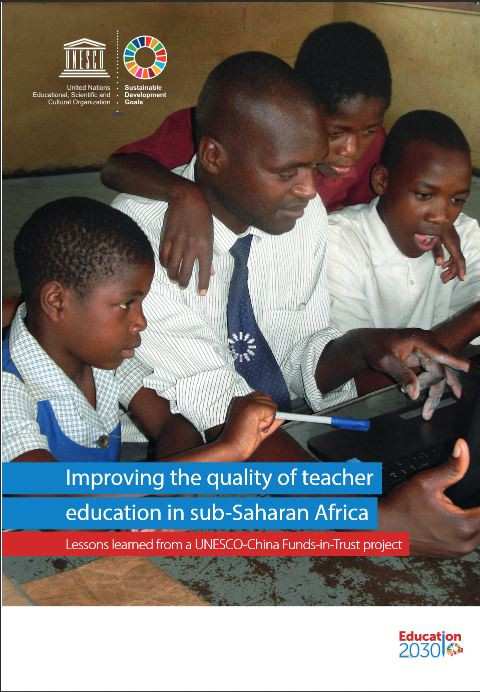 Improving the quality of teacher education in Sub-Saharan Africa: lessons learned from a UNESCO-China Funds-in-Trust project Год публикации: 2018 Организация-автор: UNESCO The booklet describes how the project started, the choice of beneficiary countries, the implementation strategies and its achievements. The different sections numbered one to four describe particular aspects of the project, using country cases to illustrate how the success of the project was due to strong country ownership and leadership. UNESCO, in partnership with the Government of the People’s Republic of China, initiated the project to enhance the institutional capacity and the professional development of teacher educators through ICT-supported learning, teaching and research. This technology aided the transformation of capacity teacher training through digitalization of instructional materials.
  I'd blush if I could: closing gender divides in digital skills through education Год публикации: 2019 Автор: Mark West | Rebecca Kraut | Han Ei Chew Организация-автор: UNESCO | EQUALS Skills Coalition This publication seeks to expose some of these biases and put forward ideas to begin closing a digital skills gender gap that is, in most parts of the world, wide and growing. Today, women and girls are 25 per cent less likely than men to know how to leverage digital technology for basic purposes, 4 times less likely to know how to programme computers and 13 times less likely to file for a technology patent. Ata moment when every sector is becoming a technology sector, these gaps should make policy-makers, educators and everyday citizens ‘blush’ in alarm. The publication explains the role gender-responsive education can play to help reset gendered views of technology and ensure equality for women and girls. This publication was prepared by UNESCO for the EQUALS Skills Coalition, one of three coalitions that comprise the EQUALS partnership. EQUALS is a global partnership of governments and organizations dedicated topromoting gender balance in the technology sector by championing equality of access, skills and leadership for women and men alike. The Skills Coalition, Access Coalition, Leadership Coalition and a transversal Research Group release knowledge products periodically, organize competitions and funds, and take actions in countries and internationally to advance EQUALS’smission. The German Federal Ministry for Economic Cooperation and Development (BMZ) generously supported this publication financially and co-leads the EQUALS Skills Coalition with UNESCO. A dedicated working group composed of digital skills and gender experts guided the development of the content.
 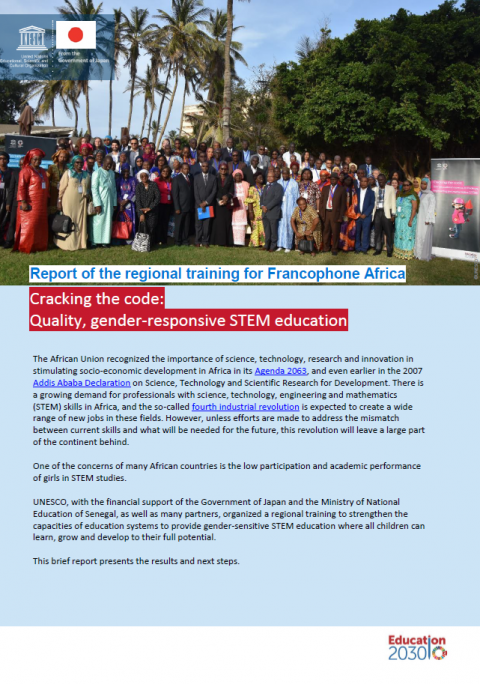 Report of the regional training for Francophone Africa, cracking the code: quality, gender-responsive STEM education Год публикации: 2019 Организация-автор: UNESCO The African Union recognized the importance of science, technology, research and innovation in stimulating socio-economic development in Africa in its Agenda 2063, and even earlier in the 2007 Addis Ababa Declaration on Science, Technology and Scientific Research for Development.There is a growing demand for professionals with science, technology, engineering and mathematics (STEM) skills in Africa, and the so-called fourth industrial revolution is expected to create a wide range of new jobs in these fields. However, unless efforts are made to address the mismatch between current skills and what will be needed for the future, this revolution will leave a large part of the continent behind.One of the concerns of many African countries is the low participation and academic performance of girls in STEM studies. UNESCO, with the financial support of the Government of Japan and the Ministry of National Education of Senegal, as well as many partners, organized a regional training to strengthen the capacities of education systems to provide gender-sensitive STEM education where all children can learn, grow and develop to their full potential. This brief report presents the results and next steps.
 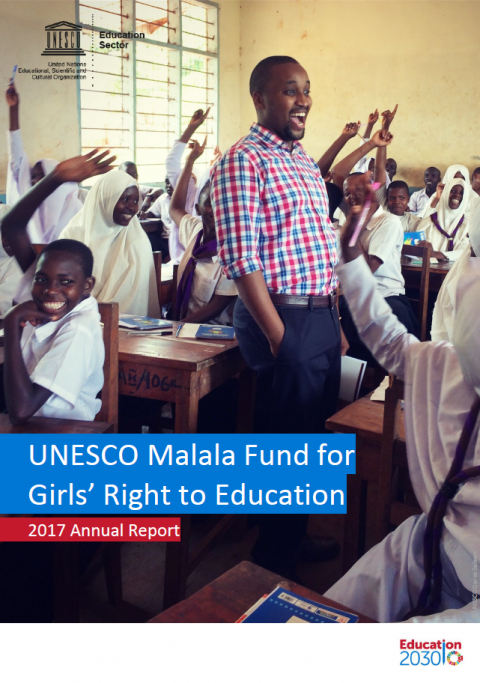 UNESCO Malala Fund for Girls' Right to Education: 2017 annual report Год публикации: 2018 Организация-автор: UNESCO The brutal assassination attempt made against Pakistani teenager and activist for girls’ education Malala Yousafzai gave birth to the UNESCO Malala Fund for Girls’ Right to Education. Part of the “Better Life, Better Future” Global Partnership for Girls’ and Women’s Education, the fund was established in 2012 to expand girls’ access to quality and gender-responsive education and ensure safe learning environments, especially in countries affected by conflict and disaster. The Islamic Republic of Pakistan initially committed 10 million USD to the Fund, and since 2014 the CJ Group is another major contributor to the Fund, along with other supporters.Fund objectivesThe Fund supports the implementation of holistic programmes which aim to: Expand access to education for girls and women, especially those hardest to reach and affected by conflict and disaster Improve the quality and relevance of education, ensuring that content, teaching practices, learning processes and environments are gender-sensitive Strengthen policy and capacity to ensure safe learning environments Education for Sustainable Development: Partners in Action; Global Action Programme (GAP) Key Partners' Report (2015-2018) Год публикации: 2019 Организация-автор: UNESCO The Global Action Programme (GAP) on Education for Sustainable Development (ESD) was launched by UNESCO as a follow up to the United Nations Decade of ESD in order to accelerate progress on sustainable development and scale up action in all areas of education and learning. Its duration is from 2015 to 2019.To that end, UNESCO works with a network of 97 GAP Key Partners from government, civil society, the private sector and academia active in five Priority Action Areas: advancing policy, transforming learning environments, building the capacity of educators, empowering youth, and accelerating sustainable solutions at the local level. Each GAP Key Partner committed to meet specific targets by 2019. To measure progress in meeting the targets set by the GAP Key Partners, 10 indicators were identified, two in each Priority Action Area. Through surveys sent to them by UNESCO, GAP Key Partners report against these 10 indicators and toward the targets set for each indicator. In the surveys, GAP Key Partners are also invited to rate the benefits of participation in the GAP for their work and provide qualitative data concerning their implementation progress. Three progress reports are scheduled to be produced: The first report, covering progress between 2015 and 2016, was released by UNESCO in 2017 This second report, covering 2015-2018, is to be published in 2019 The third and final report, covering the entire period of the GAP, 2015-2019, will be published in 2020 This second report presents the results of the GAP Key Partners survey carried out at the end of 2018, with a response rate of 78%. The report presents the analysis of the quantitative responses of GAP Key Partners to each of the 10 indicators. Based on the qualitative responses provided by the GAP Key Partners, a short comment on each of the progress status is also provided. Éducation en vue du développement durable: Partenaires dans l’action; Rapport des partenaires clés du Programme d’action global (2015-2019) Год публикации: 2019 Организация-автор: UNESCO Le Programme d’action global pour l’éducation en vue du développement durable (EDD) a été lancé par l’UNESCO dans le cadre du suivi de la Décennie des Nations Unies pour l’éducation au service du développement durable afin de donner un coup d’accélérateur à la réalisation des objectifs de développement durable et d’intensifier l’action en faveur de l’EDD dans tous les domaines de l’éducation et de l’apprentissage. Le Programme a été mis en œuvre entre 2015 et 2019. L’UNESCO a travaillé avec un réseau constitué des 97 partenaires clés du Programme d’action global. Issus des gouvernements, de la société civile, du secteur privé et de l’université, ces partenaires interviennent dans cinq domaines d’action prioritaires : promouvoir des politiques, transformer les environnements d’apprentissage, renforcer les capacités des éducateurs, autonomiser les jeunes et accélérer la recherche de solutions durables à l’échelle locale. Les partenaires clés du Programme d’action global se sont engagés à atteindre des objectifs précis en 2019. Dix indicateurs, soit deux par domaine d’action prioritaire, ont été définis.Les partenaires clés du Programme d’action global ont rendu compte des progrès accomplis au regard de ces indicateurs à l’aide des trois enquêtes que l’UNESCO leur a envoyées au cours de la mise en œuvre du Programme.Les partenaires clés ont par ailleurs été invités à évaluer en quoi leur participation au Programme d’action global avait été bénéfique à leurs activités et à fournir des données qualitatives sur le déroulement de la mise en œuvre. Trois rapports d’étape ont ainsi été produits : le premier rapport, relatif aux progrès accomplis en 2015 et 2016, a été publié par l’UNESCO en 2017 ; le second, qui concerne la période de 2015 à 2018, est paru en 2019 ; le troisième et dernier rapport (le présent document) couvre l’ensemble de la période de mise en œuvre du Programme d’action global, de 2015 à 2019. Le présent rapport livre une analyse des données quantitatives fournies par les partenaires clés du Programme d’action global pour chacun des dix indicateurs. En s’appuyant sur ces données quantitatives, il indique brièvement quels ont été les progrès réalisés par rapport aux indicateurs. On trouvera en conclusion de ce bref rapport quelques-uns des enseignements tirés du Programme d’action global qui pourront utilement guider la mise en œuvre du nouveau cadre global établi pour la période 2020-2030, L’éducation en vue du développement durable : vers la réalisation des ODD (L’EDD pour 2030).
  Proposal for a Global Action Programme on Education for Sustainable Development as Follow-up to the United Nations Decade of Education for Sustainable Development (DESD) after 2014 Год публикации: 2013 Организация-автор: UNESCO The present document contains the proposal for a Global Action Programme on Education for Sustainable Development (ESD) and the comments and observations of the Executive Board thereon.
  برنامج الملك عبد الله بن عبد العزيز الدولي لثقافة السلام والحوار: أهم منجَزات المرحلة الأولى Год публикации: 2016 Организация-автор: منظمة الأمم المتحدة للتربية والعلم والثقافة (UNESCO) انبثق برنامج الملك عبد الله بن عبد العزيز الدولي لثقافة السلام والحوار من الإطار المؤسسي لبرنامج اليونسكو لثقافة السلام واللاعنف.إن ثقافة السلام لا تقتصر على كونها مفهوماً بل تتعداه إلى كونها التزاماً بجعل السلام واقعاً ملموساً للجميع. فهي تعبِّ عن “مجموعة من القيم والمواقف والتقاليدوأنماط السلوك وأساليب الحياة تستند إلى [...] احترام الحياة وإنهاء العنف [... و] التمسك بمبادئ الحرية والعدل والديمقراطية والتسامح والتضامنوالتعاون والتعددية والتنوع الثقافي والحوار والتفاهم على مستويات المجتمع كافة وفيما بين الأمم” (المادة 1 من إعلان وبرنامج العمل بشأن ثقافة السلام،اليونسكو، 1999 ). وتثابر اليونسكو على العمل لغرس ثقافة السلام مع مراعاة اعتبارات التنمية، بمضافرة القوى مع أصحاب المصلحة الملتزمين فيمجال التربية والعلوم والثقافة، والاتصال والإعلام.