
Ресурсы
Изучайте широкий спектр ценных ресурсов ВГГ, чтобы углубить своё понимание и повысить эффективность исследований, просветительской деятельности, преподавания и обучения.
Найдено: 1,445
 The King Abdullah bin Abdulaziz International Programme for a Culture of Peace and Dialogue: Key Achievements of Phase I Год публикации: 2016 Организация-автор: UNESCO The King Abdullah bin Abdulaziz International Programme for a Culture of Peace and Dialogue arose from the institutional framework of UNESCO’s Programme for a Culture of peace and non-violence. More than a concept, the Culture of Peace is a commitment to make peace a tangible reality for all. It denotes “a set of values, attitudes, traditions and modes of behaviour and ways of life based on respect for life, ending of violence and […] adherence to the principles of freedom, justice, democracy, tolerance, solidarity, cooperation, pluralism, cultural diversity, dialogue and understanding at all levels of society and among nations” (Article 1, Declaration and Programme of Action of a Culture of Peace, UNESCO, 1999). UNESCO continue its work to nurture a Culture of Peace, with development considerations, by joining forces with committed stakeholders in education, the sciences, culture, and communication and information.
 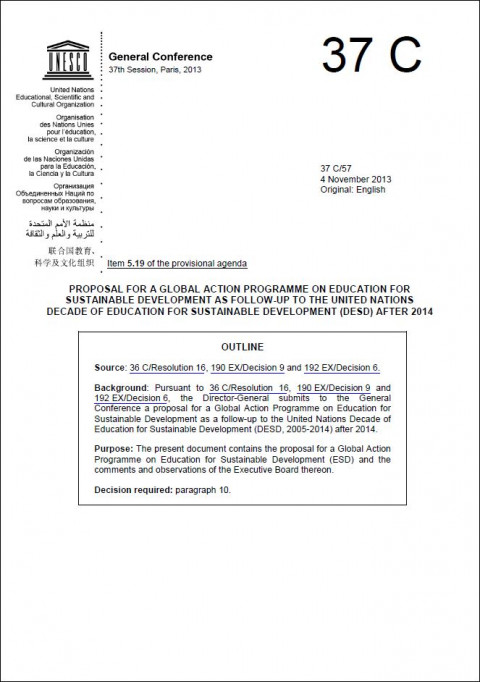 Предложение в отношении Глобальной программы действий по образованию в интересах устойчивого развития в качестве последующей деятельности по итогам Десятилетия образования в интересах устойчивого развития (ДОУР) Организации Объединенных Наций в период после 2014 г. Год публикации: 2013 Организация-автор: UNESCO Настоящий документ содержит предложение в отношении Гло-бальной программы действий по образованию в интересах устойчивого развития (ОУР), а также комментарии и замечания Исполнительного со-вета.
 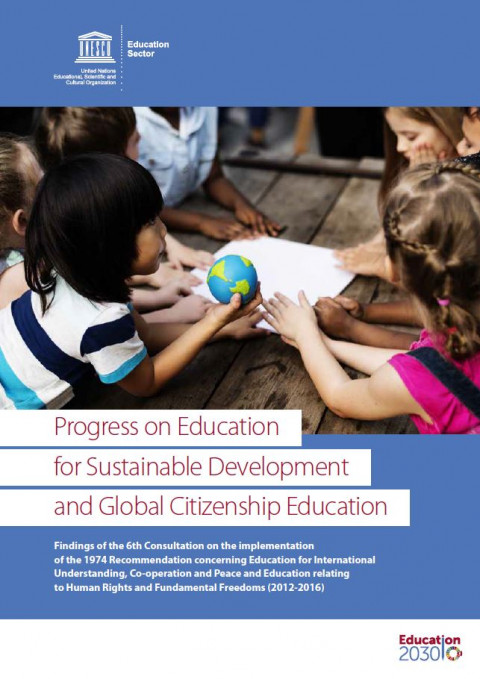 Progress on Education for Sustainable Development and Global Citizenship Education: Findings of the 6th Consultation on the Implementation of the 1974 Recommendation Год публикации: 2018 Организация-автор: UNESCO Findings of the 6th Consultation on the implementation of the 1974 Recommendation concerning Education for International Understanding, Co-operation and Peace and Education relating to Human Rights and Fundamental Freedoms (2012-2016) Progress on Education for Sustainable Development and Global Citizenship Education “The Recommendation concerning Education for International Understanding, Co-operation and Peace and Education relating to Human Rights and Fundamental Freedoms” was adopted by UNESCO’s General Conference at its 18th session in 1974. Every four years, Member States report to UNESCO on measures taken to implement the Recommendation in pre-primary, primary, secondary and post-secondary/tertiary education. This document summarizes and analyses the main findings of the 6th Consultation on the implementation of the 1974 Recommendation, covering the period of 2012 to 2016. The findings of the 6th Consultation provide important insight into how Member States are implementing the 1974 Recommendation as well as how they are progressing towards Target 4.7 of Sustainable Development Goal 4 on Education. Target 4.7 concerns Education for Sustainable Development and Global Citizenship Education, which are closely related to the 1974 Recommendation. Supporting Member States in implementing Target 4.7 is a UNESCO priority and essential to progress across the 2030 Agenda for Sustainable Development. Avances en la educación para el desarrollo sostenible y la educación para la ciudadanía mundial: resultados de la sexta consulta sobre la aplicación de la Recomendación sobre la Educación para la Comprensión Год публикации: 2018 Организация-автор: Organización de las Naciones Unidas para la Educación, la Ciencia y la Cultura (UNESCO) Hallazgos de la 6ta consulta sobre la implementación de la Recomendación de 1974 sobre Educación para la Comprensión, la Cooperación y la Paz Internacionales y la Educación relativa a los Derechos Humanos y a las Libertades Fundamentales (2012-2016). Progresos en Educación para Desarrollo Sostenible y Educación para la Ciudadanía Mundial “La Recomendación concerniente a la Educación para Comprensión, Cooperación y Paz internacional y Educación relativa a los Derechos Humanos y a las Libertades Fundamentales” fue adoptada en la Conferencia General de la UNESCO en su 18ava sesión de 1974. Cada cuatro años, los Estados Miembros reportan a la UNESCO sobre las medidas llevadas a cabo para implementar la Recomendación en los niveles preescolares, primario, secundario y post-secundario/terciario de educación. Este documento resume y analiza los hallazgos principales de la 6ta Consulta sobre la implementación de la Recomendación de 1974, cubriendo el período de 2012 a 2016. Los hallazgos de la 6ta Consulta proporcionan información importante sobre cómo los Estados Miembros están implementando la Recomendación de 1974, y de cómo están progresando hacia la Meta 4.7 del Objetivo de Desarrollo Sostenible 4 en Educación. La Meta 4.7 concierne a la Educación para el Desarrollo Sostenible y la Educación para la Ciudadanía Mundial, que están muy ligadas a la Recomendación de 1974. El apoyo a los Estados Miembros en la implementación de la Meta 4.7 es una prioridad para la UNESCO dado que es esencial para progresar hacia los objetivos de la Agenda 2030 para Desarrollo Sostenible. (Avances en la educación para el desarrollo sostenible y la educación para la ciudadanía mundial: resultados de la sexta consulta sobre la aplicación de la Recomendación sobre la Educación para la Comprensión, la Cooperación y la Paz Internacionales y la Educación relativa a los Derechos Humanos y las Libertades Fundamentales, de 1974 (2012-2016)) 지속가능발전교육과 세계시민교육의 진전: 1974년 「국제이해, 협력, 평화를 위한 교육과 인권, 기본 자유에 관한 교육 권고」의 이행(2012-2016년)에 관한 제6차 설문조사 결과 Год публикации: 2018 Организация-автор: 유네스코 「국제이해, 협력, 평화를 위한 교육과 인권, 기본 자유에 관한 교육 권고」(Recommendation concerning Education for International Understanding, Cooperation and Peace and Education relating to Human Rights and Fundamental Freedoms, 이하 1974년 권고안)는 1974년 제18차 유네스코 총회에서 채택되었다. 유네스코 회원국들은 매 4년마다 유아, 초등, 중등, 중등 이후/고등 분야 교육 내 1974년 권고안 이행 조치에 대해 유네스코에 보고한다. 이 보고서는 2012년부터 2016년까지의 1974년 권고안 이행 현황에 대한 제6차 설문조사1) (이하 제6차 설문조사) 결과를 요약·분석하고 있다. 제 6차 설문조사 결과는 회원국들이 지속가능발전목표(Sustainable Development Goal, SDGs) 내 교육 관련 목표(SDG 4) 중 세부목표 4.7을 달성하는 데 어떠한 진전이 있었는지, 그리고 1974년 권고안을 어떻게 이행하고 있는지 판단하기 위해 필요한 통찰력 있는 시각을 제공한다. 세부목표 4.7은 1974년 권고안과 밀접한 연관이 있는 지속가능발전교육(Education for Sustainable Development, ESD) 및 세계시민교육(Global Citizenship Education, GCED)과 관련이 있다(참고1). 세부목표 4.7의 이행을 위한 회원국들의 지원은 유네스코의 우선 순위이자, 지속가능발전을 위한 교육 2030 의제 전반에 걸쳐 진척을 이루는 데 필수적이다.
 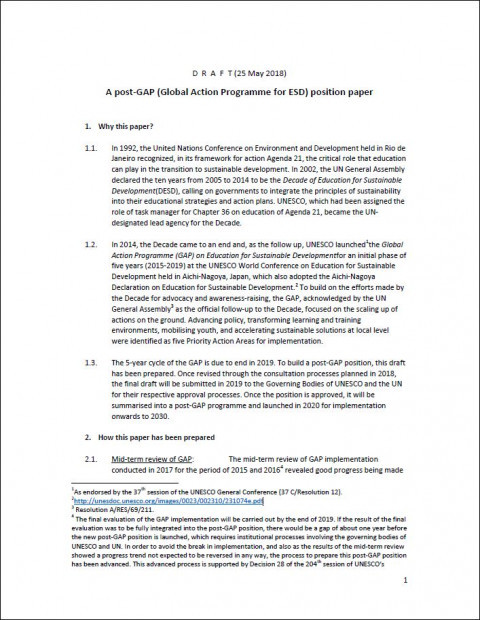 A Post-GAP (Global Action Programme for ESD) Position Paper Год публикации: 2018 Организация-автор: UNESCO The 5-year cycle of the GAP is due to end in 2019. To build a post-GAP position, this draft position paper has been prepared. Once revised through the consultation processes planned in 2018, the final draft will be submitted in 2019 to the Governing Bodies of UNESCO and the UN for their respective approval processes. Once the position is approved, it will be summarised into a post-GAP programme and launched in 2020 for implementation onwards to 2030. Концептуальный документ по пост-ГПД периоду (Глобальная программа действий по ОУР) Год публикации: 2018 Организация-автор: Организация Объединенных Наций по вопросам образования, науки и культуры (UNESCO) Пятилетний цикл Глобальной программы действий по ОУР (ГПД) должен завершиться в 2019 г. Настоящий проект подготовлен в целях разработки концепции деятельности после окончания ГПД. Вслед за внесением поправок в ходе запланированных на 2018 г. консультаций, окончательный вариант проекта будет представлен в 2019 г. на утверждение руководящим органам ЮНЕСКО и ООН. Положения утвержденного документа будут обобщены в программе деятельности, которая будет осуществляться в 2020-2030 гг. после окончания ГПД.
 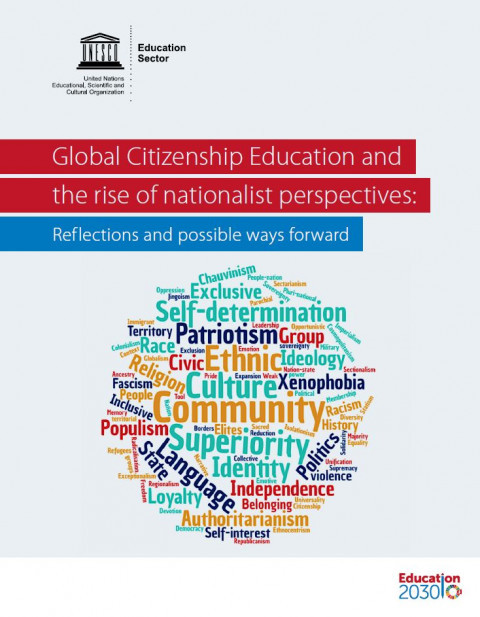 Global Citizenship Education and the Rise of Nationalist Perspectives: Reflections and Possible Ways Forward Год публикации: 2018 Организация-автор: UNESCO | APCEIU Over the past few years, many have observed a rise in nationalist perspectives across the world. These trends raise questions about the role of education and, in particular, one of UNESCO’s key areas of work in the field of education, namely Global Citizenship Education (GCED), which seeks to equip learners with the skills, values and attitudes needed to contribute to the development of peaceful and just societies. This paper seeks to clarify the evidence of the rise of nationalist perspectives and its causes, and to lay out how GCED is challenged by this phenomenon. It recommends ways forward for education stakeholders in promoting GCED, in order to strengthen ‘learning to live together’ by embedding GCED meaningfully in local and country contexts. 세계시민교육과 민족주의적 관점의 부상: 성찰과 나아갈 길 Год публикации: 2018 Организация-автор: 유네스코 | 유네스코 아시아태평양 국제이해교육원 지난 몇 년간 많은 이들이 전 세계에서 민족주의적 관점의 부상을 목도해왔다. 이에 관해 평론가들은 배타성과 외국인 공포증, 때로 인종주의적 주장과 공공장소 내 폭력적 행위가 증가하고 있는 것뿐만 아니라, 일부 국가에서 경제적 보호주의에 더욱 중점을 두는 현상에 대해 언급해왔다. 이러한 추세는 교육의 역할에 대해 많은 의문을 불러일으키고 있으며, 특히 평화롭고 공정한 사회의 발전에 필요한 능력·가치·태도 함양을 목적으로 하는, 유네스코 교육 분야의 핵심 사업인 세계시민교육(GCED, Global Citizenship Education)에 있어 심각한 도전이 되고 있다. 이 책에서는 민족주의적 관점이 부상하고 있다는 증거 및 그 원인을 규명하고, 이러한 현상으로부터 세계시민교육이 어떠한 도전을 받고 있는지를 보여주고자 한다. 이 책은 유네스코의 사업과 더불어 세계시민교육을 추진하는 다른 교육 종사자들에게 앞으로 나아갈 수 있는 방안을 권고하고자 한다.
  Report of the 2019 Arab Forum for Sustainable Development "Empowering people and ensuring inclusion and equality in the Arab region" Год публикации: 2019 Автор: United Nations (UN) Организация-автор: United Nations (UN) The Economic and Social Commission for Western Asia (ESCWA), in partnership with the League of Arab States and the United Nations system working in the Arab region, organized the 2019 Arab Forum on Sustainable Development under the theme 'Empowering People and Ensuring Inclusion and Equality in the Arab Region', in Beirut, from 9 to 11 April 2019.