
Ресурсы
Изучайте широкий спектр ценных ресурсов ВГГ, чтобы углубить своё понимание и повысить эффективность исследований, просветительской деятельности, преподавания и обучения.
Найдено: 1,402
 Address by Mr Koïchiro Matsuura, Director-General of UNESCO on the occasion of the First Meeting of the UN Inter-Agency Committee (IAC) on the United Nations Decade on Education for Sustainable Development (2005-2014); UNESCO, 12 June 2006 Год публикации: 2006 Организация-автор: UNESCO. Director-General, 1999-2009 (Matsuura, K.) This address was delivered by Mr. Koïchiro Matsuura, Director-General of UNESCO on the occasion of the first meeting of the UN Inter-Agency Committee (IAC) on the United Nations Decade on Education for Sustainable Development (2005-2014). Discours de M. Koïchiro Matsuura, Directeur général de l'UNESCO à l'occasion de la première réunion du Comité interinstitutions des Nations Unies (CCI) sur la Décennie des Nations Unies Год публикации: 2006 Организация-автор: UNESCO. Director-General, 1999-2009 (Matsuura, K.) Ce discours a été prononcé par M. Koïchiro Matsuura, Directeur général de l'UNESCO à l'occasion de la première réunion du Comité interinstitutions des Nations Unies sur la Décennie des Nations Unies sur l'éducation pour le développement durable (2005-2014).
 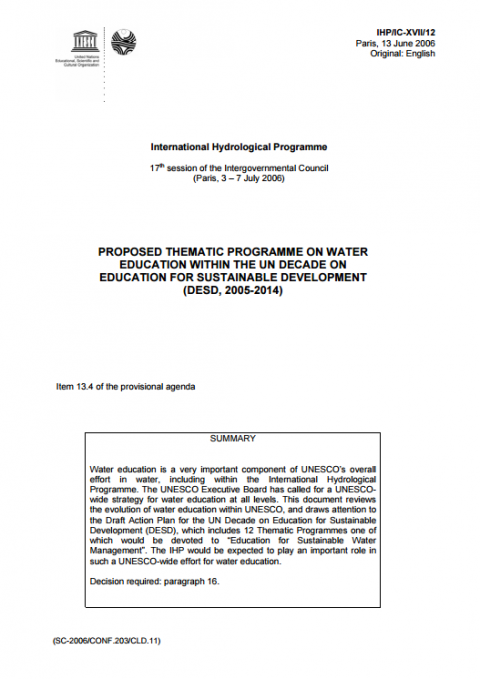 Proposed thematic programme on water education within the UN Decade on Education for Sustainable Development (DESD, 2005-2014) Год публикации: 2006 Организация-автор: International Hydrological Programme (IHP) Water education is a very important component of UNESCO’s overall effort in water, including within the International Hydrological Programme. The UNESCO Executive Board has called for a UNESCO-wide strategy for water education at all levels. This document reviews the evolution of water education within UNESCO, and draws attention to the Draft Action Plan for the UN Decade on Education for Sustainable Development (DESD), which includes 12 Thematic Programmes one of which would be devoted to “Education for Sustainable Water Management”. The IHP would be expected to play an important role in such a UNESCO-wide effort for water education.
  Learning with Intangible Heritage for a Sustainable Future: Guidelines for Educators in the Asia-Pacific Region Год публикации: 2015 Организация-автор: UNESCO Bangkok The guide provides teacher educators and teachers with an understanding of the concept of intangible cultural heritage (ICH) and explains why ICH should be integrated into the curriculum in tandem with the principles and perspectives of Education for Sustainable Development (ESD). This guide explains how the strategic incorporation of ICH elements and ESD principles into the curriculum can enable learners to gain the knowledge and skills that are necessary for ensuring sustainable development in the future. Нематериальное наследие в системе обучения в интересах устойчивого будущего Год публикации: 2015 Организация-автор: UNESCO Bangkok Руководство предоставляет работникам образования и преподавателям понимание концепции нематериального культурного наследия и объясняет внедрения нематериального культурного наследия в учебные планы вместе с принципами и теорией Образования в интересах устойчивого развития (ОУР). Руководство объясняет, как стратегическое включение элементов нематериального культурного наследия и принципов ОУР в учебные планы может помочь учащимся получить знания и навыки, необходимые для обеспечения устойчивого развития в будущем.ЮНЕСКО разработала настоящее руководство на основании результатов пилотных проектов, проведенных в четырех странах в Азиатско-Тихоокеанском регионе, где участники разработали своиместные руководства и материалы для включения элементов нематериального культурного наследия и принципов ОУР в образовательный процесс. Примеры нематериального культурного наследия, приведенные в данном руководстве, не являются более важными, чем другие, и не обязательно должны быть приоритетными. Они скорее представлены в качестве иллюстративных примеров.
 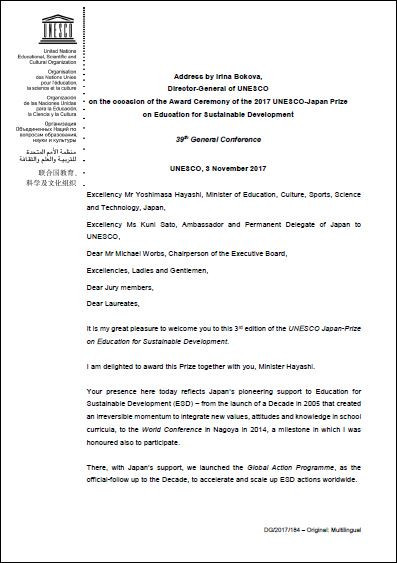 Address by Irina Bokova, Director-General of UNESCO, on the occasion of the Award Ceremony of the 2017 UNESCO-Japan Prize on Education for Sustainable Development, 39th General Conference; UNESCO, 3 November 2017 Год публикации: 2017 Организация-автор: UNESCO. Director-General, 2009-2017 (Bokova, I.G.) This address was delivered by Irina Bokova, Director-General of UNESCO, on the occasion of the Award Ceremony of the 2017 UNESCO-Japan Prize on Education for Sustainable Development at UNESCO Headquarters in Paris, on 3 November.
  Climate Risk Informed Decision Analysis (CRIDA): Collaborative Water Resources Planning for an Uncertain Future Год публикации: 2024 Организация-автор: UNESCO Intergovernmental Hydrological Programme (IHP) | International Center for Integrated Water Resources Management (ICIWaRM) | Alliance for Global Water Adaptation (AGWA) | Deltares The importance of integrating climate change considerations into water resources planning is recognized on a global scale. Various frameworks, such as the Sendai Framework for Disaster Risk Reduction, the United Nations Sustainable Development Goals, and the Paris Agreement, emphasize the need for proper planning, policy-making, and adaptation strategies. The Climate Risk Informed Decision Analysis (CRIDA) methodology was launched in 2018 as a response to these international agendas, bridging the gap between climate change uncertainty and water resource planning.
  UNESCO Framework for Culture and Arts Education: Implementation Guidance Год публикации: 2025 Организация-автор: UNESCO Culture and the arts are integral to inclusive, equitable and quality education. They nurture creativity, critical thinking, and respect for cultural diversity, empowering learners to engage meaningfully with the world and to build more just, sustainable and peaceful societies. Yet, countries have not systematically incorporated culture and arts education across all levels of education. This Implementation guidance for the UNESCO Framework for Culture and Arts Education is a collective invitation to reimagine education by placing culture and the arts at its heart and advancing a transformative vision of education for all.Through a holistic approach, the Guidance supports the integration of culture and the arts across formal, non-formal and informal education, throughout life. It offers practical orientations to help Member States fulfil the commitment enshrined in the UNESCO Framework for Culture and Arts Education, adopted by Ministers of Culture and Education in 2024. With a global perspective, this Guidance will equip policy-makers, educators and cultural actors in developing inclusive, context-relevant policies, curricula and learning environments.The Guidance is a milestone on a shared journey, inviting countries to harness their cultural strengths, respond to emerging challenges, and work together towards a more inclusive education for all.
  Strategies to Counter Antisemitism: A Handbook for Educators Год публикации: 2025 Организация-автор: UNESCO Education is the first line of defence against hate and prejudice. By targeting the root causes of hate ideologies, deconstructing the stereotypes that underlie them from an early age, and promoting inclusive models, education is the keystone of a holistic approach to combating discrimination. Tackling antisemitism through education requires tailored content that addresses its complex, shifting and multilayered forms, both past and present.Acknowledging the topic’s complexity and the paucity of resources available to education stakeholders, this concise guide developed by UNESCO and funded by the European Commission aims to provide a roadmap for policymakers, curriculum developers and educators on current approaches and initiatives. It presents ten educational practices, each grounded in academic literature and illustrated by a promising educational initiative that operationalizes core pedagogical principles. The handbook is built around the three core learning domains which inform UNESCO’s approach to Global Citizenship Education: cognitive, socio-emotional, and behavioural learning.Conceived as an accessible operational guide for practitioners, this resource sets out to start a larger conversation about the needs of educators for tackling contemporary forms of antisemitism. It aims to encourage investments in high-quality empirical research that can pave the way for a better approach to combat antisemitism.
  The Socio-Cultural Impact of COVID-19: Exploring the Role of Intercultural Dialogue in Emerging Responses Год публикации: 2020 Автор: Fethi Mansouri Организация-автор: UNESCO This brief illustrates, proponents and practitioners of ICD were quick to adapt to this crisis situation and shifted much of their activities online in order to mitigate the negative impacts of the pandemic. The shift has ensured that cross-cultural exchange, mutual support and intergroup solidarity, all key dimensions of the ICD approach, can be maintained in safe online contexts and thus continue to play a key role within the socio-cultural response to COVID-19.Through inductive exploration of authentic, local, community responses to the COVID-19 crisis, this brief aims to shed light on the new context in which the ICD agenda is being pursued, complementing the many existing quantitative analyses of the socio-cultural impact of the pandemic.