
相关资源
探索丰富的全球公民教育资源,深化理解,促进研究、倡导、教学与学习。
共找到18条结果
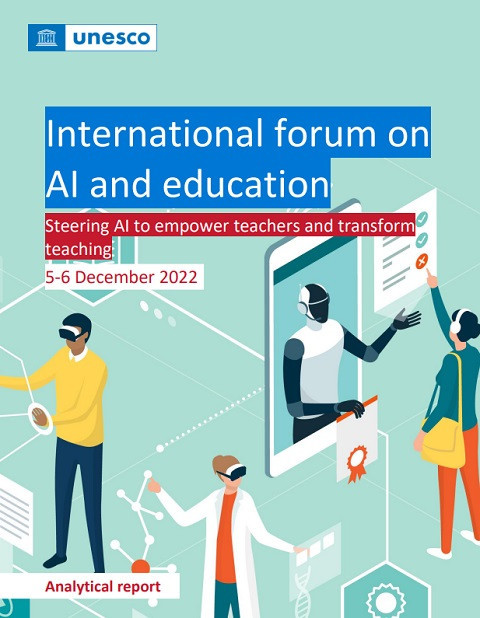 International Forum on AI and Education: Steering AI To Empower Teachers and Transform Teaching, 5–6 December 2022; Analytical Report 出版年份: 2023 作者: Fengchun Miao | Kelly Shiohira | Zaahedah Vally | Wayne Holmes 机构作者: UNESCO | JET Education Services The International Forum on AI and Education has contributed ‘to peace and security by promoting collaboration among the nations through education, science and culture’ (UNESCO, 1945). The Forum has now become the world’s leading event promoting knowledge-sharing, the understanding of peoples, and the achievement of international agreements, in the fast-developing and increasingly impactful field of AI and education. The fourth edition of the International Forum on Artificial Intelligence and Education aimed to foster knowledge sharing specifically on how to steer the design and use of AI to empower teachers and to transform teaching methodologies within the broad framework of digital transformation of education. The Forum sought to bring together a range of expertise and experiences across the globe, and, in keeping with UNESCO priorities, a special focus was placed on Africa. A total of 16 national strategies were presented at the Forum by the various national ministers and representatives invited to attend. The national strategies shared during the Forum also unveiled the varying levels of preparedness and policy responses toward AI across different regions, a reminder that the pre-existing digital divide still underpins the system-wide uptake and integration of AI in education. Therefore, not all of the strategies were directly related to or containing AI because some areas that were represented at the conference are still at the nascent stages of AI Strategy development. The presentations of national initiatives and strategies related to AI from these countries shed light on the general awareness of policy-makers on the impact of AI in education and the commitment of national governments to fostering AI competencies among students and teachers. This report focus on the following key themes: national strategies on AI and education; critical reviews of roles of AI in the digital transformation of education; ethical principles and their implementation with a specific focus on gender equality; AI competencies for teachers, and notable algorithms or AI platforms and AI-informed pedagogies. The report concludes with considerations for the future based on the authors’ own analysis of the key role of human teachers, steering the human-centered approach, mainstreaming gender equity, designing education-specific AI models and innovative pedagogy, and ensuring human agency in defining problems and designing solutions.a
  AI Competency Framework for Students 出版年份: 2024 作者: Fengchun Miao | Kelly Shiohira 机构作者: UNESCO Artificial intelligence is increasingly integral to our lives, necessitating proactive education systems to prepare students as responsible users and co-creators of AI. Integrating AI learning objectives into official school curricula is crucial for students globally to engage with AI safely and meaningfully.The UNESCO AI Competency Framework for Students aims to help educators in this integration, outlining 12 competncies across four dimensions:- A human-centred mindset- Ethics of AI- AI techniques and applications- AI system designThese competencies span three progression levels:- Understand- Apply- Create The framework details curricular goals and domain-specific pedagogical methodologies.Grounded in the vision of students as AI co-creators and responsible citizens, the publication emphasizes critical judgement of AI solutions, awareness of citizenship responsibilities in the AI era, foundational AI knowledge for lifelong learning, and inclusive, sustainable AI design.
  AI Competency Framework for Students 出版年份: 2025 作者: Fengchun Miao | Kelly Shiohira 机构作者: UNESCO Preparar a los estudiantes para ser ciudadanos responsables y creativos en la era de la IALa inteligencia artificial (IA) está cada vez más presente en nuestras vidas, lo que requiere sistemas educativos proactivos que preparen a los estudiantes para que sean usuarios responsables y cocreadores de la IA. Integrar los objetivos de aprendizaje de IA en los programas de estudio oficiales de las escuelas es fundamental para que los estudiantes de todo el mundo interactúen de forma segura y significativa con la IA.El objetivo del Marco de competencias para estudiantes en materia de IA de la UNESCO es ayudar a los educadores con esta integración, para lo cual describe 12 competencias que atraviesan cuatro dimensiones: una forma de pensar centrada en el ser humano, la ética de la IA, las técnicas y aplicaciones de la IA, la pedagogía de la IA, y la IA para el diseño de sistemas de IA. Estas competencias abarcan tres niveles de progresión: comprender, aplicar y crear. El marco detalla las metas curriculares y las metodologías pedagógicas específicas para cada dominio.Basado en una visión de los estudiantes como cocreadores de IA y ciudadanos responsables, el marco pone énfasis en el juicio crítico de las soluciones de IA, la conciencia de las responsabilidades ciudadanas en la era de la IA, el conocimiento fundacional de la IA para el aprendizaje a lo largo de la vida, y el diseño de IA inclusiva y sostenible.
  AI Competency Framework for Students 出版年份: 2025 作者: Fengchun Miao | Kelly Shiohira 机构作者: UNESCO Préparer les apprenants à devenir des citoyens responsables et créatifs à l’ère de l’IAL’intelligence artificielle (IA) fait tous les jours davantage partie intégrante de nos vies, ce qui implique d’avoir des systèmes éducatifs proactifs en mesure de préparer les élèves et les étudiants à être des utilisateurs responsables et des cocréateurs de l’IA. L’intégration d’objectifs d’apprentissage de l’IA dans les programmes scolaires officiels est essentielle pour que les apprenants du monde entier puissent s’intéresser en toute sécurité et de manière pertinente à l’IA.Le Référentiel de compétences en IA pour les apprenants de l’UNESCO vise à aider les éducateurs dans cette démarche, en décrivant 12 compétences réparties en quatre dimensions, à savoir une perspective centrée sur l’humain, l’éthique de l’IA, les techniques et applications de l’IA, et la conception de systèmes d’IA. Ces compétences se déploient selon trois niveaux de progression : Comprendre, Appliquer et Créer. Le référentiel détaille les objectifs du programme d’études et les méthodes pédagogiques spécifiques au domaine.Fondé sur une vision des élèves et des étudiants considérés comme cocréateurs de l’IA et citoyens responsables, le référentiel met l’accent sur le jugement critique vis-à-vis des solutions d’IA, la prise de conscience des responsabilités citoyennes à l’ère de l’IA, les connaissances fondamentales en matière d’IA pour l’apprentissage tout au long de la vie, ainsi que la conception d’une IA inclusive et durable.
  AI Competency Framework for Teachers 出版年份: 2024 作者: Fengchun Miao | Mutlu Cukurova 机构作者: UNESCO AI processes vast information, generates new content, and helps decision-making through predictive analyses. In education, AI has transformed the traditional teacher–student relationship into a teacher–AI–student dynamic.This shift requires a re-examination of teachers’ roles and the competencies they need in the AI era. Yet, few countries have defined these competencies or developed national programmes to train teachers in AI, leaving many educators without proper guidance.The AI competency framework for teachers addresses this gap by defining the knowledge, skills, and values teachers must master in the age of AI. Developed with principles of protecting teachers’ rights, enhancing human agency, and promoting sustainability, the publication outlines 15 competencies across five dimensions: Human-centred mindset, Ethics of AI, AI foundations and applications, AI pedagogy, and AI for professional learning. These competencies are categorized into three progression levels: Acquire, Deepen, and Create.As a global reference, this tool guides the development of national AI competency frameworks, informs teacher training programmes, and helps in designing assessment parameters. It also provides strategies for teachers to build AI knowledge, apply ethical principles, and support their professional growth.
  Guía para el uso de IA generativa en educación e investigación 出版年份: 2023 作者: Fengchun Miao | Wayne Holmes 机构作者: UNESCO Esta guía apunta a apoyar la planificación de regulaciones, políticas y programas de desarrollo de capacidades humanas apropiados para garantizar que la lAGen se convierta en una herramienta que genuinamente beneficie y empodere a docentes, estudiantes e investigadores. Explica las técnicas de IA utilizadas por la lAGen y elabora una lista de modelos de GPT puestos a disposición del público, especialmente aquellos con licencias de código abierto. También abre un debate sobre el surgimiento de EdGPT: los modelos de lAGen entrenados con datos específicos para servir a fines educativos. Además, resume algunas de las controversias clave en torno a la lAGen, desde el empeoramiento de la pobreza digital a la homogeneización de opiniones, y desde los más profundos deepfakes a cuestiones de derechos de autor. Con base en una visión humanista, la guía sugiere pasos clave para la regulación de las herramientas de lAGen, que incluyen la obligación de proteger la privacidad de los datos y el establecimiento de un límite de edad para las conversaciones independientes con las plataformas de lAGen. Para guiar el uso adecuado de las herramientas en la educación y la investigación, esta guía propone un enfoque humano-agente y adecuado a la edad para los procesos de validación ética y diseño pedagógico. Orientations pour l’intelligence artificielle générative dans l’éducation et la recherche 出版年份: 2023 作者: Fengchun Miao | Wayne Holmes 机构作者: UNESCO Ces recommandations ont pour objectif de soutenir l'élaboration de réglementations, de politiques et de programmes visant à développer les capacités humaines, dans le but de garantir que l'intelligence artificielle générative (GenAI) devienne un outil qui profite réellement aux enseignants, aux apprenants et aux chercheurs et leur donne les moyens d'agir. Il explique les techniques d'IA utilisées par la GenAI et dresse une liste des modèles de GPT qui sont mis à la disposition auprès du public, en particulier ceux qui font l'objet d'une licence à source ouverte. Il ouvre également une discussion sur l'émergence de l'EdGPT - les modèles GenAI qui sont entraînés avec des données spécifiques pour se mettre au service des objectifs dans le domaine de l'éducation. En outre, il résume certaines des principales controverses formées autour de l'IA générative, de l'aggravation de la pauvreté numérique à l'homogénéisation des opinions, en passant par les trucages (deepfakes) et les questions liées aux droits d'auteur. Fondé sur une vision humaniste, le présent document propose des étapes-clefs pour la réglementation des outils de la GenAI, notamment en rendant obligatoire la protection de la confidentialité des données et en fixant une limite d'âge pour les conversations autonomes avec les plateformes de la GenAI. Pour accompagner l'utilisation pertinente des outils dans l'éducation et la recherche, ce guide propose une approche holistique et adaptée à tout âge pour les processus de validation éthique et de conception pédagogique. Руководство по использованию генеративного искусственного интеллекта в образовании и научных исследованиях 出版年份: 2023 作者: Fengchun Miao | Wayne Holmes 机构作者: UNESCO Данное руководство направлено на поддержку разработки соответствующих правил, политик и программ развития человеческого потенциала с целью обеспечения того, чтобы генеративный искусственный интеллект (ИИ) стал инструментом, действительно приносящим пользу и расширяющим возможности учителей, учащихся и исследова телей. В нем объясняются методы искусственного интеллекта, используемые в генеративном ИИ, а также приводится список моделей СРТ, которые становятся общедоступными, особенно модели с открытым исходным кодом. Руководство также открывает обсуждение о появлении ЕсІСРТ - моделей генеративного ИИ, обученных на конкретных данных для образовательных целей. Кроме того, в нем суммируются некоторые ключевые противоречия вокруг генеративного ИИ - от ухудшения цифрового неравенства до гомогенизации мнений, от более сложных дипфейков до вопросов авторского права. Исходя из гуманистического подхода, руководство предлагает ключевые шаги по регулированию инструментов генеративного ИИ, включая обязательную защиту конфиденциальности данных и установку возрастных ограничений для самостоятельного взаимодействия с платформами генеративного ИИ. Для обеспечения правильного использования инструментов в сфере образования и исследований, в руководстве затронуты вопросы этики и проектирования педагогического процесса и заложен подход, ориентированный на человека и учитывающий возрастные особенности. ارشادات استخدام الذكاء الاصطناعي التوليدي في التعليم والبحث 出版年份: 2023 作者: Fengchun Miao | Wayne Holmes 机构作者: UNESCO تهدف هذه الإرشادات إلى دعم تخطيط اللوائح والسياسات وبرامج تنمية القدرات البشرية المناسبة ً لضمان أن يصبح الذكاء الاصطناعي التوليدي أداة تفيد المعلمين والمتعلمين والباحثين وتمكنهم حقا. وهو يشرح تقنيات الذكاء الاصطناعي التي يستخدمها الذكاء الاصطناعي التوليدي ويرسم قائمة بنماذج ً المحولات التوليدية المدربة مسبقا المتاحة للجمهور، خاصة تلك التي تخضع لترخيص مفتوح المصدر. كما ً ً حول ظهور نماذج المحولات التوليدية التعليمية المدربة مسبقا - التي يتم تدريبها باستخدام يفتح نقاشا بيانات محددة لخدمة الأغراض التعليمية. علاوة على ذلك، فهو يلخص بعض الخلافات الرئيسية حول ً الذكاء الاصطناعي التوليدي، بدءا من تفاقم الفقر الرقمي إلى تجانس ً الآراء، ومن التزييف العميق إلى قضايا حقوق الطبع والنشر. واستنادا إلى رؤية إنسانية، تقترح الإرشادات خطوات أساسية لتنظيم أدوات الذكاء الاصطناعي التوليدي، بما في ذلك فرض حماية خصوصية البيانات ووضع حد عمري للمحادثات المستقلة مع منصات الذكاء الاصطناعي التوليدي. ً لتوجيه الاستخدام السليم للأدوات في التعليم والبحث، تقترح هذه الإرشادات نهج ً ا مناسبا للعامل البشري والعمر للتحقق من الصحة الأخلاقية وعمليات التصميم التربوي. Guidance for Generative AI in Education and Research 出版年份: 2023 作者: Fengchun Miao | Wayne Holmes 机构作者: UNESCO This Guidance aims to support the planning of appropriate regulations, policies and human capacity development programmes to ensure that generative artificial intelligence (GenAI) becomes a tool that genuinely benefits and empowers teachers, learners and researchers. It explains the Al techniques used by GenAI and maps out a list of GPT models that are made publicly available, especially those under open-source licences. It also opens a discussion on the emergence of EdGPT - GenAI models that are trained with specific data to serve educational purposes. Furthermore, it summarizes some of the key controversies around GenAI, from worsening digital poverty to the homogenization of opinions, and from deeper deepfakes to issues of copyright. Based on a humanistic vision, the Guidance proposes key steps for the regulation of GenAI tools, including mandating the protection of data privacy and setting an age limit for independent conversations with GenAI platforms. To guide the proper use of the tools in education and research, this Guidance proposes a human-agent and age-appropriate approach to the ethical validation and pedagogical design processes.