
相关资源
探索丰富的全球公民教育资源,深化理解,促进研究、倡导、教学与学习。
共找到6条结果
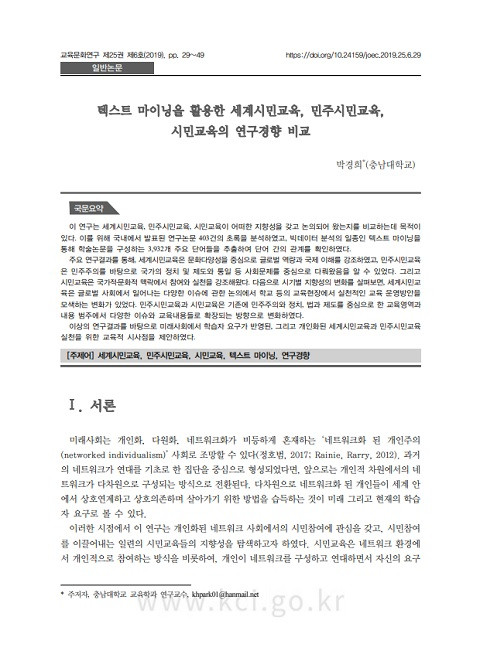 The Comparison of Research Trends on Global Citizenship Education, Democratic Civic Education, and Civic Education Using Text Mining Techniques (Journal of Education & Culture; Vol. 25, No. 6) 出版年份: 2019 作者: Kyunghee Park 机构作者: Education Research Institute of Inha University The purpose of this study is to compare the research trends of global citizenship education(GCED), democratic civic education(DCED), and civic education(CIED). For this purpose, it was analysed into abstracts of 403 articles, extracted 3,932 key-words through text mining analysis. The results of the study are as follows. First, GCED emphasized global competence and international understanding centering on cultural diversity. DCED was d iscussed mainly on the problems of national politics, and the unification issues on the democracy. CIED emphasized participation and practice in the national and cultural context. Second, with regard to the changes of orientation, GCED has changed to explore the practical education design. And DCED and CIED have changed to deal with various issues and contents. Based on these results, implications of this study were discussed for civic educations reflected future learner's diversity and personality.
 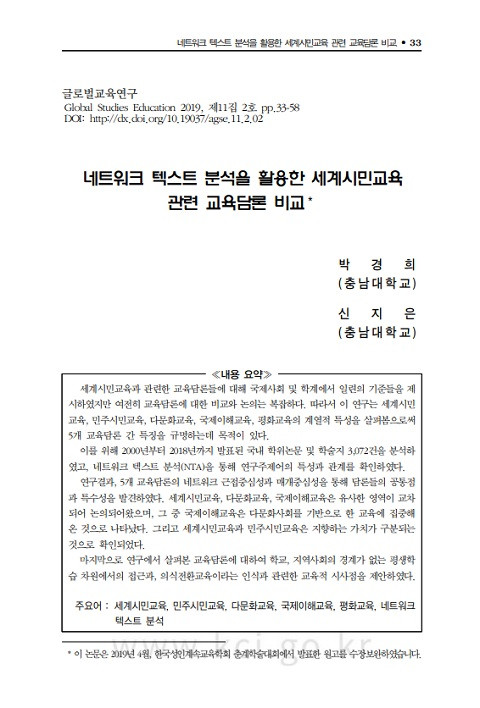 Comparison on Educational Discourses About Global Citizenship Education Using Network Text Analysis (Global Studies Education; Vol. 11, No. 2) 出版年份: 2019 作者: Kyunghee Park | JiEun Shin 机构作者: Association of | Global Studies Education The purpose of this study is to analyze the differences between ‘global citizenship education’, ‘democratic civic education’, ‘multicultural education’, ‘education for international understanding’, and ‘peace education’. For this, 3,072 research papers from 2000 to 2018 selected, and network text analysis(NTA) was conducted to confirm the characteristics and changes of the five educational discourses. As a result, the commonness and specificities of them were derived through the ‘closeness centrality’ and ‘betweenness centrality’ on the NTA. ‘Global citizenship education’, ‘multicultural education’, and ‘education for international understanding’ have crossed the content area. And ‘education for international understanding’ was based on a multicultural society. The values-oriented between ‘global citizenship education’ and ‘democratic civic education’ were distinguished. Finally, it is suggested that the five educational discourses need to be on the approach of lifelong learning, and they are education oriented toward change in consciousness.
  A Study on the Monitoring Framework of GCED in South Korea 出版年份: 2020 作者: Hwanbo Park | Daehoon Jho | Kyunghee Park | Jeongmin Eom 机构作者: APCEIU The purpose of this study is to establish a feasible monitoring system for the implementation of Global Citizenship Education (GCED) in South Korea that can both align itself with the global indicator (SDG 4.7.1) and reflect the domestic context and feasibility. The study further builds upon previous studies carried out by the Asia-Pacific Centre of Education for International Understanding (APCEIU). Particularly, it aims to refine and validate the GCED indicator system for domestic monitoring as proposed in the previous studies, which are also in line with SDG 4.7.1, the global indicator to monitor the mainstreaming of GCED/ESD.To this end, the study involved a Delphi survey and expert consultation to build the refined list and classification of GCED related thematic areas and keywords contextualized in Korea, and aligned these with global indicators so that it could establish a set of sub-indicators for the South Korean context. Then, it pilot-tested the sub-indicators by codifying and statistically analyzing key policy documents and the curricula of Teacher Education Institutes (TEIs) to validate the sub-indicators and to examine the extent to which GCED is mainstreamed in the given domains of the Korean context. Case analyses with focused interviews for some TEI curricula were also added to enrich the study. Lastly, the study draws key implications and proposes some recommendations for the establishment of a feasible and sustainable GCED monitoring system in South Korea. Considering the importance of national input in initiating the SDG agenda, the research concluded with a proposal on how to manage the global citizenship indicators in South Korea.
  2021 Study on the Monitoring Framework of GCED in South Korea 出版年份: 2021 作者: Hwanbo Park | Daehoon Jho | Kyunghee Park | Sungho Park | Jeongmin Eom 机构作者: APCEIU The purpose of this study is to establish a feasible monitoring system for the implementation of Global Citizenship Education (GCED) in South Korea that can both align itself with the global indicator (SDG 4.7.1) and reflect the domestic context and feasibility. To this end, the study continues to examine the extent to which GCED is mainstreamed in education policies in Korea by utilizing the monitoring tool developed by the aforementioned 2020 study. In so doing, it aims to build sustaining and robust data in the area of GCED policies with the consistent monitoring tool developed. Second, the study explores enabling aspects as well as gaps between policies or programmes and how GCED is implemented on the ground by schools and teachers. Through this analysis, the study draws implications for further refining of the developed monitoring system. Third, the study surveys and analyzes existing monitoring tools developed by other fields and the data accumulated through those existing tools to assess learners' knowledge acquisition, values, skills and attitudes relevant to global citizenship competences, In so doing, it explores possibilities and makes recommendations for effectively monitoring learners’ competences by utilizing and modifying existing tools as well as developing new ones.
 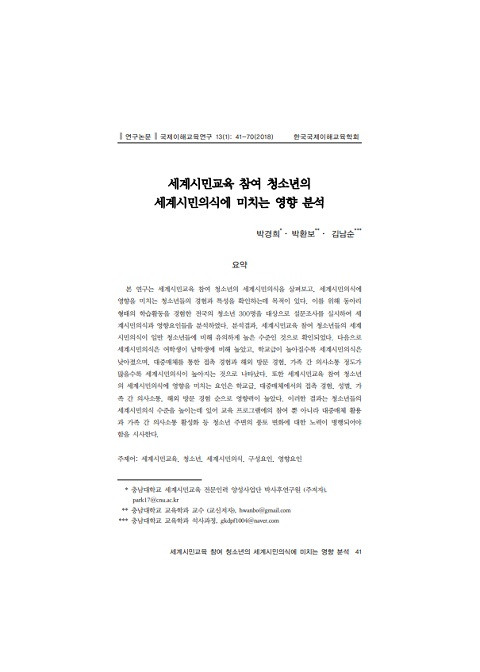 An Analysis of the Global Citizenship of Youth Participated in Global Citizenship Education (Journal of Education for International Understanding; Vol. 13, No. 1) 出版年份: 2018 作者: Kyunghee Park | Hwanbo Park | Namsoon Kim 机构作者: Korean Society of Education for International Understanding (KOSEIU) The purpose of this study is to analysis characteristics of the global citizenship for youth participated in global citizenship education and the factors influencing for global citizenship. To achieve this, the study surveyed around 300 youth participated in global citizenship education. The results of the analysis are as follows. First, global citizenship of youth participated in global citizenship education are generally higher than those of ordinary youth. Second, it was analyzed that the global citizenship was significantly higher for girls than boys; for the lower school level than higher; and for the ones having the greater experience with the mass media, overseas visits, and family communication. Factors influencing the global citizenship of youth participated in global citizenship education were influenced by school class, experience in mass media, gender, communication with family, and experience of visiting abroad. The results suggest that there is a need to think about ways to educate the global citizenship through everyday life, such as using various media and communicating with family as well as participating in education programs to improve the level of global citizenship.
 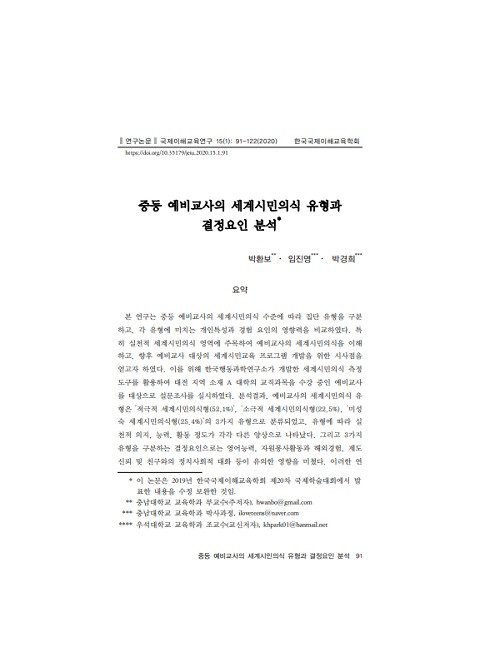 An Analysis on the Types of Global Citizenship Among the Pre-Service Secondary Teachers and the Determinant Factors (Journal of Education for International Understanding; Vol. 15, No. 1) 出版年份: 2020 作者: Hwanbo Park | Jinyoung Im | Kyunghee Park 机构作者: Korean Society of Education for International Understanding (KOSEIU) This study aims to investigate the types of global citizenship among pre-service teachers based on the level of global citizenship and to explore the factors effect on each types. Especially, this study focus on the action area among the three dimension of global citizenship. For this purpose, 180 students were surveyed A university in Daejeon metro city with measurement tool developed by Korea Institute for Research in the Behavioral Sciences (KIRBS). The results show that the types of pre-service teachers divided into 3 group, ‘active global citizenship (52.1%)’, ‘passive global citizenship (22.5%)’, and ‘immature global citizenship (25.4%)’. fluency of English language, experience of volunteer and overseas, institutional trust, and communication with friends about political issues were significant factor effect on the practical type of global citizenship. The findings suggest that it is necessary to provide global citizenship education based on the characteristics of the pre-service teachers.