UNESCO CLEARINGHOUSE ON
GLOBAL CITIZENSHIP EDUCATION
HOSTED BY APCEIU
English
Français
Español
Русский
العربية
中文
한국어
关于我们
全球公民教育
全球公民教育信息库
相关资源
活动
新闻
English
Français
Español
Русский
العربية
中文
한국어
Search
Advanced Search
关于我们
全球公民教育
全球公民教育信息库
相关资源
活动
新闻
相关资源
探索丰富的全球公民教育资源,深化理解,促进研究、倡导、教学与学习。
搜索
Searching...
高级搜索
© APCEIU
共找到
1
条结果
相关度
最新
年份
A Theoretical Discussion on Universal Core Elements and Korean Distinctiveness in Global Citizenship Education (The Journal of Korean Education; Vol. 37, No. 2)
出版年份:
2010
作者:
Youlkwan Sung
机构作者:
Korean Educational Development Institute (KEDI)
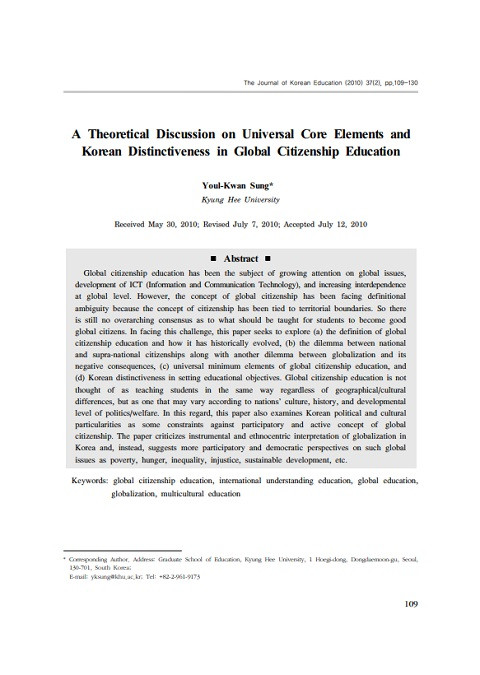
Global citizenship education has been the subject of growing attention on global issues, development of ICT (Information and Communication Technology), and increasing interdependence at global level. However, the concept of global citizenship has been facing definitional ambiguity because the concept of citizenship has been tied to territorial boundaries. So there is still no overarching consensus as to what should be taught for students to become good global citizens. In facing this challenge, this paper seeks to explore (a) the definition of global citizenship education and how it has historically evolved, (b) the dilemma between national and supra-national citizenships along with another dilemma between globalization and its negative consequences, (c) universal minimum elements of global citizenship education, and (d) Korean distinctiveness in setting educational objectives. Global citizenship education is not thought of as teaching students in the same way regardless of geographical/cultural differences, but as one that may vary according to nations' culture, history, and developmental level of politics/welfare. In this regard, this paper also examines Korean political and cultural particularities as some constraints against participatory and active concept of global citizenship. The paper criticizes instrumental and ethnocentric interpretation of globalization in Korea and, instead, suggests more participatory and democratic perspectives on such global issues as poverty, hunger, inequality, injustice, sustainable development, etc.
本网站使用Cookie以提升用户体验。详情请查看Cookie政策。
Cookie政策
.