
相关资源
探索丰富的全球公民教育资源,深化理解,促进研究、倡导、教学与学习。
共找到22条结果
 Региональные консультации национальных правозащитных учреждений стран Центральной Азии: Отчет о конференции 出版年份: 2016 机构作者: UN. Office of the United Nations High Commissioner for Human Rights (UN. OHCHR) | United Nations Development Programme (UNDP) Конференция впервые стала площадкой для консультаций национальных правозащитных учреждений (НПЗУ) Центральной Азии в целях содействия укреплению партнерских отношений и обеспечения возможностей взаимной поддержки и обмена экспертным опытом. Особое вниманиеуделено роли НПЗУ в их взаимодействии с правительством и другими партнерами в стране, а также роли НПЗУ в части достижения Целей Устойчивого Развития (ЦУР).
 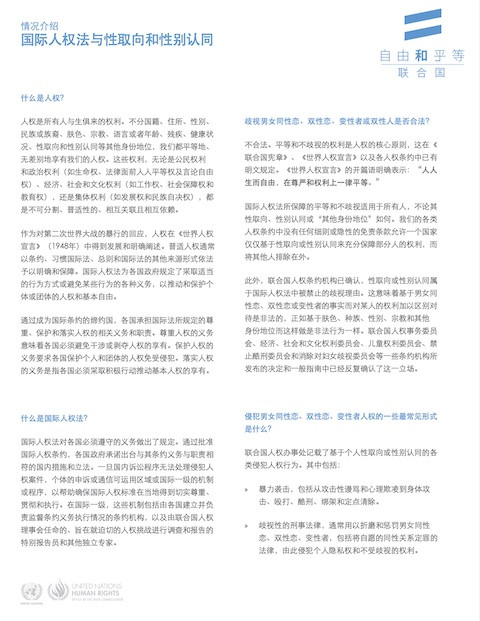 International Human Rights Law & Sexual Orientation & Gender Identity 出版年份: 2017 机构作者: UN. Office of the United Nations High Commissioner for Human Rights (UN. OHCHR) | United Nations Free & Equal What are human rights? What is international human rights law? Is it ever legal to discriminate against lesbian, gay, bisexual, transgender or intersex people? What are some of the most common forms of human rights violations affecting LGBT people? What have the UN General Assembly and Human Rights Council said on this subject? What practical steps does international law require States to take in order to safeguard the rights of LGBT people? 国际人权法与性取向和性别认同 出版年份: 2017 机构作者: UN. Office of the United Nations High Commissioner for Human Rights (UN. OHCHR) | United Nations Free & Equal 什么是人权?什么是国际人权法?歧视男女同性恋、双性恋、变性者或双性人是否合法?侵犯男女同性恋、双性恋、变性者人权的一些最常见形式是什么?联合国大会及人权事务委员会对该主题有何表述?各国在尊重男女同性恋、双性恋和变性者方面有哪些法律义务?
  Human rights education in the school systems of Europe, Central Asia and North America: a compendium of good practice 出版年份: 2009 机构作者: Council of Europe | UNESCO | UN. Office of the United Nations High Commissioner for Human Rights (UN. OHCHR) | OSCE. Office for Democratic Institutions and Human Rights (ODIHR) “Human Rights Education in the School Systems of Europe, Central Asia and North America: A Compendium of Good Practice” is a compilation of 101 examples of good practice in human rights education in primary schools, secondary schools and teacher training institutions in the Organization for Security and Co-operation in Europe (OSCE) area, which is also covered by the United Nations Educational, Scientific and Cultural Organization (UNESCO), the Office of the United Nations High Commissioner for Human Rights (OHCHR) and, partially, the geographical mandate of the Council of Europe (CoE).The term “human rights education” is often used in this resource in a broader sense, to also include educationfor democratic citizenship and education for mutual respect and understanding, which are all based on internationally agreed human rights standards. These three areas are seen as interconnected and essential within educational systems in order to prepare youth to be active, responsible and caring participants in their communities, as well as at the national and global levels.Human rights education has been defined as education, training and information aimed at building a universal culture of human rights. A comprehensive education in human rights not only provides knowledge about human rights and the mechanisms that protect them, but also imparts the skills needed to promote, defend and apply human rights in daily life. Education for democratic citizenship focuses on educational practices and activities designed to help young people and adults to play an active part in democratic life and exercise their rights and responsibilities in society. Education for mutual respect and understanding highlights self-respect, respect for others, and the improvement of relationships between people of differing cultural traditions.This book aims to support quality teaching in these areas and to inspire educational policymakers (those working in education ministries and local school boards) and administrators, teachers, teacher trainers, non-formal educators and all other interested actors, as well as to facilitate networking and the exchange of experience among education professionals. Образование в области прав человека в школьной системе Европы, Центральной Азии и Северной Америки: сборник примеров успешных практик 出版年份: 2009 机构作者: Council of Europe | UNESCO | UN. Office of the United Nations High Commissioner for Human Rights (UN. OHCHR) | OSCE. Office for Democratic Institutions and Human Rights (ODIHR) Сборник примеров успешных практик «Образование в области прав человека в школьной системе Европы, Центральной Азии и Северной Америки» включает 101 пример успешных практик в сфере образования в области прав человека в начальной, средней школе и в педагогических учебных заведениях в регионе ОБСЕ, на который также распространяются полномочия ЮНЕСКО, УВКПЧ ООН и, частично, географический мандат СЕ.Настоящее издание состоит из пяти основных разделов:Раздел I. Законодательные акты, руководящие принципы и стандарты; Раздел II. Подходы и практики улучшения учебной атмосферы; Раздел III. Учебные пособия для преподавателей и учащихся; Раздел IV. Повышение квалификации преподавателей; Раздел V. Методы оценки.Образование в области прав человека определяют как образование, обучение и информирование, направленное на формирование всеобщей культуры прав человека. Комплексное образование в области прав человека дает не только знания о правах человека и действующих механизмах их защиты, но и навыки, необходимые для продвижения, защиты и реализации прав человека в повседневной жизни. Воспитание демократической гражданственности нацелено на осуществление образовательных практик и мероприятий, призванных помочь молодым людям и взрослым принимать активное участие в жизни общества, основанного на принципах демократии, а также осуществлять свои права и обязанности в обществе. Воспитание в духе взаимного уважения и понимания подчеркивает важность самоуважения, уважения других людей и улучшения отношений между людьми, представляющими различные культурные традиции.Настоящая книга задумана как средство поддержки качества обучения в этих областях, как стимул для лиц, ответственных за формирование политики в области образования (сотрудников министерств образования и местных школьных советов), директоров, учителей, преподавателей педагогических учебных заведений, преподавателей, специалистов неформальной сферы образования и всех других заинтересованных лиц, а также как инструмент, содействующий формированию сетей и обмену опытом между специалистами в сфере образования. L'éducation aux droits de l'homme dans les systèmes scolaires d'Europe, d'Asie centrale et en Amérique du Nord: un recueil de bonnes pratiques 出版年份: 2009 机构作者: Conseil de l'Europe | Organisation des Nations Unies pour l'éducation, la science et la culture (UNESCO) | UN. Office of the United Nations High Commissioner for Human Rights (UN. OHCHR) | OSCE. Office for Democratic Institutions and Human Rights (ODIHR) “L'Éducation aux Droits de l'Homme dans les systèmes scolaires de l'Europe, l'Asie centrale et en Amérique du Nord: Un Recueil de Bonnes Pratiques" est une compilation de 101 exemples de bonnes pratiques dans l'éducation aux droits de l'homme dans les écoles primaires, les écoles secondaires et les établissements de formation des enseignants de l'Organisation pour Sécurité et la Coopération dans la zone Europe (OSCE), qui est également couvert par l'Organisation des Nations Unies pour l'éducation, la science et la culture (UNESCO), le Bureau du Haut Commissariat des Nations Unies aux Droits de l'Homme (HCDH) et, en partie, la situation géographique mandat du Conseil de l'Europe (CoE). Le terme «éducation aux droits de l'homme» est souvent utilisé dans cette ressource dans un sens plus large, pour inclure également l'éducation à la citoyenneté démocratique et l'éducation pour le respect et la compréhension mutuelle, qui sont toutes basées sur les normes des droits humains internationalement convenus. Ces trois domaines sont considérés comme interconnectés et essentiel dans les systèmes éducatifs afin de préparer les jeunes à être des participants actifs, responsables et dans leur communautés, ainsi qu'aux niveaux national et mondial. L'éducation aux droits de l'homme a été défini comme l'éducation, la formation et de l'information visant à la construction d'une culture universelle des droits de l'homme. Une formation approfondie dans les droits de l'homme fournit non seulement des connaissances sur les droits humains et les mécanismes qui les protègent, mais confère également les compétences nécessaires pour promouvoir, défendre et appliquer les droits de l'homme dans la vie quotidienne. L'éducation à la citoyenneté démocratique met l'aCECnt sur les pratiques et les activités visant à aider les jeunes et les adultes à jouer un rôle actif dans la vie démocratique et à exercer leurs droits et responsabilités dans la société de l'éducation. L'éducation pour le respect et la compréhension mutuelle met en évidence le respect de soi, respect des autres, et l'amélioration des relations entre les gens de différentes traditions culturelles. Ce livre vise à soutenir l'enseignement de qualité dans ces domaines et d'inspirer les décideurs éducatifs (ceux qui travaillent dans les ministères de l'éducation et les conseils scolaires locaux) et les administrateurs, les enseignants, les formateurs d'enseignants, les éducateurs non formels et tous les autres acteurs intéressés, ainsi que pour faciliter la mise en réseau et l'échange d'expériences entre les professionnels de l'éducation.
 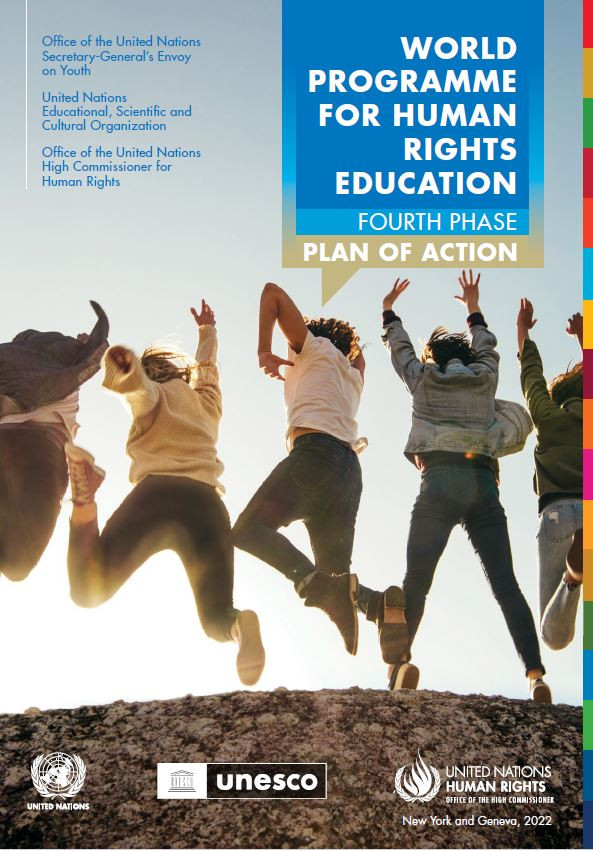 World Programme for Human Rights Education, Fourth Phase: Plan of Action 出版年份: 2022 机构作者: Organización de las Naciones Unidas para la Educación, la Ciencia y la Cultura (UNESCO) | UN. Office of the Secretary-General’s Envoy on Youth | UN. Office of the United Nations High Commissioner for Human Rights (UN. OHCHR) Human rights education for youth, in both formal and non-formal settings, promotes a shared sense of humanity and fosters a common understanding that all human beings are equally deserving of dignity, respect and justice. It empowers youth to fulfil their role as active citizens, to take action and uphold their human rights and those of others, and to participate meaningfully in public affairs and democratic decision-making processes.In recognition of this, the United Nations Member States launched the fourth phase (2020–2024) of the World Programme for Human Rights Education to advance human rights education programming for youth at the national level. This focus also contributes to the achievement of the 2030 Agenda for Sustainable Development, particularly Goal 4 on Education and target 4.7, which touches upon the aims of education.
  World Programme for Human Rights Education: Plan of Action; Third Phase 出版年份: 2017 机构作者: UNESCO | UN. Office of the United Nations High Commissioner for Human Rights (UN. OHCHR) The plan of action for the third phase (2015–2019) of the World Programme, which benefited from the input and review of governmental and nongovernmental experts and practitioners, proposes a concrete strategy and practical ideas for further implementing human rights education and training in the above-mentioned areas at the national level. Its key elements are highlighted below:Human rights education in the primary and secondary school systems and in higher education, and human rights training for teachers and educators, civil servants, law enforcement officials and the military. Programa mundial para la educación en derechos humanos: Plan de acción; Tercera etapa 出版年份: 2017 机构作者: Organización de las Naciones Unidas para la Educación, la Ciencia y la Cultura (UNESCO) | UN. Office of the United Nations High Commissioner for Human Rights (UN. OHCHR) En el Plan de acción para la tercera etapa (2015-2019) del Programa Mundial —que contó con aportaciones y revisiones de diversos expertos y profesionales gubernamentales y no gubernamentales— se proponen una estrategia concreta e ideas prácticas para seguir impartiendo formación y educación en derechos humanos en los ámbitos mencionados en el plano nacional. A continuación se destacan sus elementos principales. Educación en derechos humanos en la enseñanza primaria y secundaria y en la enseñanza superior y formación en derechos humanos de los maestros y los educadores, los funcionarios públicos, los miembros de las fuerzas del orden y el personal military. Programme mondial en faveur de l’éducation aux droits de l’homme : Plan d’action ; Troisième phase 出版年份: 2017 机构作者: Organisation des Nations Unies pour l'éducation, la science et la culture (UNESCO) | UN. Office of the United Nations High Commissioner for Human Rights (UN. OHCHR) Le plan d’action pour la troisième phase (2015-2019) du Programme mondial, qui a bénéficié de l’apport et des avis critiques d’experts et praticiens gouvernementaux et non gouvernementaux, propose une stratégie concrète et des idées pratiques pour poursuivre la mise en œuvre de l’éducation et de la formation aux droits de l’homme dans les secteurs susmentionnés au niveau national. Ses principaux éléments sont indiqués ci-dessous:L’éducation aux droits de l’homme dans les systèmes d’enseignement primaire, secondaire et supérieur, ainsi que la formation aux droits de l’homme des enseignants, des éducateurs, des fonctionnaires, des responsables de l’application des lois et du personnel militaire.