
相关资源
探索丰富的全球公民教育资源,深化理解,促进研究、倡导、教学与学习。
共找到1,583条结果
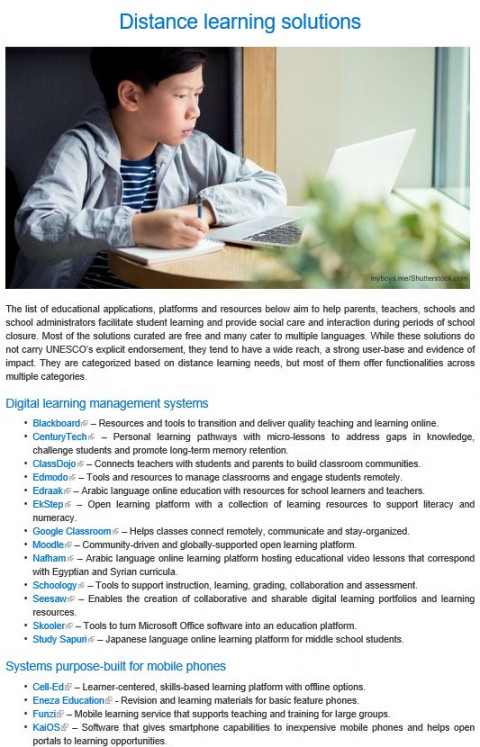 Solutions d’apprentissage à distance 出版年份: 2020 机构作者: UNESCO La liste d’applications et de plates-formes éducatives ci-dessous vise à aider parents, enseignants, établissements et responsables pédagogiques à faciliter l’apprentissage des élèves et à assurer des interactions et des services sociaux pendant la fermeture des écoles. La plupart des solutions sont gratuites et plusieurs sont multilingues. Bien qu’elles ne soient pas explicitement soutenues par l’UNESCO, ces solutions ont généralement une large portée, de nombreux utilisateurs et une efficacité avérée. Elles sont classées par type de besoin pédagogique mais la plupart présente des fonctionnalités relevant de plusieurs catégories. Инструменты дистанционного обучения 出版年份: 2020 机构作者: UNESCO Приведенный ниже список образовательных приложений, платформ и ресурсов призван помочь родителям, учителям, школам и школьным администраторам облегчить процесс обучения учащихся и обеспечить социальную помощь и взаимодействие в периоды закрытия школ. Большинство предложений доступны бесплатно и многие поддерживаются на нескольких языках. Хотя эти предложения не имеют непосредственной поддержки ЮНЕСКО, они, как правило, имеют широкий охват, мощную базу пользователей и подтверждения достигнутых результатов. Они распределены исходя из потребностей дистанционного обучения, но большинство из них предлагают функциональные возможности по нескольким категориям.
  Incheon Declaration: Education 2030: Towards inclusive and equitable quality education and lifelong learning for all 出版年份: 2015 机构作者: UNESCO The "Incheon Declaration: Education 2030: Towards inclusive and equitable quality education and lifelong learning for all" was signed and adopted at the end of the World Education Forum 2015 (WEF 2015) by over 130 Education Ministers and more than 1500 participants. The Declaration marks an important step in the development of international education policy, continuing the Education for All (EFA) movement started in Jomtien in 1990 and formalized in Dakar in 2000. The Declaration also reaffirms the commitment to realize the SDG4, “Ensure inclusive and equitable quality education and promote life-long learning opportunities for all” and the willingness to invest efforts on access, equity and inclusion, quality and learning outcomes, within a lifelong learning approach. Déclaration d'Incheon: Education 2030: Vers une éducation inclusive de qualité et équitable et de l'apprentissage à vie pour tous 出版年份: 2015 机构作者: UNESCO La ‘Déclaration de Incheon: Education 2030: Vers une éducation inclusive de qualité et équitable et l'apprentissage continu pour tous’ a été signé et adopté à la fin du Forum Mondial sur l'Éducation 2015 (FME 2015) par plus de 130 ministres de l'éducation et plus de 1500 participants. La Déclaration marque une étape importante dans le développement de la politique de l'éducation internationale, continue l'Education pour tous (EPT) a commencé à Jomtien en 1990 et formalisé à Dakar en 2000. La Déclaration réaffirme également l'engagement de réaliser le SDG4, ‘Assurer inclusivement l'éducation équitable de la qualité et promouvoir les possibilités d'apprentissage continu pour tous’ et la volonté d'investir des efforts sur l'accès, l'équité et l'inclusion, la qualité des résultats et de l'apprentissage, dans une approche de l'apprentissage continu.
 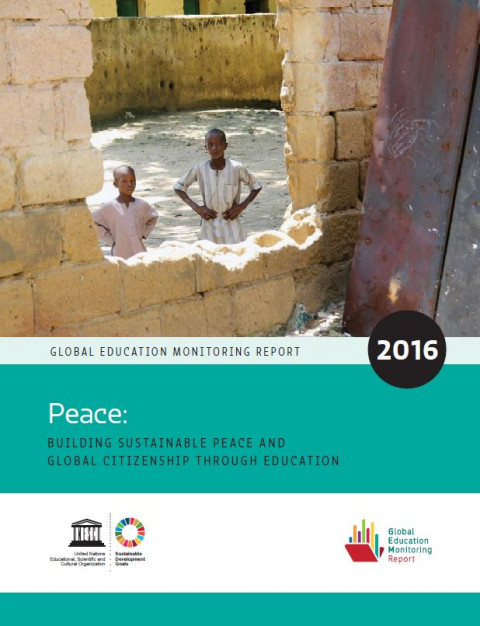 Peace: building sustainable peace and global citizenship through education;Global education monitoring report summary 2016 出版年份: 2017 机构作者: UNESCO The 2016 GEM Report, the first of a new 15-year series, shows that education will not deliver its full potential to catapult the world forward unless rates of improvement dramatically shift, and education systems consider sustainable development in the way services are delivered. This Peace: Building sustainable peace and global citizenship through education publication is a select extract from the full 2016 Global Education Monitoring (GEM) Report: Education for people and planet: Creating sustainable futures for all. It contains two chapters from that full Report – one on peace, political participation and access to justice and the other on education for global citizenship and sustainable development — , along with the associated policy recommendations and a short section of a recent GEM Report Policy Paper Textbooks pave the way to sustainable development.
  Education à la citoyenneté mondiale: thèmes et objectifs d'apprentissage 出版年份: 2015 机构作者: UNESCO This publication, titled Global Citizenship Education: Topics and learning objectives, is the first pedagogical guidance from UNESCO on global citizenship education. It is the result of an extensive research and consultation process with experts from different parts of the world. This guidance draws on the UNESCO publication Global Citizenship Education: Preparing learners for the challenges of the 21st century and the outcomes of three key UNESCO events on global citizenship education: the Technical Consultation on Global Citizenship Education (September 2013), as well as the First and Second UNESCO Fora on Global Citizenship Education, organized in December 2013 and January 2015 respectively. Before it was finalized, the guidance was field-tested by education stakeholders in selected countries in all regions to ensure its relevance in different geographical and socio-cultural contexts. Following the foundational work of UNESCO to clarify the conceptual underpinnings of global citizenship education and provide policy and programmatic directions, this document has been developed in response to the needs of Member States for overall guidance on integrating global citizenship education in their education systems. It presents suggestions for translating global citizenship education concepts into practical and age-specific topics and learning objectives in a way that allows for adaptation to local contexts. It is intended as a resource for educators, curriculum developers, trainers as well as policy-makers, but it will also be useful for other education stakeholders working in non-formal and informal settings.
  Education for peace: planning for curriculum reform; guidelines for integrating an education for peace curriculum into education sector plans and policies 出版年份: 2015 机构作者: UNESCO | UNESCO International Bureau of Education (IBE) | UNESCO International Institute for Educational Planning (IIEP) This Resource and Development Capacity Package was developed based on the belief that, as part of a wider social, economic and political effort, education can play a significant role in a country’s peace-building efforts. Its purpose is to assist Member States in integrating or strengthening peace education programs in their national education systems to promote peace and prevent future conflict. UNESCO, IBE, and IIEP developed this resource within the framework of UNESCO’s Intersectoral Project, Promoting a culture of peace and nonviolence in Africa through education for peace and conflict prevention. The Package contains Technical Guidelines and Capacity Development training modules on policy, program design and curriculum planning to integrate peace and conflict prevention into all aspects of the education system. It is meant for curriculum developers and planners from Africa. The development of the package received the support of the UNESCO Addis-Ababa Office, which assisted in the testing of materials in Addis-Ababa (Ethiopia) and Yaounde (Cameroon).This resource will furthermore help to ensure that curricula, teaching and learning resources and teacher education are in line with the post-2015 vision of education for holistic development. This vision reconceptualises education in terms of global citizenship and responsibility by focusing on inclusion and social cohesion that is global in orientation. In this regard, Global Citizenship Education (GCED) seeks to empower learners with knowledge, skills, values and attitudes that are needed to forge more just and inclusive societies, capable of resolving existing conflicts and emerging global challenges. Éducation pour la paix: la planification de la réforme du curriculum; lignes directrices pour l'intégration d'un programme d'éducation pour la paix dans les plans et politiques du secteur éducatif 出版年份: 2015 机构作者: UNESCO | UNESCO International Bureau of Education (IBE) | UNESCO International Institute for Educational Planning (IIEP) Cette trousse de ressources et de développement des capacités a été élaborée sur la base de la conviction que, dans le cadre d'un effort plus large social, économique et politique, l'éducation peut jouer un rôle important dans les efforts de consolidation de la paix d'un pays. Son but est d'aider les États membres à intégrer ou renforcer les programmes d'éducation à la paix dans leurs systèmes nationaux d'éducation pour promouvoir la paix et prévenir les conflits futurs. UNESCO, le BIE, et l'IIPE ont développé cette ressource dans le cadre du projet intersectoriel de l'UNESCO, Promouvoir une culture de la paix et de la non-violence en Afrique par l'éducation pour la paix et la prévention des conflits. Le paquet contient des directives techniques et des modules de formation de renforcement des capacités sur la politique, la conception des programmes et de la planification des programmes pour intégrer la paix et de prévention des conflits dans tous les aspects du système d'éducation. Il est destiné aux concepteurs de programmes et les planificateurs de l'Afrique. Le développement de l'emballage a reçu le soutien du Bureau d'Addis-Abeba de l'UNESCO, qui a participé à l'essai des matériaux à Addis-Abeba (Ethiopie) et Yaoundé (Cameroun).Cette ressource sera en outre aider à faire en sorte que les programmes, les ressources d'enseignement et d'apprentissage et la formation des enseignants sont en ligne avec la vision post-2015 de l'éducation pour le développement holistique. Cette vision reconceptualise l' éducation en termes de citoyenneté et de responsabilité globale en mettant l'accent sur l'inclusion et la cohésion sociale qui est mondiale dans l'orientation. À cet égard, Éducation à la Citoyenneté Mondiale (ECM) vise à habiliter les apprenants des connaissances, des compétences, des valeurs et des attitudes qui sont nécessaires pour forger des sociétés plus justes et inclusives, capables de résoudre les conflits existants et nouveaux défis mondiaux.
  : Противодействие нетерпимости и дискриминации в отношении мусульман: руководящие принципы. Борьба с исламофобией через образование для преподавателей 出版年份: 2013 机构作者: UNESCO | Council of Europe | OSCE. Office for Democratic Institutions and Human Rights (ODIHR) Intolerance and discrimination against Muslims are not new phenomena. However, they have evolved and gained momentum in recent years, particularly under conditions of the “war on terror”, the global economic crisis, anxieties about national identity and difficulties in coping with the increased diversity in many societies. Such developments have contributed to a growth in resentment and fear of Muslims and Islam that often been fuelled by sections of the media and by some political discourse. Muslims are often portrayed as extremists who threaten the security and well-being of others.These stereotypes have impact not only on young people but also on their parents, as well as on teachers and other education professionals. This presents a new challenge for educators. While teachers cannot be expected to resolve the political and social tensions among communities, they can play a central role in shaping the attitudes and behaviours of young people. The actions and approaches adopted by teachers and school administrators can be crucial in promoting respect for diversity and mutual understanding, both in schools and in society.Developed by OSCE/ODIHR, the Council of Europe and UNESCO, these Guidelines aim to support educators in countering intolerance and discrimination against Muslims. They are intended for a wide audience, including teachers, principals and head teachers, education policymakers and officials, teacher trainers, teacher unions and professional associations, and NGOs. The Guidelines are relevant for both primary and secondary education and can also be used in non-formal education settings.
  UNESCO Global Action Programme on Education for Sustainable Development: information folder 出版年份: 2017 机构作者: UNESCO This is a comprehensive folder containing 13 information sheets on different aspects of the Global Action Programme on ESD (GAP) and its key actors and partners. It aims to familiarize educators, learners and the general public with the GAP and advise them on how to spread the word.