
相关资源
探索丰富的全球公民教育资源,深化理解,促进研究、倡导、教学与学习。
共找到795条结果
 Arts for Transformative Education: A Guide for Teachers from the UNESCO Associated Schools Network 出版年份: 2024 作者: Benjamin Bolden | Sean Corcoran | Tiina Kukkonen | Jeffrey Newberry | Nathan Rickey 机构作者: UNESCO | Canadian Commission for UNESCO UNESCO’s vision of transformative education involves building learners’ capacities and empowering them to take action for a more peaceful and sustainable world. The arts offer tremendous potential for supporting learning that transforms individuals and communities. To fully realize that potential, teachers need to structure and support educational experiences that optimize what students will take away from them. This guide presents the research-informed Arts for Transformative Education model, a pioneering approach and thinking tool for teachers. The model was developed from data provided by over 600 teachers of the UNESCO Associated Schools network from 39 countries. The publication presents Learning Experience Descriptions and Snapshots illustrating how the model functions in real-world projects from around the globe, as well as Guidelines for Teachers outlining a step-by-step process for activating arts learning to empower transformative education.
  Global Inventory of Regional and National Qualifications Frameworks 2017, Vol. I: Thematic Chapters 出版年份: 2017 机构作者: European Centre for the Development of Vocational Training (CEDEFOP) | European Training Foundation (ETF) | UNESCO | UNESCO Institute for Lifelong Learning (UIL) The global inventory 2017 further strengthens the knowledge base on developments in national and regional qualifications frameworks, as implemented by countries and regions, by end of 2016. It acts as an observatory of progress in establishing NQFs, as well as the challenges and success factors in implementation. The thematic chapters (Volume I) discuss key trends and policy issues emerging from qualifications frameworks and learning outcomes reforms and developments. Volume II consists of NQF case studies of 100 countries from all continents and seven regional qualifications frameworks (RQF). The case studies look at the educational, social, economic and political context in which an NQF is embedded, main policy objectives, implementation of learning outcomes, stakeholder involvement and institutional arrangements. They also show how NQFs open for and link to validation arrangements, support recognition and learning pathways. They conclude with important lessons and future plans.The global inventory draws on inventories from four agencies: the European Centre for the Development of Vocational Training (Cedefop), the European Training Foundation (ETF), the United Nations Educational, Scientific and Cultural Organisation (UNESCO) and the UNESCO Institute for Lifelong Learning (UIL), working and communicating with country officials and experts. It also draws on extensive international research in qualifications reforms, comparability of qualifications, and use of learning outcomes.
  Global Inventory of Regional and National Qualifications Frameworks 2017, Vol. II: National and Regional Cases 出版年份: 2017 机构作者: European Centre for the Development of Vocational Training (CEDEFOP) | European Training Foundation (ETF) | UNESCO | UNESCO Institute for Lifelong Learning (UIL) The global inventory 2017 further strengthens the knowledge base on developments in national and regional qualifications frameworks, as implemented by countries and regions, by end of 2016. It acts as an observatory of progress in establishing NQFs, as well as the challenges and success factors in implementation. The thematic chapters (Volume I) discuss key trends and policy issues emerging from qualifications frameworks and learning outcomes reforms and developments. Volume II consists of NQF case studies of 100 countries from all continents and seven regional qualifications frameworks (RQF). The case studies look at the educational, social, economic and political context in which an NQF is embedded, main policy objectives, implementation of learning outcomes, stakeholder involvement and institutional arrangements. They also show how NQFs open for and link to validation arrangements, support recognition and learning pathways. They conclude with important lessons and future plans.The global inventory draws on inventories from four agencies: the European Centre for the Development of Vocational Training (Cedefop), the European Training Foundation (ETF), the United Nations Educational, Scientific and Cultural Organisation (UNESCO) and the UNESCO Institute for Lifelong Learning (UIL), working and communicating with country officials and experts. It also draws on extensive international research in qualifications reforms, comparability of qualifications, and use of learning outcomes.
  Recommendation on Adult Learning and Education, 2015 出版年份: 2016 机构作者: UNESCO | UNESCO Institute for Lifelong Learning (UIL) The Recommendation on Adult Learning and Education was adopted at the 38th Session of the UNESCO General Conference in November 2015. The Recommendation supports the Education 2030 Framework for Action, reflects global trends, and will guide the transformation and expansion of equitable learning opportunities for youth and adults. The 2015 Recommendation takes a comprehensive and systematic approach to ALE, defining three key domains of learning and skills: literacy and basic skills; continuing education and vocational skills; as well as liberal, popular and community education and citizenship skills.It also describes five transversal areas of action: policy; governance; financing; participation, inclusion and equity; and quality. These areas of action were already introduced to the international community in the Belém Framework for Action, adopted at CONFINTEA in 2009 as a means of guiding Member States in improving ALE. This integrative and consistent approach to ALE will help Member States to ensure inclusive and equitable quality education and promote lifelong learning opportunities for all (Sustainable Development Goal 4).
  World Heritage Forests: Carbon Sinks Under Pressure 出版年份: 2021 作者: Tales Carvalho Resende | David Gibbs | Nancy Harris | Elena Osipova 机构作者: UNESCO | International Union for Conservation of Nature (IUCN) | World Resources Institute This report provides the first global scientific assessment of greenhouse gas emissions and sequestration in forests found in UNESCO World Heritage sites.World Heritage forests, whose combined area of 69 million hectares is roughly twice the size of Germany, are some of the most biodiversity-rich habitats on Earth and play a crucial role in climate regulation by absorbing carbon dioxide (CO2) from the atmosphere. However, these forests are under increasing anthropogenic pressures, including climate change.By combining remote sensing data with site-level monitoring, this report has quantified the climate benefits of World Heritage forests for the first time, assessed the impacts on carbon of common threats to World Heritage forests and identified sites that are net carbon sources. It therefore provides information to facilitate dialogues between policymakers and local stakeholders for the development of effective solutions aimed at maintaining the continuing role of World Heritage forests as sinks and stable carbon stores for future generations.
  Getting Every School Climate-ready: How Countries are Integrating Climate Change Issues in Education 出版年份: 2021 机构作者: UNESCO This document summarizes the findings of selected studies by UNESCO and its partners on how climate change issues are integrated in education.These findings shed light on four key questions: where do we stand on climate change education; what do teachers say; what are the examples of country good practices on climate change education; and what does inter-ministerial collaboration on education for sustainable development look like?
  [Summary] Reimagining Our Futures Together: A New Social Contract for Education 出版年份: 2021 机构作者: International Commission on the Futures of Education | UNESCO Our humanity and planet Earth are under threat. Urgent action, taken together, is needed to change course and reimagine our futures. Education, long acknowledged as a powerful force for positive change, has new, urgent and important work to do. Informed by a global consultation process engaging about one million people, this report of the International Commission on the Futures of Education invites governments, institutions, organizations, and citizens around the world to forge a new social contract for education that will help us build peaceful, just, and sustainable futures together and for all.The report features in-depth looks at digital technologies, climate change, democratic slippage and societal polarization and the uncertain future of work. It aims not only to open the conversation about education to everyone and provoke thought, but to spur each of us on to action. It argues, above all, that it is through millions of individual and collective acts of courage, leadership, resistance, creativity and care that we will change course and transform education to build just, equitable and sustainable futures.
  Media and Information Literate Citizens: Think Critically, Click Wisely! 出版年份: 2021 作者: Alton Grizzle | Carolyn Wilson | Ramon Tuazon | C.K. Cheung | Jesus Lau | Rachel Fischer | Dorothy Gordon | Kwame Akyempong | Jagtar Singh | Paul R. Carr | Kristine Stewart | Samy Tayie | Olunifesi Suraj | Maarit Jaakkola | Gina Thésée | Curmira Gulston 机构作者: UNESCO Content providers such as libraries, archives, museums, media and digital communications companies can enable inclusive and sustainable development. However, they do not always live up to these ideals, which creates challenges for the users of these services. Content providers of all types open up new opportunities for lifelong learning. But at the same time, they open up challenges such as misinformation and disinformation, hate speech, and infringement of online privacy, among others.Media and information literacy is a set of competencies that help people to maximize advantages and minimize harms. Media and information literacy covers competencies that enable people to critically and use of digital technologies. Capacities in these areas are indispensable for all citizens regardless of their ages or backgrounds.This pioneering curriculum presents a comprehensive competency framework of media and information pedagogical suggestions. It features various detailed modules covering the range of competencies needed to navigate today’s communications ecosystem. This resource links media and education, education for sustainable development, cultural literacy and the exponential information literacy curriculum, everyone can become media and information literate as well as peer-educators of media and information literacy.
  Sub-Education Policy Review Report: Inclusive Education 出版年份: 2021 机构作者: UNESCO Inclusion highlights opportunities for an equal involvement of individuals with disabilities (physical, social, and emotional) when possible into typical education, but leaves accessible the probability of individual selections and possibilities for special aid and accommodations for persons who need it. This review was initiated by UNESCO to inform the ongoing discourse about inclusive education within Malaysia, Indonesia, Brunei, Philippine and Timur-Leste. Sustainable Development Goal 4 (SDG 4) reinforces the importance of inclusive education which adheres nations to adopt the framework of action in providing inclusion and equity through education of children with perceived differences. The review contributes to the body of literature on inclusive education by synthesizing policy recommendations and evaluations and identifying contradictions and overlaps in those policies. This review draws upon UNESCO reports pertaining to inclusive education policies and initiatives. In addition, a systematic review of empirical studies on inclusive education policy (2010-2020) identified from related and major databases (Eric) is conducted. Both the UNSECO reports and empirical studies are analyzed based on the SDG4 and its targets pertaining to inclusion policy.
 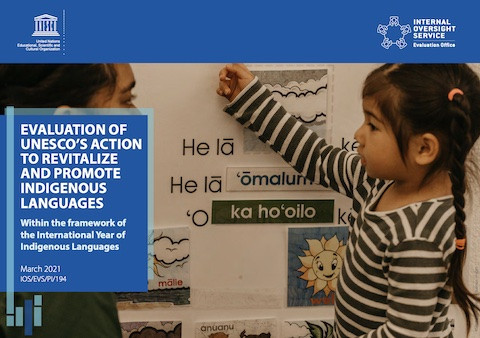 Evaluation of UNESCO’s Action to Revitalize and Promote Indigenous Languages: Within the Framework of the International Year of Indigenous Languages 出版年份: 2021 作者: Claire Thomas | Lydia van de Fliert | Oliver Loode | Silvia Quattrini | Mihaela Cojocaru 机构作者: UNESCO To draw attention to the critical loss of indigenous languages and the urgent need to preserve, revitalize and promote them and to take further urgent steps at the national and international levels, in 2016 the United Nations General Assembly in its resolution 71/178 proclaimed the year beginning on 1 January 2019 the International Year of Indigenous Languages (hereafter the IYIL2019). UNESCO was invited to serve as the lead agency for the Year and the coordination role was internally assigned to the Communication and Information Sector. UNESCO requested an evaluation of its action within the IYIL2019 with a view to learning from its experience during 2019 and further strengthening its coordination and implementation role during the upcoming Decade of Indigenous Languages (2022-2032).As the lead agency for the IYIL2019, UNESCO played a key role raising awareness of not only the critical loss of indigenous languages, but also the positive value and meanings that indigenous languages provide to Indigenous Peoples and humanity at large. The evaluation found that UNESCO led the development of an ambitious and relevant Action Plan for the Year. It also succeeded in setting up an 18-member Steering Committee composed of representatives of Member States, Indigenous Peoples and the UN three-party indigenous mechanisms. UNESCO staff implemented more than 80 activities around the world, with three-quarters of these at the global level and the majority of national events in Latin America and the Caribbean region. It also maintained an interactive website, which registered more than 880 events around the world.Leading and coordinating the IYIL2019 was not without its challenges, particularly as UNESCO was asked to lead this effort within existing resources and relying on a very small core team. Its programme sectors found creative solutions for indigenous language programming, but without a budget for intersectoral activities, collaboration between sectors was limited to information sharing and activities in Africa and the Arab States were few. The evaluation also found that the Action Plan lacked a meaningful results framework and thereby did not facilitate the monitoring of the IYIL2019. Partnerships with UNESCO networks and the wider UN system were underutilized and many opportunities for future collaboration have been highlighted for the upcoming Decade.