
相关资源
探索丰富的全球公民教育资源,深化理解,促进研究、倡导、教学与学习。
共找到2条结果
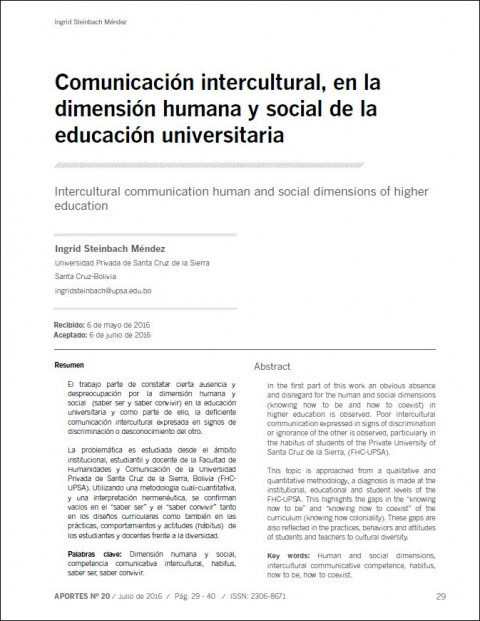 Intercultural Communication Human and Social Dimensions of Higher Education 出版年份: 2016 作者: Ingrid Steinbach Méndez 机构作者: Universidad Privada de Santa Cruz de la Sierra The starting point of this work is verifying the absence of and disregard for the human and social dimensions (knowing how to be and knowing how to coexist) in university education, including deficient intercultural communication manifested in discrimination ora lack of acknowledgement of the other. The problem is studied from the standpoints of the institution, the students and the faculty of the Faculty of Humanities and Communication of the Universidad Privada de Santa Cruz de la Sierra, Bolivia (FHC-UPSA). Using a qualitative quantitative methodology and a hermeneutic interpretation, voids are confirmed in the areas of "knowing how to be" and "knowing how to coexist" in the curricular designs as well as in the practices, behaviors and attitudes (habitus) of the students and faculty when faced with diversity. Comunicación intercultural, en la dimensión humana y social de la educación universitaria 出版年份: 2016 作者: Ingrid Steinbach Méndez 机构作者: Universidad Privada de Santa Cruz de la Sierra El trabajo parte de constatar una ausencia y despreocupación por la dimensión humana y social (saber ser y saber convivir) en la educación universitaria y como parte de ello, la deficiente comunicación intercultural expresada en signos de discriminación o desconocimiento del otro.La problemática es estudiada desde el ámbito institucional, estudiantil y docente de la Facultad de Humanidades y Comunicación de la Universidad Privada de Santa Cruz de la Sierra, Bolivia (FHC-UPSA). Utilizando una metodología cuali-cuantitativa, y una interpretación hermenéutica, se confirman vacíos en el "saber ser" y el "saber convivir" tanto en los diseños curriculares como también en las prácticas, comportamientos y actitudes (hábitus) de los estudiantes y docentes frente a la diversidad.