
相关资源
探索丰富的全球公民教育资源,深化理解,促进研究、倡导、教学与学习。
共找到2条结果
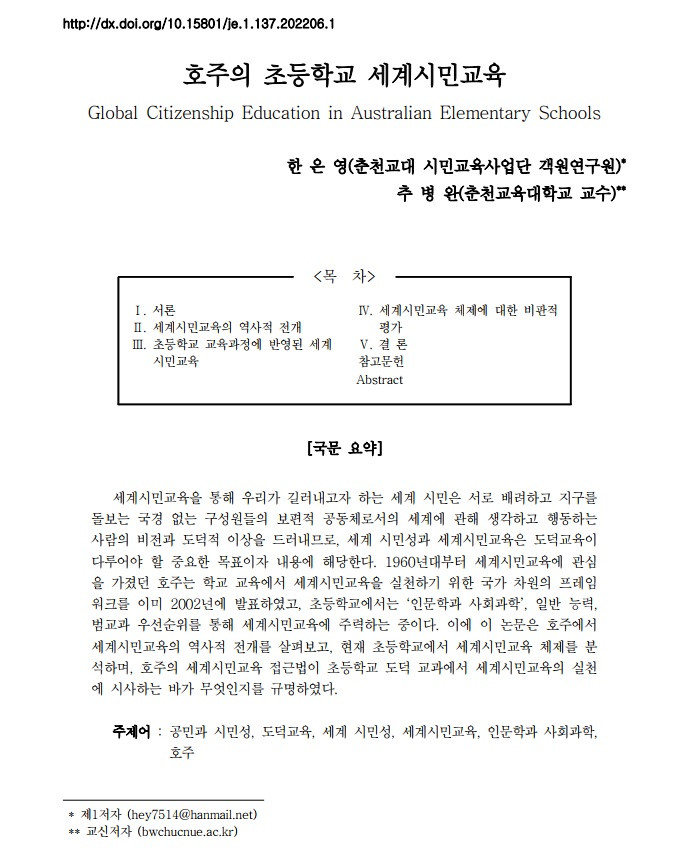 Global Citizenship Education in Australian Elementary Schools(Journal of Ethics; Vol. 137, No 1) 出版年份: 2022 作者: 한은영 | 추병완 机构作者: 한국윤리학회 Global citizens think and act about the world as a universal community of borderless members who care for each other and are dedicated to taking care of the earth. Considering these visions and moral ideals, global citizenship education is an important goal and content of moral education. However, at present, we do not have a framework for dealing with global citizenship education in moral education. In this regard, Australia is the country we should pay attention to. Australia declared a national statement for global citizenship education in 2002. Since 2009, it has been reflected in the Australian curriculum. This article examines the historical development of global citizenship education in Australia, analyzes the current systems of global citizenship education system in primary schools, and investigates what Australia's approach to global citizenship education suggests for elementary moral education in Korea. In conclusion, we proposed three things. First, we must develop and apply a framework for the practice of global civic education in moral education. Second, we should emphasize the aspects of knowledge and understanding, skills and processing, behavior and participation as well as values and attitudes. Third, we must seek a balance between moderate global citizenship education and critical global citizenship education.
  Supporting Change in Practice: Case Studies on the Use of the ACER-APCEIU Global Citizenship Education Monitoring Toolkit; Country Case-Australia 出版年份: 2025 作者: Rachel Parker | Karena Menzie-Ballantyne 机构作者: APCEIU APCEIU published Supporting Change in Practice: Case Studies on the Use of the ACER-APCEIU Global Citizenship Education Monitoring Toolkit, which shares key findings from the research conducted in Australia and the Republic of Korea. The two reports, based on case studies from two countries, build upon the three-phase Asia-Pacific GCED Monitoring Project (2022–2024) jointly undertaken by ACER and APCEIU to strengthen monitoring and evaluation of GCED and support progress toward SDG 4.7 across the region. The three phases of the initiative identified enabling conditions for GCED, validated the regional GCED Monitoring Framework, and developed the ACER-APCEIU GCED Monitoring Toolkit. The reports for each phase can be found here: Phase I, Phase II, and Phase III.The reports move the project forward by examining how the Toolkit can be practically applied in real educational settings. The study aimed to examine how the Toolkit could be used to support collaboration among key education stakeholders—teachers, school leaders, and education supervisors—in 1) goal setting, 2) planning, 3) implementing, and 4) reflecting on GCED practices. Through this process, the research sought to understand how the Toolkit could help strengthen the connection between policy commitments and everyday educational practice, supporting teachers, school leaders, and system leaders to embed GCED more systematically and sustainably within their existing framework. Both studies conducted in Australia and the Republic of Korea have been guided by the following research questions: How does the GCED Monitoring Toolkit support key stakeholder groups to collaboratively embed GCED in policy and practice? a. What aspects of the Toolkit enable or challenge stakeholders to achieve their GCED goals and objectives? b. How do key stakeholders perceive its usefulness?Are there any aspects of the Toolkit that stakeholders would change to improve its usefulness in supporting the implementation and contextualisation of GCED in policy and practice?The reports demonstrate how a GCED Monitoring Toolkit can be translated into actionable processes within real educational settings. It offers valuable insights for policymakers, school leaders, teachers, and researchers aiming to monitor and strengthen GCED implementation and systematically embed GCED within their educational ecosystems.