
相关资源
探索丰富的全球公民教育资源,深化理解,促进研究、倡导、教学与学习。
共找到67条结果
 Developing Positive Values: A case study of Holocaust Memorial Day in the primary schools of one local authority in Scotland Many schools and local authorities saw the initial Holocaust Memorial Day as an important stimulus to develop lessons and events in Holocaust history amongst young people of vital importance for today. The focus of this paper is to examine the potential for Holocaust education in the primary curriculum in Scotland and whether the instance of Holocaust Memorial Day and the undertaking of a serious commitment to it by a local authority had an impact on the teaching and raising of Holocaust issues in the primary schools in that area. The authors previously argued (Maitles & Cowan, 1999) that there needed to be a major commitment from the Scottish Executive and/or local councils to encourage teachers and schools to coordinate or introduce Holocaust education in the schools. To test this, the field research for this survey was conducted by means of a questionnaire to every primary school in the local authority and achieved a 91% response rate. Strong national commitment to Holocaust educational activities, backed up by commitment from the local authority, in terms of staff development and teaching materials, ensured a quality of experience as well as the quantity. Linked to this was an effective structure in the schools, with a designated Holocaust education coordinator and the involvement of the wider community. This led teachers in schools to imaginatively develop pupil skills, knowledge and understanding and informed attitudes in Holocaust history which potentially has a resonance in the wider citizenship area. (By the publisher) Values and Attitudes - Positive and Negative: A study of the impact of teaching the Holocaust on citizenship among Scottish 11-12 year olds Previous research on teaching the Holocaust, notably case studies in the primary or the secondary sectors, suggests that Holocaust education can make a significant contribution to citizenship by developing pupils’ understandings of justice, tolerance, human rights issues, and the many forms of racism and discrimination. Yet, there have been no longitudinal studies into its impact on primary pupils. This paper reports on the first stages of ongoing longitudinal research (sponsored by the Scottish Executive Education Department) and concentrates on the relevance of Holocaust education to citizenship, by comparing the attitudes of primary 7 pupils before and after Holocaust teaching using data from questionnaires. Results show an improvement in pupils’ values and attitudes after learning about the Holocaust in almost every category related to minority groups, ethnic or otherwise. One significant finding was a deep anti-English feeling and this in itself indicates the need for further investigation. (By the author)
 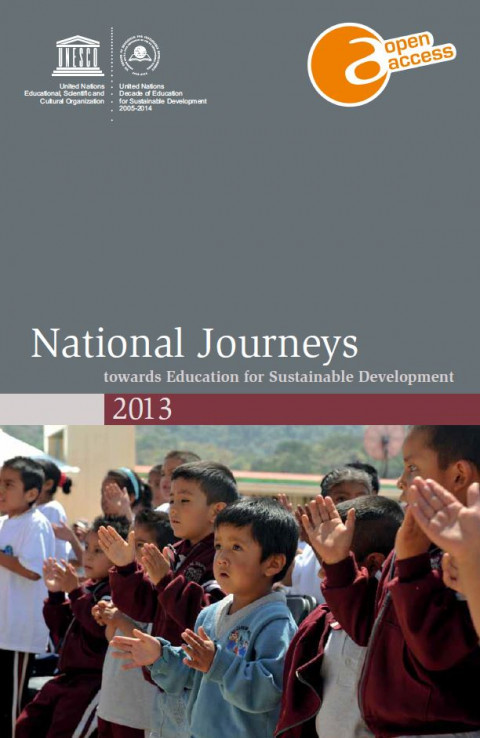 National journeys towards education for sustainable development, 2013: reviewing national ESD experiences from Costa Rica, Morocco, South Africa, Sweden, VietNam 出版年份: 2013 机构作者: UNESCO This publication has sourced information from a series of national reviews commissioned by UNESCO in 2011/2012 and was written by experts in Costa Rica, Morocco, South Africa, Sweden and Viet Nam. The countries presented in this report are not necessarily the ‘best’ examples of the region, as many other countries are also progressing effectively towards implementing Education for Sustainable Development (ESD). Rather, the countries selected illustrate the wide diversity of ESD approaches and initiatives taking place in different parts of the world. The national studies were then edited and harmonized before common themes and lessons learnt were identified to support other national efforts in moving towards the end of the UN Decade of Education for Sustainable Development. Voyages nationaux vers l'éducation pour le développement durable, 2013: examen des expériences nationales EDD du Costa Rica, Maroc, Afrique du Sud, Suède, Vietnam 出版年份: 2013 机构作者: UNESCO Cette publication a source d'informations à partir d'une série d'examens nationaux mandatés par l'UNESCO en 2011/2012 et a été rédigé par des experts au Costa Rica, Maroc, Afrique du Sud, la Suède et le Viet Nam. Les pays présentés dans ce rapport ne sont pas nécessairement les exemples «meilleurs» de la région, comme beaucoup d'autres pays progressent également de manière efficace pour mettre en œuvre l'éducation pour le développement durable (EDD). Au contraire, les pays sélectionnés illustrent la grande diversité des approches et des initiatives qui se déroulent dans différentes parties du monde EDD. Les études nationales ont ensuite été modifiés et harmonisés avant les thèmes et les enseignements tirés ont été identifiés pour soutenir d'autres efforts nationaux dans le déplacement vers la fin de la Décennie des Nations Unies pour l'éducation au développement durable communs. Éducation pour le développement durable: bonnes pratiques dans l'éducation de la petite enfance 出版年份: 2012 机构作者: UNESCO To support the growing interest in early childhood issues and ESD, UNESCO is publishing this volume containing 12 examples of programmes addressing ESD in early childhood settings and practices. These good practices and shared experiences, which were provided by a range of different stakeholders, are concrete examples of successful implementation of ESD in different fields and sectors, from the political to the school level, and including formal, nonformal and informal learning situations. Education pour le développement durable: bonnes pratiques en matière de biodiversité 出版年份: 2012 机构作者: UNESCO To support the growing interest in biodiversity issues and ESD, UNESCO is publishing this volume containing 24 examples of programmes addressing biodiversity in ESD settings and practices. These good practices and shared experiences, which were provided by a range of different stakeholders, are concrete examples of successful implementation of ESD in different fields and sectors, from the political to the school level, and including formal, non-formal and informal learning situations. Education for sustainable development; good practices in addressing biodiversity 出版年份: 2012 机构作者: UNESCO To support the growing interest in biodiversity issues and ESD, UNESCO is publishing this volume containing 24 examples of programmes addressing biodiversity in ESD settings and practices. These good practices and shared experiences, which were provided by a range of different stakeholders, are concrete examples of successful implementation of ESD in different fields and sectors, from the political to the school level, and including formal, non-formal and informal learning situations. Buenas prácticas de educación para el desarrollo sostenible en la primera infancia 出版年份: 2012 机构作者: UNESCO To support the growing interest in early childhood issues and ESD, UNESCO is publishing this volume containing 12 examples of programmes addressing ESD in early childhood settings and practices. These good practices and shared experiences, which were provided by a range of different stakeholders, are concrete examples of successful implementation of ESD in different fields and sectors, from the political to the school level, and including formal, nonformal and informal learning situations.
  Supporting Change in Practice: Case Studies on the Use of the ACER-APCEIU Global Citizenship Education Monitoring Toolkit: Country Case-Republic of Korea 出版年份: 2025 作者: Suyeon Park | Sunmi Ji | Yoonyoung Lee 机构作者: APCEIU APCEIU is pleased to announce the release of its new publications, Supporting Change in Practice: Case Studies on the Use of the ACER-APCEIU Global Citizenship Education Monitoring Toolkit, which shares key findings from the research conducted in Australia and the Republic of Korea. The two reports, based on case studies from two countries, build upon the three-phase Asia-Pacific GCED Monitoring Project (2022–2024) jointly undertaken by ACER and APCEIU to strengthen monitoring and evaluation of GCED and support progress toward SDG 4.7 across the region. The three phases of the initiative identified enabling conditions for GCED, validated the regional GCED Monitoring Framework, and developed the ACER-APCEIU GCED Monitoring Toolkit. The reports for each phase can be found here: Phase I, Phase II, and Phase III. The newly released reports move the project forward by examining how the Toolkit can be practically applied in real educational settings. The study aimed to examine how the Toolkit could be used to support collaboration among key education stakeholders—teachers, school leaders, and education supervisors—in 1) goal setting, 2) planning, 3) implementing, and 4) reflecting on GCED practices. Through this process, the research sought to understand how the Toolkit could help strengthen the connection between policy commitments and everyday educational practice, supporting teachers, school leaders, and system leaders to embed GCED more systematically and sustainably within their existing framework. Both studies conducted in Australia and the Republic of Korea have been guided by the following research questions: 1. How does the GCED Monitoring Toolkit support key stakeholder groups to collaboratively embed GCED in policy and practice? a. What aspects of the Toolkit enable or challenge stakeholders to achieve their GCED goals and objectives? b. How do key stakeholders perceive its usefulness? 2. Are there any aspects of the Toolkit that stakeholders would change to improve its usefulness in supporting the implementation and contextualisation of GCED in policy and practice?The reports demonstrate how a GCED Monitoring Toolkit can be translated into actionable processes within real educational settings. It offers valuable insights for policymakers, school leaders, teachers, and researchers aiming to monitor and strengthen GCED implementation and systematically embed GCED within their educational ecosystems.
  UNESCO Women for Ethical AI: Outlook Study on Artificial Intelligence and Gender 出版年份: 2024 机构作者: UNESCO The gender chapter of the UNESCO Recommendation on the Ethics of AI is a concrete commitment by 194 Member States to advance gender equality in the AI ecosystem. To track progress in the implementation of the gender provisions of UNESCO’s Recommendation, and to assess the impacts of AI on gender equality, the UNESCO Women for Ethical AI (W4EAI) Platform has been established. This report advances the workstream through evidence-based insights in three critical areas: women’s participation in AI development and deployment, the inclusion of gender equality concerns in AI governance and the impact of AI on gender equality. It highlights the significant underrepresentation of women in AI, the lack of gender-disaggregated data, and the compounded challenges women face in the field. The report also addresses the neglect of gender dimensions in AI policy, the risks posed by AI systems to women, and the need for responsible and ethical AI governance to promote gender equality. Finally, it outlines actionable recommendations to enhance gender equality through and in AI, emphasizing the importance of comprehensive data collection, targeted interventions, and inclusive policy-making.