
相关资源
探索丰富的全球公民教育资源,深化理解,促进研究、倡导、教学与学习。
共找到5条结果
 The Contribution of the New Mexican Culture to Education for World Citizenship(Sinéctica, Revista electrónica de educación; no. 60) 出版年份: 2023 作者: Gloria Esther Briceño Alcaraz 机构作者: Sinéctica, Revista Electrónica de Educación A couple of years ago, UNESCO suggested transforming educational models based on an in-tegral and humanist paradigm in order to train new generations with a social and civic di-mension, based on human rights. In this essay we propose to analyze the work of education as a preferential instrument not only to develop traditional school skills, but also as an ac-tion to form citizens with a sense of responsibility and social self-awareness that promote a culture of peace. The citizen-subject represents an identity or discursive construction that is forged in the social framework in which it is situated, always in tension between individual freedom, autonomy and collective normative frameworks (Cerda, 2004), hence the interest in approaching from a critical perspective of discourse analysis (Van Dijk, 2014) to the pro-posal of the new educational model of Mexico called the New Mexican School (2022) and open the discussion on this pedagogical model and the formative fields that affect education for global citizenship. El aporte de la nueva cultura mexicana a la educación para la ciudadanía mundial(Sinéctica, Revista electrónica de educación; núm. 60) 出版年份: 2023 作者: Gloria Esther Briceño Alcaraz 机构作者: Sinéctica, Revista Electrónica de Educación La UNESCO sugirió hace un par de años transformar los modelos educativos con base en un paradigma integral y humanista a fin de formar a las nuevas generaciones con dimensión social y ciudadana, cuya base fueran los derechos humanos. En este ensayo nos planteamos analizar el quehacer de la educación como instrumento preferente no solo para desarrollar las capacidades escolares tradicionales, sino como acción formadora de ciudadanos con sentido de responsabilidad y autoconciencia social que promuevan una cultura de paz. El sujeto-ciudadano representa una construcción identitaria o discursiva que se va forjando en el entramado social en el que este se sitúa, siempre en tensión entre la libertad individual, la autonomía y los marcos normativos colectivos (Cerda, 2004), de ahí el interés en aproximarnos desde una perspectiva crítica del análisis del discurso (Van Dijk, 2014) a la propuesta de la llamada nueva escuela mexicana (2022) y abrir la discusión sobre este modelo pedagógico y los campos formativos que inciden en la educación para la ciudadanía mundial.
 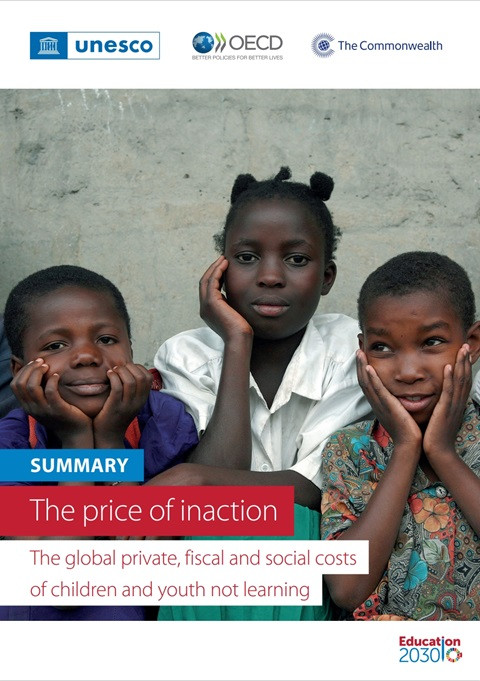 [Summary] The Price of Inaction: The Global Private, Fiscal and Social Costs of Children and Youth Not Learning 出版年份: 2024 机构作者: UNESCO | Organisation for Economic Co-operation and Development (OECD) | Commonwealth Secretariat Education is a fundamental human right for all. The United Nations Sustainable Development Goal (SDG) 4 on education has received considerable attention since its adoption in 2015. But more than halfway through the implementation period, achieving the ambitious agenda of inclusive and equitable quality education for all by 2030 remains a significant challenge for countries around the globe. As this report shows, the US$10 trillion social cost of failing to educate all the world’s children is just too high. This is the summary of The Price of Inaction: The Global Private, Fiscal and Social Costs of Children and Youth Not Learning. [Resumen] El precio de la inacción: el costo global privado, fiscal y social de que los niños, niñas y jóvenes no aprendan 出版年份: 2024 机构作者: UNESCO | Organisation for Economic Co-operation and Development (OECD) | Commonwealth Secretariat La educación es un derecho humano fundamental para todas y todos. El Objetivo de Desarrollo Sostenible (ODS) 4 de las Naciones Unidas sobre educación ha recibido una atención considerable desde su adopción en 2015. Sin embargo, a más de la mitad del periodo de implementación, la consecución de la ambiciosa agenda de una educación de calidad inclusiva y equitativa para todos en 2030 sigue siendo un desafío considerable para los países del mundo entero. Como muestra este estudio, el costo social de 10 billones de dólares de no educar a todas las niñas y todos los niños del mundo es demasiado elevado. [Résumé] Le prix de l’inaction : les coûts privés, fiscaux et sociaux à l’échelle mondiale des enfants et des jeunes qui n’apprennent pas 出版年份: 2024 机构作者: UNESCO | Organisation for Economic Co-operation and Development (OECD) | Commonwealth Secretariat L'éducation est un droit humain fondamental pour tous. L'objectif de développement durable (ODD) 4 des Nations Unies sur l'éducation a suscité une attention considérable depuis son adoption en 2015. Cependant, à plus de la moitié de la période de mise en œuvre, atteindre l'ambitieux objectif d'une éducation de qualité, inclusive et équitable pour tous d'ici 2030 reste un défi majeur pour les pays du monde entier. Comme le montre ce rapport, le coût social de 10 000 milliards de dollars américains lié à l'échec de l'éducation de tous les enfants dans le monde est tout simplement trop élevé.