
相关资源
探索丰富的全球公民教育资源,深化理解,促进研究、倡导、教学与学习。
共找到526条结果
 L'Education au développement durable: visions d'enfants 出版年份: 2011 机构作者: UNESCO These eleven drawings and paintings were entered in the UNESCO “Draw me peace” competition. Each drawing represents a particular aspect of Education for Sustainable Development and reflects the next generations’ vision for a better, fairer future.
 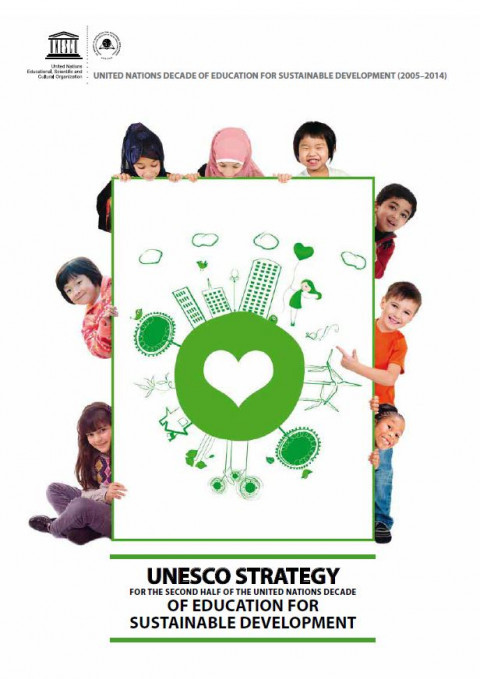 UNESCO strategy for the second half of the United Nations decade of education for sustainable development 出版年份: 2010 机构作者: UNESCO The UNESCO Strategy for the Second Half of the United Nations (UN) Decade of Education for Sustainable Development (DESD) draws on the findings and lessons learnt from the first phase of the DESD monitoring and evaluation (M&E) process (as reflected in the 2009 DESD M&E report Learning for a Sustainable World: Review of Contexts and Structures for Education for Sustainable Development. It also builds on the UNESCO World Conference on ESD and the Bonn Declaration as well as on the outcomes of other key international ESD meetings. The Bonn Declaration gives particular emphasis to the importance of education for the global development agenda and underlines the essential contribution of ESD to shaping the purpose, content and quality of all education. The UNESCO strategy will be implemented in line with the International Implementation Scheme (IIS), which, along with the Bonn Declaration, will provide the global strategic framework for UNESCO and its DESD partners during the second half of the Decade. The Strategy takes into account key DESD regional challenges and opportunities. It is also shaped by the shared vision of education emerging from the four 2008-2009 UNESCO international education conferences: one of education systems that encourage equity and inclusion, quality learning, flexibility and innovation. While UNESCO puts highest emphasis on achieving Education for All (EFA), the Organization’s actions in education extend beyond this, to pay explicit attention to inclusion, social cohesion and social justice, to lifelong learning and to the crucial role of higher education and research. The overall goal of the UNESCO Strategy for the Second Half of the DESD is to support Member States and other stakeholders in addressing global sustainable development challenges at regional, national and global level through ESD, thus addressing the challenges of learning for bringing about a more sustainable world. Address by Irina Bokova, Director-General of UNESCO on the occasion of the Conference on Education for Sustainable Development in Support of Cultural and Biological Diversity; Oman, 24 January 2011 出版年份: 2011 机构作者: UNESCO. Director-General, 2009-2017 (Bokova, I.G.) This address was given by Irina Bokova, Director-General of UNESCO on the occasion of the Conference on Education for Sustainable Development in Support of Cultural and Biological Diversity. Discours de Mme Irina Bokova, Directrice Générale de l'UNESCO, à l'occasion de la Conférence sur L'Education au Service du Développement Durable en Appui à la Diversité Culturelle et Biologique, Oman, 24 Janvier 2011 出版年份: 2011 机构作者: UNESCO. Director-General, 2009-2017 (Bokova, I.G.) This address was given by Irina Bokova, Director-General of UNESCO on the occasion of the Conference on Education for Sustainable Development in Support of Cultural and Biological Diversity. L'Enseignement pour le développement durable de l'Arctique 出版年份: 2009 作者: Lars Kullerud 机构作者: UNESCO Education is an essential component of sustainable development. However, for the Arctic there is a history of education systems that tried to force central school models on local people, including different degrees of suppression of local language. This has been improved today to various degrees in the Arctic states. However, lack of skilled teachers with local roots is a circumpolar challenge. Arctic higher educational institutions also face many challenges when attempting to be innovative and competitive due to their small size and geographic isolation. The model of the University of the Arctic allows for a dynamic development of shared education systems through mutual cooperation. This network can be a very efficient tool to for delivering a relevant curriculum for a changing North. Education for Arctic sustainable development 出版年份: 2009 作者: Lars Kullerud 机构作者: UNESCO Education is an essential component of sustainable development. However, for the Arctic there is a history of education systems that tried to force central school models on local people, including different degrees of suppression of local language. This has been improved today to various degrees in the Arctic states. However, lack of skilled teachers with local roots is a circumpolar challenge. Arctic higher educational institutions also face many challenges when attempting to be innovative and competitive due to their small size and geographic isolation. The model of the University of the Arctic allows for a dynamic development of shared education systems through mutual cooperation. This network can be a very efficient tool to for delivering a relevant curriculum for a changing North.
 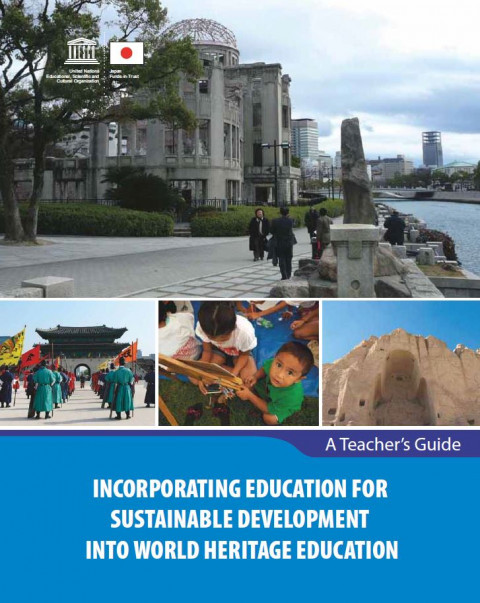 Incorporating education for sustainable development into world heritage education: a teacher's guide 出版年份: 2010 机构作者: UNESCO Bangkok This publication, A Teacher’s Guide: Incorporating Education for Sustainable Development into World Heritage Education, represents the collective efforts of workshop participants to produce a practical tool for teachers to modify available curricula and incorporate ESD concepts and principles into WHE. It has taken a long time for the guide to be available in print. Nonetheless, the content of the guide remains practical and relevant in incorporating Education for Sustainable Development into World Heritage Education. Intégrer l'éducation au développement durable dans l'éducation au patrimoine mondial: un guide pour l'enseignant 出版年份: 2010 机构作者: UNESCO Bangkok Cette publication, intitulée Un guide pour les enseignants: intégrer l'éducation au développement durable dans l'éducation au patrimoine mondial, représente les efforts collectifs des participants à l'atelier pour produire un outil pratique pour les enseignants afin de modifier les programmes disponibles. Le guide a mis du temps à être disponible en version imprimée. Néanmoins, le contenu du guide reste pratique et pertinent pour intégrer l'éducation au développement durable dans l'éducation au patrimoine mondial. Learning to live with risk: disaster risk reduction to encourage education for sustainable development: concept note 出版年份: 2009 作者: Ria Hidajat 机构作者: International Strategy for Disaster Reduction | German Committee for Disaster Reduction In this paper the German Committee for Disaster Reduction and the UN ISDR Thematic Platform on Knowledge and Education introduced their reflection on linking Education for Sustainable Development and Disaster Risk Management. It is aimed in particular at the participants of the World Conference of Education for Sustainable Development and other stakeholders engaged in promoting Education, Sustainable Development and Disaster Risk Reduction at all levels. The paper elucidates how Disaster Risk Reduction supports Education for Sustainable Development or even shows that Disaster Risk Reduction is imperative for Sustainable Development. Disaster Risk Reduction is about preventing disasters caused by natural events, such as earthquakes, floods, landslides, storms or volcanic eruptions. Hazards are part of nature but can turn into disasters as a result of human interactions. Disasters are among the biggest obstacles to achieving the UN’s Millennium Development Goals for poverty reduction. Apprendre à vivre avec le risque: réduction des risques de catastrophe pour encourager l'éducation au développement durable: note conceptuelle 出版年份: 2009 作者: Ria Hidajat 机构作者: International Strategy for Disaster Reduction | German Committee for Disaster Reduction Dans ce document, le Comité allemand pour la prévention des catastrophes et la Plate-forme thématique de l'ISDR sur la connaissance et l'éducation ont présenté leur réflexion sur le lien entre l'éducation pour le développement durable et la gestion des risques de catastrophe. Il s'adresse en particulier aux participants à la Conférence mondiale sur l'éducation au développement durable et aux autres parties prenantes engagées dans la promotion de l'éducation, du développement durable et de la prévention des catastrophes à tous les niveaux. Le document élucide comment la réduction des risques de catastrophe soutient l'éducation pour le développement durable ou montre même que la réduction des risques de catastrophe est impérative pour le développement durable. La réduction des risques de catastrophe consiste à prévenir les catastrophes causées par des événements naturels tels que des tremblements de terre, des inondations, des glissements de terrain, des tempêtes ou des éruptions volcaniques. Les dangers font partie de la nature mais peuvent se transformer en désastres à la suite des interactions humaines. Les catastrophes figurent parmi les principaux obstacles à la réalisation des Objectifs du Millénaire pour le développement de l'ONU pour la réduction de la pauvreté.