
相关资源
探索丰富的全球公民教育资源,深化理解,促进研究、倡导、教学与学习。
共找到249条结果
 Address by Irina Bokova, Director-General of UNESCO on the occasion of the Seminar on Climate Change and Education at the UN University: Responding to Climate Change Starts with Education; Tokyo, 26 November 2010 出版年份: 2010 机构作者: UNESCO. Director-General, 1999-2009 (Matsuura, K.) This document is an address of Irina Bokova, Director-General of UNESCO on the occasion of the Seminar on Climate Change and Education at the UN University “Responding to Climate Change Starts with Education” in Tokyo, 26 November 2010. She highlighted the importance of climate change education for the sustainable future and underlined the importance of several programme such as Sandwatch and YouthXchange which have been lead by the UNESCO. Climate change starter's guidebook: an issues guide for education planners and practitioners 出版年份: 2011 作者: Alejandro Deeb | Amber French | Julia Heiss | Jason Jabbour | Dominique LaRochelle | Arkadiy Levintanus | Anna Kontorov | Rummukainen Markku | Gerardo Sanchez Martinez | Rosalyn McKeown | Nicolay Paus | Antoine Pecoud | Guillaume Pénisson | Daniel Puig | Vanessa Retana | Serban Scrieciu | Morgan Strecker | Vimonmas Vachatimanont | Benjamin Witte | Noriko Yamada. 机构作者: United Nations Environment Programme (UNEP) The Climate Change Starter’s Guide provides an introduction and overview for education planners and practitioners on the wide range of issues relating to climate change and climate change education, including causes, impacts, mitigation and adaptation strategies, as well as some broad political and economic principles. The aim of this guide is to serve as a starting point for mainstreaming climate change education into school curricula. It has been created to enable education planners and practitioners to understand the issues at hand, to review and analyse their relevance to particular national and local contexts, and to facilitate the development of education policies, curricula, programmes and lesson plans. The guide covers four major thematic areas: 1. the science of climate change, which explains the causes and observed changes; 2. the social and human aspects of climate change including gender, health, migration, poverty and ethics; 3. policy responses to climate change including measures for mitigation and adaptation; and 4. education approaches including education for sustainable development, disaster reduction and sustainable lifestyles. A selection of key resources in the form of publication titles or websites for further reading is provided after each of the thematic sections. The United Nations Educational, Scientific and Cultural Organization (UNESCO) provides its expertise and know-how in areas such as education, culture, and the social sciences. In particular, UNESCO emphasises the role of education in support of climate change adaptation and mitigation in providing skills and capacities but also through shaping the values, attitudes and behaviours needed to put the world on a more sustainable path. The United Nations Environment Programme (UNEP) works with countries to strengthen their ability to adapt to climate change, move towards low-carbon growth, reduce emissions from deforestation and forest degradation, improve understanding of climate science, and raise public awareness of the changing climate. UNEP is supporting countries to seize the opportunities of moving towards low-carbon growth, while improving human health and well-being, generating green jobs and moving towards a green economy. With this publication, the two organizations have embarked on a collaboration on climate change education that we are committed to building upon and expanding in the period ahead. Learning to live with risk: disaster risk reduction to encourage education for sustainable development: concept note 出版年份: 2009 作者: Ria Hidajat 机构作者: International Strategy for Disaster Reduction | German Committee for Disaster Reduction In this paper the German Committee for Disaster Reduction and the UN ISDR Thematic Platform on Knowledge and Education introduced their reflection on linking Education for Sustainable Development and Disaster Risk Management. It is aimed in particular at the participants of the World Conference of Education for Sustainable Development and other stakeholders engaged in promoting Education, Sustainable Development and Disaster Risk Reduction at all levels. The paper elucidates how Disaster Risk Reduction supports Education for Sustainable Development or even shows that Disaster Risk Reduction is imperative for Sustainable Development. Disaster Risk Reduction is about preventing disasters caused by natural events, such as earthquakes, floods, landslides, storms or volcanic eruptions. Hazards are part of nature but can turn into disasters as a result of human interactions. Disasters are among the biggest obstacles to achieving the UN’s Millennium Development Goals for poverty reduction. Symposium on climate change education and sustainable cities, 31 August 2009, United Nations Office at Nairobi, Kenya 出版年份: 2009 机构作者: United Nations Environment Programme (UNEP) | United Nations Centre for Human Settlement Programme (UN Habitat) Education plays an important role in promoting knowledge, skills and values that are necessary for the realization of a sustainable society. It also assists learners to learn to cope with today's challenges such as climate change and urbanization. The overarching theme of the symposium was the critical role of education in promoting sustainable urbanization with a particular focus on climate change and its challenges. This broad theme was divided into two major sub-themes: 1. Role of education in building sustainable cities 2. Mainstreaming climate change in education for building sustainable cities. The key objective of the symposium was to raise awareness about the decade of education on sustainable development and to promote a constructive dialogue between local authorities, practitioners, academia and civil society organizations on the role of education in addressing the challenges of sustainable urbanization and climate change. A major thrust of the dialogue was “moving from rhetoric to action”. Key concepts of the Symposium Cities Half of humanity now lives in cities, and around one billion urban residents live in slums. The urbanization of poverty is therefore one of the most daunting challenges of the 21st century. Cities offer opportunities, but most urban development is largely toxic, segregated and inefficient. If cities are to come to terms with rapid levels of urbanization, they require leaders, managers and staff capable of adopting innovative and robust approaches to planning, developing, managing and financing growth for all citizens. Climate Change Globally, climate change is now recognized as one of the defining challenges of the 21st century. The future of hundreds of millions of people in urban areas across the world will be affected by the different impacts of climate change. Developing and least developed countries have higher vulnerability to climate change impacts compared to developed countries. Climate change has been identified as one of the main strategic perspectives to inform education and learning for sustainable development and by extension sustainable city development. Climate change issues need to be part of public awareness, learning and education for a sustainable future. The integrated, multifaceted vision provided by ESD is particularly well-suited to addressing climate change and city development in terms of understanding its causes, recognising its impact and effects, and preparing and implementing appropriate mitigation and adaptation responses. Water education for sustainable development: a global synthesis 出版年份: 2012 机构作者: International Hydrological Programme (IHP) Water education is key to achieve the water related MDGs. While there is a range of materials and projects focusing on water-related education, these are not well connected to offer customised solutions to individual countries. Some of the limitations identified with the existing water education include use of outdated, biased or irrelevant information; poor medium of instruction; lack of continuity between different levels of water education; lack of integration with the wider curriculum and with local knowledge; lack of practical relevance to local and community needs; lack of resources; and poor linkages with locally available professional bodies. The programme on “Water Education” is an initiative of the International Hydrological Programme (IHP) of UNESCO, Water and Sustainable Education focused on an integrated understanding of biological and hydrological processes at a catchment’s scale in order to create a scientific basis for a new, cost-effective and systemic approach to the sustainable management of freshwater resources. Address by Irina Bokova, Director-General of UNESCO, on the occasion of Ministerial Breakfast Meeting: Scaling up Action on Education for Sustainable Development; UNESCO, 8 November 2013 出版年份: 2013 作者: UNESCO. Director-General, 2009-2017 (Bokova, I.G.) 机构作者: UNESCO. Director-General, 2009-2017 (Bokova, I.G.) This address was given by Irina Bokova, Director-General of UNESCO, on the occasion of Ministerial Breakfast Meeting "Scaling up Action on Education for Sustainable Development." Address by Irina Bokova, Director-General of UNESCO, on the occasion of the Opening of the UNESCO World Conference on Education for Sustainable Development; Aichi-Nagoya, Japan, 10 November 2014 出版年份: 2014 作者: UNESCO. Director-General, 2009-2017 (Bokova, I.G.) 机构作者: UNESCO. Director-General, 2009-2017 (Bokova, I.G.) This address by Irina Bokova, Director-General of UNESCO was presented on the occasion of the Opening of the UNESCO World Conference on Education for Sustainable Development.
 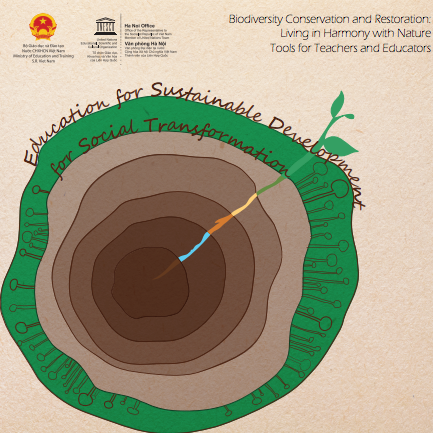 Education for sustainable development for social transformation 出版年份: 2017 机构作者: UNESCO Hanoi | Viet Nam. Ministry of Education and Training This course on Education for Sustainable Development for Social Transformation explains the connection between sustainable development, education and the successful implementation of national and international policies and initiatives on Sustainable Development, such as the Education for Sustainable Development Framework, Global Citizenship Education and the post-2015 Development Agenda. A particular focus is placed on Viet Nam's implementation of these initiatives, including MOET's Action Plan to Implement the National Strategy on Natural Disaster Prevention, Control and Mitigation in the Education Sector in the 2011-2020 Period.The courses promote creative thinking and a holistic approach to some of our planet's most pressing issues. A contribution to sustainable development will be made by encouraging students, families, schools and communities to be bioliterate.
  Education for Sustainable Development: The Tunisian Experience as an Example 出版年份: 2006 作者: Fatima Al-Tarhouni 机构作者: Federation of the Universities of the Islamic World The author in this article is giving analytical description of education for sustainable development. She uses the Tunisian experience as an example of implementing education for sustainable development.
 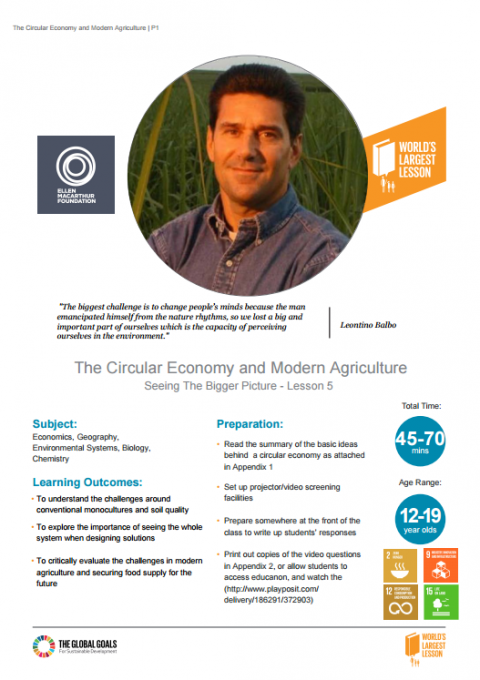 The Circular Economy and Modern Agriculture: Seeing The Bigger Picture - Lesson 5 机构作者: United Nations Children's Fund (UNICEF) World’s Largest Lesson is a collaborative education project to support the announcement of the United Nations Global Goals for Sustainable Development. Learning outcomes of the project: • To understand the challenges around conventional monocultures and soil quality • To explore the importance of seeing the whole system when designing solutions • To critically evaluate the challenges in modern agriculture and securing food supply for the future