
相关资源
探索丰富的全球公民教育资源,深化理解,促进研究、倡导、教学与学习。
共找到276条结果
 Understanding Pupil Preconceptions of the Holocaust in English Schools While the Holocaust is a central part of history teaching today, there is nevertheless a distinct absence of research on the knowledge and understanding that pupils acquire before their formal studies. This empirically-grounded article based on research in three English schools explores what ideas pupils already have and explains what the potential implications of these might be. It suggests that there are various gaps and established myths which exist and that these may limit further understanding if they are not addressed. It then outlines measures which could be taken to facilitate an improvement in Holocaust education with reference to these problems. (By the author) Teaching, Learning, and the Holocaust: An Integrative Approach Classroom study of the Holocaust evokes strong emotions in teachers and students. Teaching, Learning, and the Holocaust assesses challenges and approaches to teaching about the Holocaust through history and literature. Howard Tinberg and Ronald Weisberger apply methods and insights of the Scholarship of Teaching and Learning to examine issues in interdisciplinary teaching, with a focus on the community college setting. They discuss student learning and teacher effectiveness and offer guidance for teaching courses on the Holocaust, with relevance for other contexts involving trauma and atrocity. (By the author)
  Historicizing the Uses of the Past: Scandinavian Perspectives on History Culture, Historical Consciousness and Didactics of History Related to World War II This book presents new developments in Scandinavian memory cultures related to World War II and the Holocaust by combining this focus with the perspective of history didactics. The theoretical framework of historical consciousness offers an approach linking individual and collective uses and re-uses of the past to the question how history can and should be taught. It also offers some examples of good practice in this field. The book promotes a teaching practice which, in taking the social constructivist notions of historical consciousness as a starting point, can contribute to self-reflecting and critical thinking - being fundamental for any democratic political culture. (By the author) Holocaust Education and English Language Learner Students - Reflections on Teaching the Shoah Teaching the Holocaust involves confronting many challenges regardless of the setting involved. The complex nature of Holocaust history demands that students and teachers function at high intellectual levels as they study that history, and the need to determine how sensitive topics should be approached challenges educators in ways that are not present when teaching most other topics. Thus, any teaching of the Shoah places significant demands on teachers‘ content knowledge and pedagogical expertise. These demands increase when educators teach students whose backgrounds differ from those of the general population. Specifically, students whose language skills limit their understanding of texts and classroom dialogue face multiple challenges as they seek to learn within new school environments. Moreover, the distinctive cultural milieu and life experiences that form the frames of references from which these students approach the study of all social studies topics make it imperative that teachers build curricula that include culturally relevant perspectives in order to ensure that students are provided an opportunity to learn material at sophisticated levels. This paper considers how these factors influence the teaching of the Shoah in a Roman Catholic high school located in a major city in the western United States. More than 80% of the school’s students are either immigrants to the United States or members of the first generation of their families to be born in this country; thus, most students have been identified as English Language Learners (ELLs), a category used to determine if special language services should be provided to them. This paper overviews English language learning in the United States and teaching social studies to ELL students before discussing teaching the Holocaust in a parochial school whose primary focus is on teaching ELL students. (By the author - Introduction) Challenging stereotypes and avoiding the superficial: A suggested approach to teaching the Holocaust Alison Kitson provides a rationale for a scheme of work for Year 9 (13-14 year olds). She argues that teachers should analyse the kind of historical learning that is taking place when the Holocaust is studied. Critical of the assumption that learning will take place as a result of exposure, she argues that teachers need to think about learning outcomes and to explore how these connect and support each other. She draws upon the types of historical thinking specified by the National Curriculum in England and shows how these can link up with areas of knowledge that pupils need if they are to understand the context of the Holocaust. Like Kate Hammond, she argues that emotional, human response and moral learning can and should be involved in teaching the Holocaust and that this can support ‒ rather than detract from ‒ rigorous historical analysis of sources and causes. (By the publisher)
  The Rhetoric of Teaching: Understanding the Dynamics of Holocaust Narratives in an English Classroom This volume examines the nature and influence of oral teacher narratives in a single instructional unit. The analyses focus on narrative data that the author generated during a 6-week thematic unit that was taught by a third year teacher in a public middle school. The topic of the Holocaust was chosen because it was well suited for the exploration of oral narrative; the author examines how one teacher rhetorically shaped “knowing about the Holocaust” in her language arts classroom. Because teaching is analyzed through a rhetorical lens, the book is situated at the intersection of classroom discourse studies, rhetoric and composition, and sociolinguistic approaches to narrative. (By the publisher) Moral dilemmas: History, teaching and the Holocaust Salmons discusses the new Holocaust Exhibition at the Imperial War Museum in London, which was originally controversial but has since been favorably received by the general public. The author argues that it is both possible and legitimate for an exhibition devoted to the history of the Holocaust to raise important moral questions. (By the publisher) Learn, Teach, Prevent - Holocaust Education In The 21st Century: The Ethel LeFrak Holocaust Conference Proceedings The National Catholic Center for Holocaust Education publishes conference proceedings following each of its conferences. In 2008, Mrs. Ethel LeFrak, a noted New York philanthropist, created The Ethel LeFrak Holocaust Education Conference Endowment Fund, which underwrites publication of The Ethel LeFrak Holocaust Education Conference Proceedings. Copies of the proceedings are available for purchase by contacting ncche@setonhill.edu
 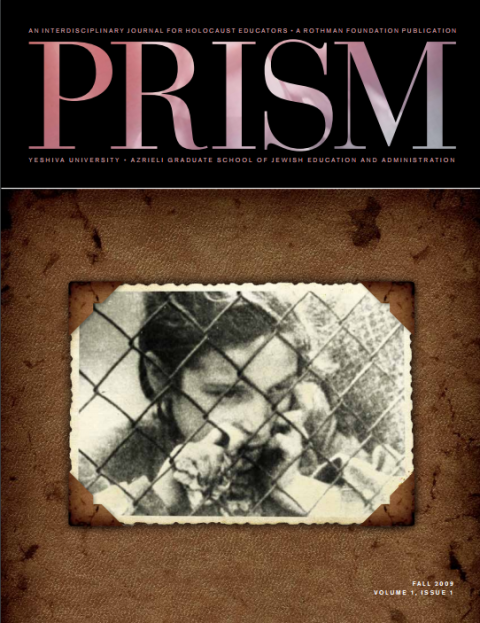 The necessity of darkness. The pedagogic imperative to teach about the death camps How much knowledge about the Holocaust is too much for students? How early is too early to begin to teach about the event? How do we find the correct balance between teaching about the atrocities and teaching about Jewish agency? The Azrieli Graduate School of Jewish Education and Administration debate these and other pedagogical questions in these pages. (By the publisher) The duty to remember: Holocaust remembrance and education in contemporary France Though the decades following the liberation of France in 1944 were characterized by myths and repressions, since the 1970s historians, filmmakers, educators, the general public, and government officials have made considerable efforts to reconcile the dark aspects of France's history and to integrate them into French memory and national history. As Vichy's involvement in the perpetration of the Holocaust moved from the periphery into the mainstream of French consciousness, so did Holocaust remembrance and education. Though for several decades these initiatives appear to have provided a symbolic protection against anti-Semitic acts, the 21st century has been marked by a resurgence of anti-Semitic incidents in France. This paper explores the evolution of France's memory of Vichy's anti-Semitism, the measures taken to incorporate Holocaust remembrance and education into national memory and history, and the reasons why these measures no longer appear to have the same effect in contemporary France. (By the author)