
相关资源
探索丰富的全球公民教育资源,深化理解,促进研究、倡导、教学与学习。
共找到139条结果
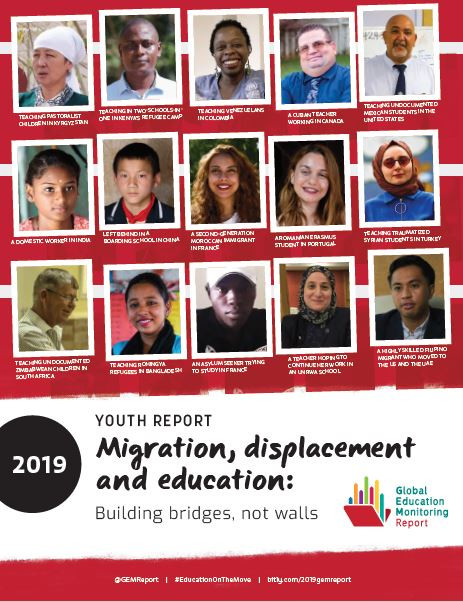 Migration, displacement and education: building bridges, not walls; Global education monitoring report, youth report, 2019 出版年份: 2018 机构作者: Global Education Monitoring Report Team The Education 2030 Incheon Declaration and Framework for Action specifies that the mandate of the Global Education Monitoring Report is to be ‘the mechanism for monitoring and reporting on SDG 4 and on education in the other SDGs’ with the responsibility to ‘report on the implementation of national and international strategies to help hold all relevant partners to account for their commitments as part of the overall SDG follow-up and review’. It is prepared by an independent team hosted by UNESCO. This is among the most aspirational global commitments of the United Nations 2030 Agenda for Sustainable Development. Migration and displacement are two global challenges the agenda needs to address in achieving the 17 Sustainable Development Goals (SDGs), including SDG4: ‘Ensure inclusive and equitable quality education and promote lifelong learning opportunities for all’.
 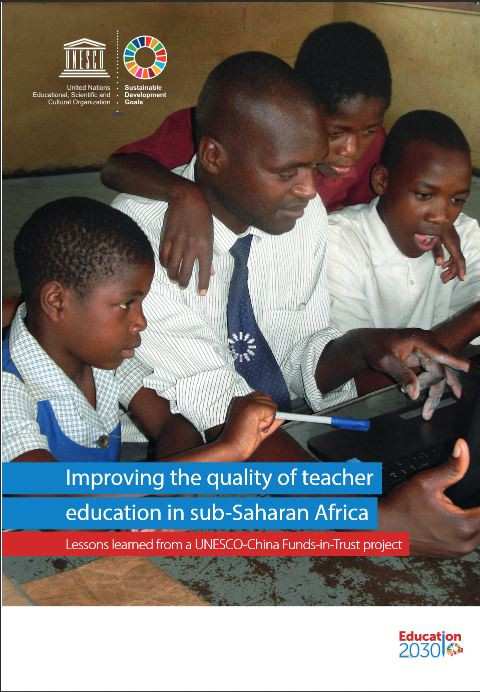 Improving the quality of teacher education in Sub-Saharan Africa: lessons learned from a UNESCO-China Funds-in-Trust project 出版年份: 2018 机构作者: UNESCO The booklet describes how the project started, the choice of beneficiary countries, the implementation strategies and its achievements. The different sections numbered one to four describe particular aspects of the project, using country cases to illustrate how the success of the project was due to strong country ownership and leadership. UNESCO, in partnership with the Government of the People’s Republic of China, initiated the project to enhance the institutional capacity and the professional development of teacher educators through ICT-supported learning, teaching and research. This technology aided the transformation of capacity teacher training through digitalization of instructional materials.
  Integrating education for sustainable development (ESD) in teacher education in South-East Asia: a guide for teacher educators 出版年份: 2018 机构作者: UNESCO Bangkok This publication is a cumulative output of the project Sustainability Begins with Teachers in South-East Asia, implemented by UNESCO Bangkok, in cooperation with SEAMEO from 2017 to 2018, with the generous support of the Government of Japan. The initial content was developed together with the representatives of the universities and teacher education institutions who participated in the South-East Asia Sub-Regional Workshop on Education for Sustainable Development for Teacher Education Institutions, held from 5 to 9 June 2017 in Chiang Rai, Thailand. Content has since been enhanced through the sharing of knowledge and experiences gathered from a series of in-country workshops held in Cebu, Philippines; Luang Prabang, Lao PDR; Kampot, Cambodia; Bangkok, Thailand; and Yogyakarta, Indonesia. This culminated in a project review workshop in Bangkok from 24 to 26 April 2018 in which different in-country experiences were shared and comments on the guidebook collected. Twenty-six universities and teacher education institutions have taken part in the project process in total. This guidebook is a result of this collaborative journey.
  Libro de Datos del ODS 4 出版年份: 2019 机构作者: UNESCO Institute for Statistics (UIS) Esta publicación presenta los indicadores de monitoreo global usados por los países y la comunidad internacional para el desarrollo con el fin de realizar el seguimiento del progreso hacia el Objetivo de Desarrollo Sostenible 4 (ODS 4) en educación. Los indicadores han sido producidos por el Instituto de Estadística de la UNESCO (UIS), con base en los últimos datos disponibles más recientes.El UIS es la fuente oficial de datos en educación internacionalmente comparables y la agencia responsable de la custodia de los datos para el ODS 4. Su mandato refleja la confianza de la comunidad internacional en los datos del UIS y su comprobada trayectoria en el trabajo metodológico y elaboración de estándares con las oficinas nacionales de estadística, los ministerios sectoriales y los socios técnicos en cada región. Recueil de données de l’ODD4 出版年份: 2019 机构作者: UNESCO Institute for Statistics (UIS) Cette publication présente les indicateurs de suivi mondiaux utilisés par les pays et la communauté du développement international pour surveiller les progrès réalisés sur la voie de l’Objectif de développement durable 4 (ODD 4) relatif à l’éducation. Les indicateurs ont été produits par l’Institut de statistique de l’UNESCO (ISU), sur la base des dernières données disponibles.L’ISU est la source officielle de données comparables au plan international sur l’éducation et l’organisme dépositaire pour les données relatives à l’ODD 4. Ce mandat témoigne de la confiance de la communauté internationale dans les données de l’ISU et de son expérience avérée dans les travaux méthodologiques et l’élaboration de normes avec les bureaux nationaux de statistique, les ministères compétents et les partenaires techniques dans chacune des regions SDG 4 Data Book 2019 出版年份: 2019 机构作者: UNESCO Institute for Statistics (UIS) This publication presents the global monitoring indicators used by countries and the international development community to monitor progress towards Sustainable Development Goal 4 (SDG 4) on education. The indicators were produced by the UNESCO Institute for Statistics (UIS), based on the latest available data.The UIS is the official source of internationally-comparable education data and the custodian agency for SDG 4 data. This mandate reflects the trust of the international community in UIS data and its proven track record in methodological work and standard-setting with national statistical offices, line ministries and technical partners in every region.
  تقرير أهداف التنمية المستدامة 2017 出版年份: 2017 机构作者: United Nations (UN) يستعرض تقرير أهداف التنمية املستدامة لعام 2017 التقدم المحرز نحو تحقيق الأهداف السبعة عشر في السنة الثانية من تنفيذ خطة التنمية المستدامة لعام 2030 .ويستند التقرير إلى أحدث البيانات المتاحة. وهو يسلط الضوء على المكاسب والتحديات في الوقت الذي يتحرك فيه المجتمع الدولي صوب تحقيق الطموحات والمباديء التي تبناها في خطة عام 2030. The Sustainable Development Goals Report 2017 出版年份: 2017 机构作者: United Nations (UN) In adopting the 2030 Agenda for Sustainable Development, world leaders resolved to free humanity from poverty, secure a healthy planet for future generations, and build peaceful, inclusive societies as a foundation for ensuring lives of dignity for all.This report provides a snapshot of our efforts to date. It stresses that high-level political leadership and new partnerships will be essential for sustaining momentum. It also underscores the need for reliable, timely, accessible and disaggregated data to measure progress, inform decision-making and ensure that everyone is counted.
  Girl Goals: What has Changed for Girls? Adolescent Girls’ Rights over 30 Years 出版年份: 2025 机构作者: United Nations Children's Fund (UNICEF) | United Nations Entity for Gender Equality and the Empowerment of Women (UN Women) | Plan International This report makes three key recommendations on action we can take now to advance adolescent girls’ rights at scale, in ways that account for fiscally constrained contexts and multiple competing priorities: 1. Ensure tangible and actionable support for adolescent girls’ voices, advocacy and action. The current generation of girls are raising their voices to be heard and are already at the forefront of making change around the world. With the right support, resources and seats at the table, adolescent girls can help transform the world for the better, shaping better policy outcomes for themselves and everyone. This is not about girls’ voices above all others, or endless consultation, but about specific, meaningful actions that ensure girls get the support they need and are heard on policy issues that matter to them. 2. Establish and track explicit targets for change for adolescent girls, who are too often invisible and sidelined Setting explicit targets to monitor outcomes for adolescent girls is key to making progress. Context-specific prioritization will be necessary, but there are some issues that stand out globally. Gaps in progress (such as child marriage gains accruing disproportionately to wealthier households) demonstrate the need forprogrammes that address poverty and economic realities alongside harmful social norms. The disproportionate number of adolescent girls not in education, employment or training, not entering the labour market as young women, and left behind when it comes to digital skills, is a threat to the gains made for girls and to economic growth that will benefit everyone. Stagnation on issues like underweight also stand out. Country- specific priorities supported by data- driven accountability mechanisms and investments are needed to translate policy commitments into change on the ground. 3. Resource and deliver smartly to unlock the social and economic dividend Governments and partners should invest in solutions proven to change outcomes across multiple SDGs at scale – for example, investing in education and skills, cash transfers and economic empowerment programmes designed to support girls. Existing systems, from maternal health care to school curricula, should be adapted to meet girls’ needs rather than creating small- scale, separate projects. Streamlined, evidence-based ‘add-ons’ – such as adding parenting support to existing maternal health-care programmes – can be cost effective and accelerate outcomes if well designed. Change is possible, and this report shows that great gains have been made. Smart investments now can transform the world for girls, families, communities and national economies. It is time to act.
  UNESCO Associated Schools Network: guide for national coordinators 出版年份: 2018 机构作者: UNESCO This document describes in detail the history of the UNESCO Associated Schools Network, its mission, goals, management, membership, and other information. It is a guide for National Coordinators who are the link between the schools in their country, their National Commission and other national authorities, and the International Coordinator at UNESCO.