
相关资源
探索丰富的全球公民教育资源,深化理解,促进研究、倡导、教学与学习。
共找到153条结果
 Exploring the Circular Economy: Seeing The Bigger Picture - Lesson 2 机构作者: United Nations Children's Fund (UNICEF) World’s Largest Lesson is a collaborative education project to support the announcement of the United Nations Global Goals for Sustainable Development. Learning outcomes of the project: • to compare living systems with man-made systems • to critique our materials economy • to begin to investigate an alternative model: the circular economy
  Understanding the Challenge of Finite Resources: Seeing The Bigger Picture - Lesson 3 机构作者: United Nations Children's Fund (UNICEF) World’s Largest Lesson is a collaborative education project to support the announcement of the United Nations Global Goals for Sustainable Development. Learning outcomes of the project: • To understand and the urgent challenge that finite resources pose to our current economic system • To explore economic history since the industrial revolution through personal narrative • To critically evaluate our current consumption and production systems and explore better ways of dealing with resources.
  Designing for a Circular Economy: Seeing The Bigger Picture - Lesson 4 机构作者: United Nations Children's Fund (UNICEF) World’s Largest Lesson is a collaborative education project to support the announcement of the United Nations Global Goals for Sustainable Development. Learning outcomes of the project: • To learn about companies that have adopted the circular economy framework • To design a product or service based on the circular economy
  European pack for visiting Auschwitz-Birkenau Memorial and museum - Guidelines for teachers and educators 出版年份: 2011 机构作者: Council of Europe | Auschwitz-Birkenau Memorial and Museum | Poland. Ministry of Education Taking groups of students to the Auschwitz-Birkenau Memorial and Museum is a heavy responsibility, but it is a major contribution to citizenship if it fosters understanding of what Auschwitz stands for, particularly when the last survivors are at the end of their lives. This pack is designed for teachers wishing to organize student visits to authentic places of remembrance, and for the guides, academics and others who work every day with young people at Auschwitz. To avoid the risk of inappropriate reactions or the failure to benefit from a large investment in travel and accommodation, considerable preparation and discussion is necessary before the visit and serious reflection afterwards. This pack offers insights into the complexities of human behaviour so that students can have a better understanding of what it means to be a citizen. The young people who visit Auschwitz in the next few years will be witnesses of the last witnesses. Their generation will be the last to hear the survivors speaking on the spot. The Council of Europe, the Polish Ministry of Education and the Auschwitz-Birkenau Memorial and Museum are jointly sponsoring this project aimed at preventing crimes against humanity through Holocaust remembrance teaching. (By the Council of Europe) Peloton européen pour visiter Auschwitz-Birkenau Memorial et des musées - Lignes directrices pour les enseignants et les éducateurs 出版年份: 2011 机构作者: Conseil de l'Europe | Auschwitz-Birkenau Memorial and Museum | Poland. Ministry of Education Prendre des groupes d'élèves au Mémorial d'Auschwitz-Birkenau et le musée est une lourde responsabilité, mais il est une contribution majeure à la citoyenneté si elle favorise la compréhension de ce que signifie Auschwitz, en particulier lorsque les derniers survivants sont à la fin de leur vie. Ce pack est conçu pour les enseignants qui souhaitent organiser des visites d'étudiants dans des lieux authentiques de mémoire, et pour les guides, les universitaires et les autres personnes qui travaillent tous les jours avec les jeunes à Auschwitz. Pour éviter le risque de réactions inappropriées ou l'échec de bénéficier d'un investissement important dans Voyage et hébergement, préparation et discussions est nécessaire avant la visite et de réflexion sérieuse après. Ce pack offre un aperçu de la complexité du comportement humain afin que les étudiants puissent avoir une meilleure compréhension de ce que signifie être un citoyen. Les jeunes gens qui visitent Auschwitz au cours des prochaines années seront témoins des derniers témoins. Leur génération sera la dernière pour entendre les survivants parlant sur place. Le Conseil de l'Europe, le ministère polonais de l'éducation et d'Auschwitz-Birkenau Memorial et Musée parrainent conjointement ce projet visant à la prévention des crimes contre l'humanité à travers l'enseignement de commémoration de l'Holocauste. (Par le Conseil de l'Europe) Pack européen pour la visite du Mémorial et du Musée d'Auschwitz-Birkenau - Pistes pédagogiques pour enseignants et éducateurs (2012) 出版年份: 2011 机构作者: Conseil de l'Europe | Auschwitz-Birkenau Memorial and Museum | Poland. Ministry of Education Taking groups of students to the Auschwitz-Birkenau Memorial and Museum is a heavy responsibility, but it is a major contribution to citizenship if it fosters understanding of what Auschwitz stands for, particularly when the last survivors are at the end of their lives. This pack is designed for teachers wishing to organize student visits to authentic places of remembrance, and for the guides, academics and others who work every day with young people at Auschwitz. To avoid the risk of inappropriate reactions or the failure to benefit from a large investment in travel and accommodation, considerable preparation and discussion is necessary before the visit and serious reflection afterwards. This pack offers insights into the complexities of human behaviour so that students can have a better understanding of what it means to be a citizen. The young people who visit Auschwitz in the next few years will be witnesses of the last witnesses. Their generation will be the last to hear the survivors speaking on the spot. The Council of Europe, the Polish Ministry of Education and the Auschwitz-Birkenau Memorial and Museum are jointly sponsoring this project aimed at preventing crimes against humanity through Holocaust remembrance teaching. (By the Council of Europe)
  Education for sustainable development for social transformation 出版年份: 2017 机构作者: UNESCO Hanoi | Viet Nam. Ministry of Education and Training This course on Education for Sustainable Development for Social Transformation explains the connection between sustainable development, education and the successful implementation of national and international policies and initiatives on Sustainable Development, such as the Education for Sustainable Development Framework, Global Citizenship Education and the post-2015 Development Agenda. A particular focus is placed on Viet Nam's implementation of these initiatives, including MOET's Action Plan to Implement the National Strategy on Natural Disaster Prevention, Control and Mitigation in the Education Sector in the 2011-2020 Period.The courses promote creative thinking and a holistic approach to some of our planet's most pressing issues. A contribution to sustainable development will be made by encouraging students, families, schools and communities to be bioliterate. Education for sustainable development for social transformation 出版年份: 2017 机构作者: UNESCO Hanoi | Viet Nam. Ministry of Education and Training This course on Education for Sustainable Development for Social Transformation explains the connection between sustainable development, education and the successful implementation of national and international policies and initiatives on Sustainable Development, such as the Education for Sustainable Development Framework, Global Citizenship Education and the post-2015 Development Agenda. A particular focus is placed on Viet Nam's implementation of these initiatives, including MOET's Action Plan to Implement the National Strategy on Natural Disaster Prevention, Control and Mitigation in the Education Sector in the 2011-2020 Period.The courses promote creative thinking and a holistic approach to some of our planet's most pressing issues. A contribution to sustainable development will be made by encouraging students, families, schools and communities to be bioliterate. Education for sustainable development for social transformation 出版年份: 2017 机构作者: UNESCO Hanoi | Viet Nam. Ministry of Education and Training This course on Education for Sustainable Development for Social Transformation explains the connection between sustainable development, education and the successful implementation of national and international policies and initiatives on Sustainable Development, such as the Education for Sustainable Development Framework, Global Citizenship Education and the post-2015 Development Agenda. A particular focus is placed on Viet Nam's implementation of these initiatives, including MOET's Action Plan to Implement the National Strategy on Natural Disaster Prevention, Control and Mitigation in the Education Sector in the 2011-2020 Period.The courses promote creative thinking and a holistic approach to some of our planet's most pressing issues. A contribution to sustainable development will be made by encouraging students, families, schools and communities to be bioliterate.
 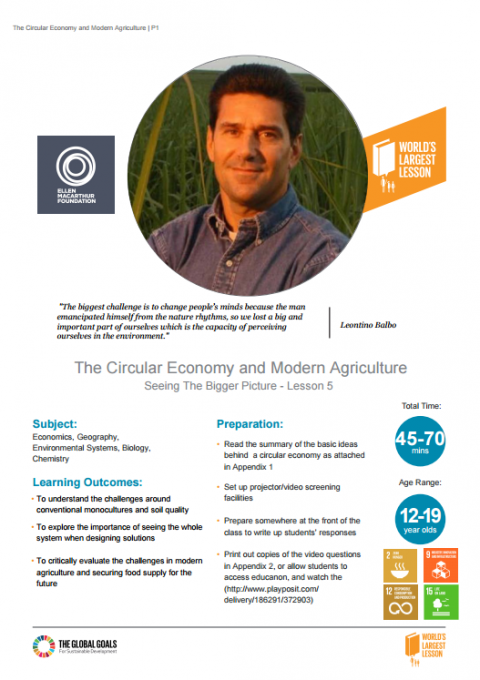 The Circular Economy and Modern Agriculture: Seeing The Bigger Picture - Lesson 5 机构作者: United Nations Children's Fund (UNICEF) World’s Largest Lesson is a collaborative education project to support the announcement of the United Nations Global Goals for Sustainable Development. Learning outcomes of the project: • To understand the challenges around conventional monocultures and soil quality • To explore the importance of seeing the whole system when designing solutions • To critically evaluate the challenges in modern agriculture and securing food supply for the future