UNESCO CLEARINGHOUSE ON
GLOBAL CITIZENSHIP EDUCATION
HOSTED BY APCEIU
English
Français
Español
Русский
العربية
中文
한국어
关于我们
全球公民教育
全球公民教育信息库
相关资源
活动
新闻
English
Français
Español
Русский
العربية
中文
한국어
Search
Advanced Search
关于我们
全球公民教育
全球公民教育信息库
相关资源
活动
新闻
相关资源
探索丰富的全球公民教育资源,深化理解,促进研究、倡导、教学与学习。
搜索
Searching...
高级搜索
© APCEIU
共找到
141
条结果
相关度
最新
年份
Inclusion and gender equality: brief on inclusion in education
出版年份:
2023
机构作者:
UNESCO
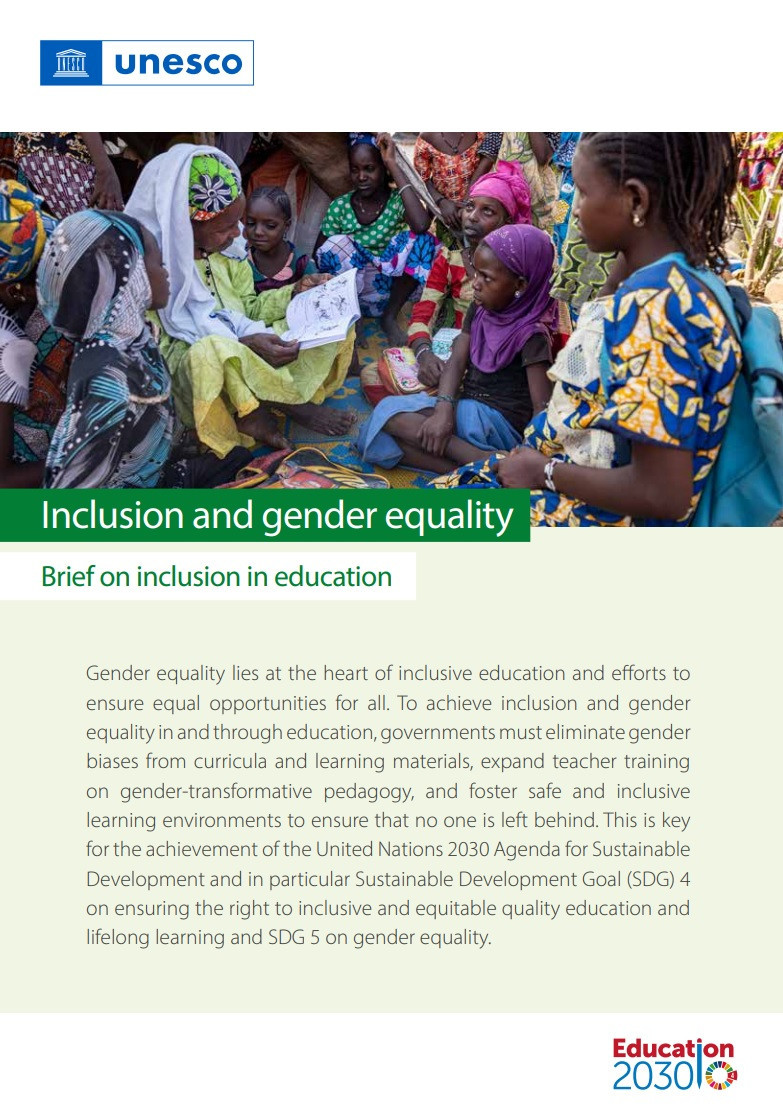
<Brief on inclusion in education>Gender equality lies at the heart of inclusive education and efforts to ensure equal opportunities for all. To achieve inclusion and gender equality in and through education, governments must eliminate gender biases from curricula and learning materials, expand teacher training on gender-transformative pedagogy, and foster safe and inclusive learning environments to ensure that no one is left behind. This is key for the achievement of the United Nations 2030 Agenda for Sustainable Development and in particular Sustainable Development Goal (SDG) 4 on ensuring the right to inclusive and equitable quality education and lifelong learning and SDG 5 on gender equality.<Introduction>Gender refers to the socially constructed roles and relationships, personality traits, attitudes, behaviours, values, relative power and influence that society ascribes to the two sexes on a differential basis. Gender affects people’s lives every day in myriad ways. Gendered expectations, whether of oneself or of others, impact the choices people make. They structure people’s relationships and have the power to shape what people believe they can and should accomplish. Gendered power structures distribute and influence power, often resulting in systemic inequalities (UNESCO, 2021).Gender also intersects with other characteristics which can exacerbate education exclusion, such as age, geography, poverty, disability, ethnicity, indigeneity, language, religion, and migration or displacement status. Addressing the overlapping differences that create disadvantage and marginalization can help to build more inclusive and equitable education systems.Achieving gender equality in and through education is essential for inclusive education and inclusive societies. It is key to the achievement of the United Nations 2030 Agenda for Sustainable Development and in particular Sustainable Development Goal (SDG) 4 on ensuring the right to inclusive and equitable quality education and lifelong learning and SDG 5 on gender equality. In any country’s context, this means ensuring all learners have equal access to all levels of education, equal educational pathways and equal opportunities to apply the outcomes of their education. A world where inclusion and gender equality in and through education is achieved allows girls and boys, women and men and non-binary people to have equal rights and opportunities to education and the power and agency to shape their lives and futures.This brief discusses how gender equality impacts learners’ inclusion and the ways in which gender equality and inclusion are interconnected in education.
1
・・・
1
・・・
11
12
13
14
15
13
14
15
本网站使用Cookie以提升用户体验。详情请查看Cookie政策。
Cookie政策
.