
相关资源
探索丰富的全球公民教育资源,深化理解,促进研究、倡导、教学与学习。
共找到1,330条结果
 التربية على المواطنة العالمية: مواضيع وأهداف تعلمية 出版年份: 2015 机构作者: UNESCO هذا الدليل "التربية على المواطنة العالمية: المواضيع والأهداف التعلمية" هو أول التوجيهات التربوية لليونسكو حول تعليم المواطنة العالمية. أتى هذا الدليل نتيجة لبحوث معمقة وعملية استشارية مع خبراء من مختلف أصقاع العالم. يرتكز هذا التوجيه على دليل اليونسكو» التربية على المواطنة العالمية: تحضير المتعلمين لتحديات القرن الواحد والعشرين " ومخرجات الأحداث لليونسكو حول التربية على المواطنة العالمية: المشاورة الفنية حول التربية على المواطنة العالمية (أيلول/سبتمبر 2013) وندوة اليونسكو الأولى والثانية حول التربية على المواطنة العالمية، واللتين عقدتا في كانون الأول/ديسمبر 2013 وكانون الثاني/يناير من العام 2015 على التوالي. قبل الانتهاء من العمل على هذا التوجيه، اختبره أصحاب المصلحة في المجال التعليمي اختباراً ميدانياً في عدد من الدول المنتقاة بغية الحرص على ملاءمته للسياقات الجغرافية والاجتماعية الثقافية المختلفة. تهدف التربية على المواطنة العالمية إلى أن تشكل قوة تحويلية، وبناء المعرفة والمهارات والقيم والسلوكيات التي يحتاج إليها المتعلمون ليتمكنوا من المساهمة في عالم أكثر دمجاً وعدلا وسلاماً. ويقدم هذا الدليل اقتراحات لترجمة مفاهيم التربية على المواطنة العالمية إلى مواضيع وأهداف تعلمية عملية ومراعية للأعمار بطريقة تسمح بمواءمتها مع السياقات المحلية. ويهدف الدليل إلى أن يشكل مورداً للمربين ومطوري المناهج والمدربين، بالإضافة إلى صانعي السياسات، فضلا عن كونه مهماً أيضاً لغيرهم من أصحاب المصلحة في المجال التعليمي، العاملين في أطر نظامية أو غير نظامية. يعرّف الدليل بالتربية العالمية ومقوماتها التعلمية وكيفية إدماجها في النطم التربوية وتطبيقها داخل الصف.
  세계시민교육: 학습 주제 및 학습 목표 出版年份: 2015 机构作者: 유네스코 세계시민교육은 학습자들이 더 포용적이고, 정의롭고, 평화로운 세상을 만드는 데 이바지할 수 있도록 필요한 지식, 기능, 가치, 태도를 길러줌으로써 변혁적인 교육을 달성하고자 한다.이 책 『세계시민교육 : 학습 주제 및 학습 목표』는 세계시민교육에 대한 유네스코의 첫 교수·학습 지침서이다. 세계시민교육의 개념을 지역적 맥락에 맞게 활용할 수 있도록 실제 연령별 학습 주제 및 학습 목표로 구체화한 제안을 담고 있다. 교육자, 교육과 정 개발자, 교사교육자 및 정책입안자를 대상으로 개발된 본 지침서는 무형식 및 비형식 교육환경에 있는 교육 관계자들에게도 유용한 자료가 될 것이다.
  International Technical Guidance on Sexuality Education: An Evidence-Informed Approach for Schools, Teachers and Health Educators 出版年份: 2009 机构作者: UNESCO Based on a rigorous and current review of evidence on sexuality education programmes, this International Technical Guidance on Sexuality Education is aimed at education and health sector decision-makers and professionals. It has been produced to assist education, health and other relevant authorities in the development and implementation of school-based sexuality education programmes and materials. Volume I focuses on the rationale for sexuality education and provides sound technical advice on characteristics of effective programmes. A companion document, (Volume II ) focuses on the topics and learning objectives to be covered in a ‘basic minimum package’ on sexuality education for children and young people from 5 to 18+ years of age and includes a bibliography of useful resources. The International Technical Guidance is relevant not only to those countries most affected by HIV and AIDS, but also to those facing low prevalence and concentrated epidemics.
  Global Citizenship Education: Topics and Learning Objectives 出版年份: 2015 机构作者: UNESCO This publication, titled Global Citizenship Education: Topics and learning objectives, is the first pedagogical guidance from UNESCO on global citizenship education. It is the result of an extensive research and consultation process with experts from different parts of the world. This guidance draws on the UNESCO publication Global Citizenship Education: Preparing learners for the challenges of the 21st century and the outcomes of three key UNESCO events on global citizenship education: the Technical Consultation on Global Citizenship Education (September 2013), as well as the First and Second UNESCO Fora on Global Citizenship Education, organized in December 2013 and January 2015 respectively. Before it was finalized, the guidance was field-tested by education stakeholders in selected countries in all regions to ensure its relevance in different geographical and socio-cultural contexts. Following the foundational work of UNESCO to clarify the conceptual underpinnings of global citizenship education and provide policy and programmatic directions, this document has been developed in response to the needs of Member States for overall guidance on integrating global citizenship education in their education systems. It presents suggestions for translating global citizenship education concepts into practical and age-specific topics and learning objectives in a way that allows for adaptation to local contexts. It is intended as a resource for educators, curriculum developers, trainers as well as policy-makers, but it will also be useful for other education stakeholders working in non-formal and informal settings.
  Éducation à la citoyenneté mondiale: thèmes et objectifs d'apprentissage 出版年份: 2015 机构作者: UNESCO Le présent ouvrage, intitulé Éducation à la citoyenneté mondiale : Thèmes et objectifs d’apprentissage, est le premier guide pédagogique de l’UNESCO sur l’éducation à la citoyenneté mondiale. Il est le fruit d’un processus approfondi de recherche et de consultation avec des spécialistes de différentes régions du monde. Ce guide s’inspire de la publication de l’UNESCO intitulée Éducation à la citoyenneté mondiale : Préparer les apprenants aux défis du XXIe siècle ainsi que des résultats de trois événements clés de l’UNESCO sur l’éducation à la citoyenneté mondiale : la Consultation technique sur l’éducation à la citoyenneté mondiale (septembre 2013) et les premier et deuxième Forums de l’UNESCO sur l’éducation à la citoyenneté mondiale, organisés en décembre 2013 et en janvier 2015. Avant sa finalisation, le guide a été expérimenté sur le terrain par des acteurs de l’éducation dans différents pays de chaque région, afin de veiller à ce qu’il soit adapté à des contextes géographiques et socioculturels divers. Inspirée des travaux de base de l’UNESCO visant à clarifier les fondements conceptuels de l’éducation à la citoyenneté mondiale, et à fournir des orientations politiques et programmatiques, cette publication a été élaborée pour répondre aux besoins des États membres, en leur donnant des indications générales sur l’intégration de l’éducation à la citoyenneté mondiale dans leurs systèmes éducatifs. Elle propose des moyens de transposer l’éducation à la citoyenneté mondiale dans des thèmes et des objectifs d’apprentissage pratiques et tenant compte de l’âge de l’apprenant, qui puissent être adaptés aux contextes locaux. Cette publication a été conçue pour servir de document de référence aux éducateurs, aux concepteurs de programmes éducatifs, aux formateurs et aux décideurs, mais elle sera également utile à d’autres acteurs de l’éducation travaillant dans des contextes non formels et informels.
 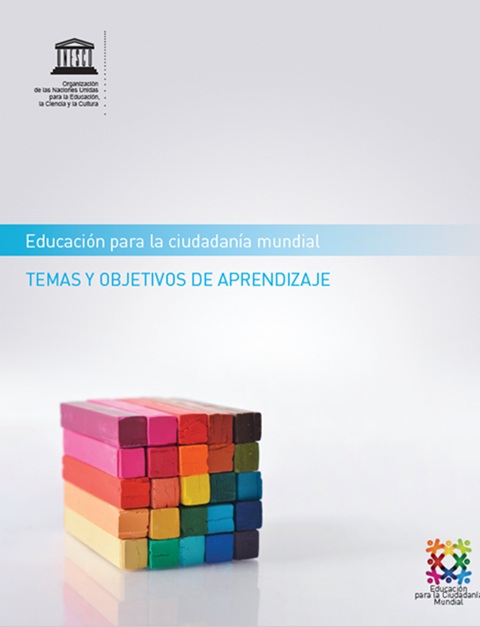 Educación para la ciudadanía mundial: temas y objetivos de aprendizaje 出版年份: 2015 机构作者: UNESCO La educación para la ciudadanía mundial aspira a ser un factor de transformación, inculcando los conocimientos, las habilidades, los valores y las actitudes que los educandos necesitan para poder contribuir a un mundo más inclusivo, justo y pacífico.La presente publicación, titulada Educación para la ciudadanía mundial: Temas y objetivos de aprendizaje, es la primera guía de la UNESCO al respecto. Se presentan sugerencias para plasmar los conceptos de la educación para la ciudadanía mundial en temas y objetivos de aprendizaje específicos para cada grupo de edad de un modo que facilita su adaptación a las circunstancias locales. Es un recurso para los educadores, los responsables de la elaboración de programas de estudios, los instructores y los encargados de la formulación de políticas, pero también será de utilidad para otros copartícipes en la educación que trabajan en contextos no formales e informales.
  Implementing the Right to Education: a Compendium of Practical Examples 出版年份: 2016 机构作者: UNESCO This publication is a compilation of practical examples of measures taken by Member States in implementing the provisions of the UNESCO Convention and Recommendation against Discrimination in Education. These examples are taken from national reports submitted to UNESCO for the Eighth Consultation of Member States on the implementation of these two international standard-setting instruments. The Convention and the Recommendation celebrated their fi fty-fi fth anniversary in 2015. Both express the fundamental principles of non-discrimination and equality of educational opportunities enshrined in UNESCO’'s Constitution. Since these fundamental principles were essential in the process of Education for All, the instruments have naturally become the cornerstone of this important domain.The Education 2030 development agenda will provide further opportunity to mobilise the Convention and the Recommendation in guiding Member States in the effective realization of the right to education. This compendium seeks to provide an overview of promising measures taken to ensure equality of educational opportunities and non-discrimination, while also serving as a tool for information sharing and advocacy in connection with the right to education.
 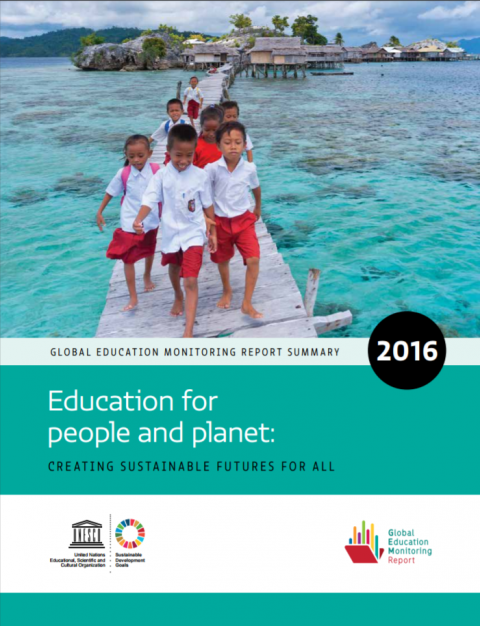 L'Education pour les peuples et la planète: créer des avenirs durables pour tous, résumé du rapport mondial de suivi sur l'éducation, 2016 出版年份: 2016 机构作者: UNESCO The GEM Report provides an authoritative account of how education is the most vital input for every dimension of sustainable development. Better education leads to greater prosperity, improved agriculture, better health outcomes, less violence, more gender equality, higher social capital and an improved natural environment. Education is key to helping people around the world understand why sustainable development is such a vital concept for our common future. Education gives us the key tools – economic, social, technological, even ethical – to take on the SDGs and to achieve them. These facts are spelled out in exquisite and unusual detail throughout the report. Yet the report also emphasizes the remarkable gaps between where the world stands today on education and where it has promised to arrive as of 2030. La Educación al servicio de los pueblos y el planeta: creación de futuros sostenibles para todos, resumen del informe de seguimiento de la educación en el mundo 2016; 出版年份: 2016 机构作者: UNESCO The GEM Report provides an authoritative account of how education is the most vital input for every dimension of sustainable development. Better education leads to greater prosperity, improved agriculture, better health outcomes, less violence, more gender equality, higher social capital and an improved natural environment. Education is key to helping people around the world understand why sustainable development is such a vital concept for our common future. Education gives us the key tools – economic, social, technological, even ethical – to take on the SDGs and to achieve them. These facts are spelled out in exquisite and unusual detail throughout the report. Yet the report also emphasizes the remarkable gaps between where the world stands today on education and where it has promised to arrive as of 2030. Образование в интересах людей и планеты: ПОСТОЕНИЕ УСТОЙЧИВОГО БУДУЩЕГО ДЛЯВСЕХ, РЕЗЮМЕ ВСЕМИРНОГО ДОКЛАДА ПО МОНИТОРИНГУ ОБРАЗОВАНИЯ, 2016 出版年份: 2016 机构作者: UNESCO The GEM Report provides an authoritative account of how education is the most vital input for every dimension of sustainable development. Better education leads to greater prosperity, improved agriculture, better health outcomes, less violence, more gender equality, higher social capital and an improved natural environment. Education is key to helping people around the world understand why sustainable development is such a vital concept for our common future. Education gives us the key tools – economic, social, technological, even ethical – to take on the SDGs and to achieve them. These facts are spelled out in exquisite and unusual detail throughout the report. Yet the report also emphasizes the remarkable gaps between where the world stands today on education and where it has promised to arrive as of 2030.