
相关资源
探索丰富的全球公民教育资源,深化理解,促进研究、倡导、教学与学习。
共找到3,162条结果
 Learn, Teach, Prevent - Holocaust Education In The 21st Century: The Ethel LeFrak Holocaust Conference Proceedings The National Catholic Center for Holocaust Education publishes conference proceedings following each of its conferences. In 2008, Mrs. Ethel LeFrak, a noted New York philanthropist, created The Ethel LeFrak Holocaust Education Conference Endowment Fund, which underwrites publication of The Ethel LeFrak Holocaust Education Conference Proceedings. Copies of the proceedings are available for purchase by contacting ncche@setonhill.edu
 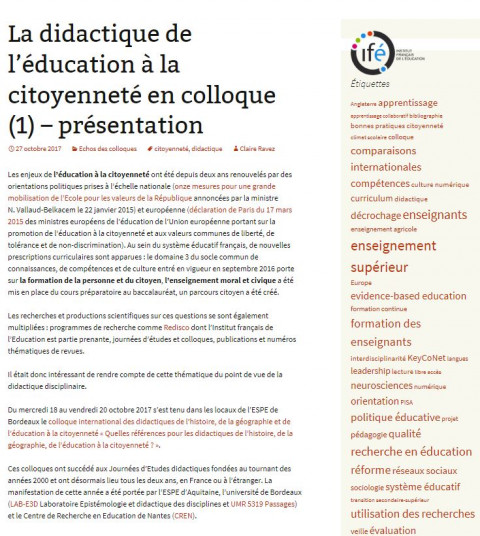 La didactique de l’éducation à la citoyenneté en colloque 出版年份: 2017 作者: Claire Ravez 机构作者: Institut Français de l'Education (IFÉ) Les enjeux de l’éducation à la citoyenneté ont été depuis deux ans renouvelés par des orientations politiques prises à l’échelle nationale (onze mesures pour une grande mobilisation de l’Ecole pour les valeurs de la République annoncées par la ministre N. Vallaud-Belkacem le 22 janvier 2015) et européenne (déclaration de Paris du 17 mars 2015 des ministres européens de l’éducation de l’Union européenne portant sur la promotion de l’éducation à la citoyenneté et aux valeurs communes de liberté, de tolérance et de non-discrimination). Au sein du système éducatif français, de nouvelles prescriptions curriculaires sont apparues : le domaine 3 du socle commun de connaissances, de compétences et de culture entré en vigueur en septembre 2016 porte sur la formation de la personne et du citoyen, l’enseignement moral et civique a été mis en place du cours préparatoire au baccalauréat, un parcours citoyen a été créé.
 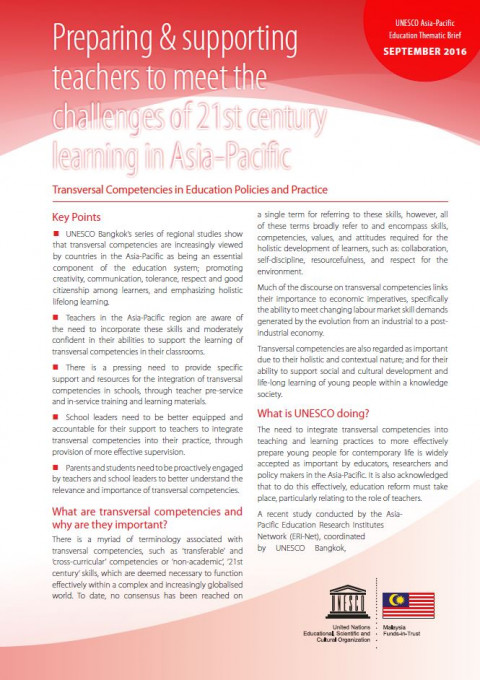 Подготовка и поддержка учителей для решения задач обучения 21-го века в Азиатско-Тихоокеанском регионе 出版年份: 2016 机构作者: Regional Bureau for Education in Asia and the Pacific | UNESCO Bangkok Подготовка и поддержка учителей для решения задач обучения 21-го века в Азиатско-Тихоокеанском регионе. Междисциплинарные компетенции в области политики и практики в области образования. Это итог исследований III фазы ERI-Net для междисциплинарных компетенций в области политики и практики в образовании.
 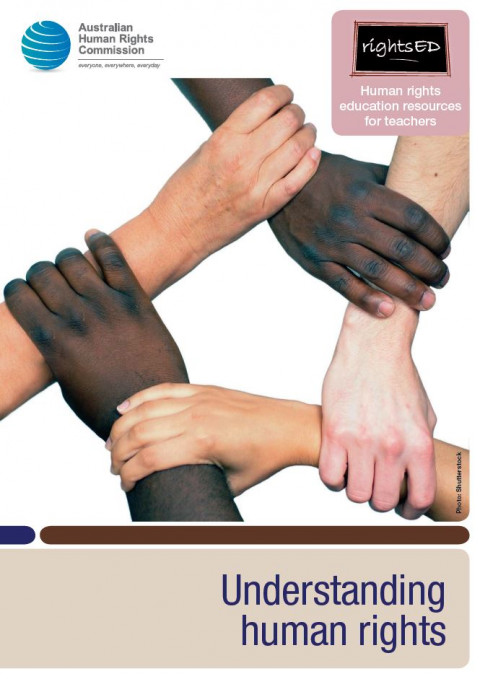 Understanding Human Rights 出版年份: 2010 机构作者: Australian Human Rights Commission Human rights are basic to humanity. They apply to all people everywhere. An understanding of human rights is an important part of our individual status as human beings and of our collective status as members of the global community of humankind.To understand how human rights affect us in our daily lives and to acknowledge our responsibilities in recognising the need to balance those rights with the rights of others, we require an understanding of what human rights are.So what are human rights? Where did they come from? How do they impact on humanity? How do they affect me?
 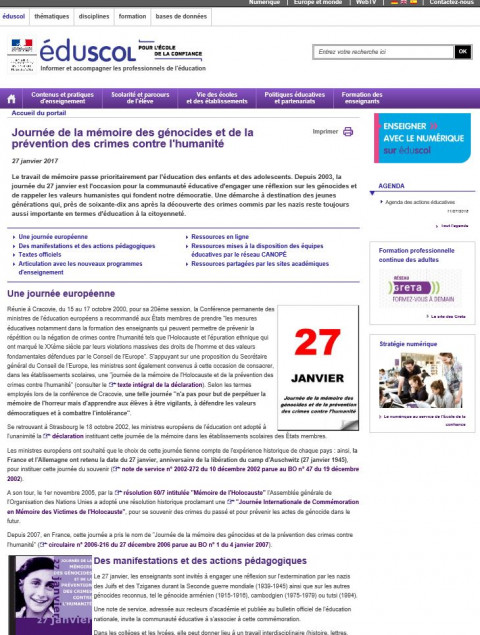 Journée de la mémoire des génocides et de la prévention des crimes contre l'humanité 出版年份: 2017 机构作者: éduscol Le travail de mémoire passe prioritairement par l'éducation des enfants et des adolescents. Depuis 2003, la journée du 27 janvier est l'occasion pour la communauté éducative d'engager une réflexion sur les génocides et de rappeler les valeurs humanistes qui fondent notre démocratie. Une démarche à destination des jeunes générations qui, près de soixante-dix ans après la découverte des crimes commis par les nazis reste toujours aussi importante en termes d'éducation à la citoyenneté.
  Inégalités sociales et migratoires : Comment l’école amplifie-t-elle les inégalités ? 出版年份: 2016 机构作者: Conseil natiional d'évaluation du système scolaire (CNESCO) En se fondant sur 22 contributions commandées pour l’occasion par le Cnesco à près de 40 chercheurs français et étrangers, ainsi que sur des enquêtes, des études et des articles publiés par des chercheurs ou des organismes, le Cnesco présente dans ce rapport un bilan global des inégalités scolaires d’origines sociale et migratoire en France aujourd’hui. Cette analyse à visée holistique se déroule en trois parties : tout d’abord, une définition conceptuelle des inégalités sociales à l’école et des approches de la justice scolaire ; ensuite, un état des lieux quantitatif présentant ces inégalités scolaires ; enfin, une présentation des politiques scolaires entreprises depuis quatre décennies dans l’objectif de combattre les injustices sociales à l’école tant au primaire qu’au secondaire, ainsi qu’un bilan sur leur efficacité.Qu’est-ce qu’une école juste ? Comment décrire, observer les inégalités ? Toutes les inégalités scolaires sont-elles illégitimes ? Dans une approche historique, les différences de parcours selon les niveaux scolaires ont longtemps eu lieu dès la fin de l’école primaire. L’avènement du collège unique en 1975 marque un tournant majeur dans la recherche de davantage d’égalité des chances à l’école.La massification de l’enseignement secondaire permet à davantage d’élèves d’accéder au baccalauréat, les inégalités sociales face à ce diplôme reculent plus encore avec la création du baccalauréat professionnel. Le socle commun de connaissances, de compétences et de culture, l’adaptation de l’école à l’élève, la différenciation pédagogique, la revalorisation des parcours individuels : autant de concepts plus récents, reflets d’une école du 21e siècle, qui ont pour objet un apprentissage minimum de certaines connaissances pour tous, et qui tendent donc à plus de justice.Mais si l’école française ségrégue moins les élèves de façon flagrante qu’il y a 50 ans, elle tend cependant à maintenir de nombreuses inégalités sociales et migratoires en son sein, plus cachées, moins observables, mais pourtant bien présentes. Ce sont ces inégalités que le Cnesco souhaite étudier.
  Éducation à la citoyenneté à l’école : Politiques, pratiques scolaires et effets sur les élèves 出版年份: 2016 作者: Géraldine Bozec 机构作者: Conseil natiional d'évaluation du système scolaire (CNESCO) Ce rapport de recherche, commandé par le CNESCO, constitue une revue de la littérature à la fois française et internationale portant sur l’éducation à la citoyenneté. Il vise à avancer dans la compréhension d’un objet de recherche encore délaissé à ce jour dans les études françaises et à identifier des pistes de recherche qui pourraient s’avérer fécondes à l’avenir. Il privilégie les travaux mobilisant des données empiriques. Le rapport dresse d’abord un état de lieux de l’apprentissage de la citoyenneté à l’école française, à partir d’une analyse des politiques, des programmes et des pratiques scolaires (Partie I). Il met ensuite en perspective le cas français en resituant ses spécificités et les points communs qu’il partage avec d’autres cas nationaux en matière d’éducation à la citoyenneté (Partie II). Enfin, il présente un bilan des recherches visant à évaluer les effets de l’éducation à la citoyenneté sur les représentations, les attitudes et les pratiques des élèves (Partie III). En conclusion, des orientations de recherche qui apparaissent, à l’issue de cet état des lieux, comme encore peu explorées et potentiellement fructueuses, sont identifiées.
  L’éducation à la citoyenneté : regards sur la situation international et française 出版年份: 2013 机构作者: Centre international d'études pédagogiques La notion d'éducation à la citoyenneté revêt des sens différents suivant les contextes et les acteurs. Cette bibliographie propose une série de documents sur les thèmes de l'éducation à la citoyenneté et de l'instruction civique et morale dans le monde. Elle recense des publications récentes sélectionnées dans la base de données bibliographiques du Centre de ressources et d'ingénierie documentaires du CIEP. On trouvera dans une première partie des études concernant plusieurs pays, complétée de quelques études nationales.
  L’éducation à la citoyenneté dans une perspective mondiale : Un guide pratique pour la formation universitaire en éducation préscolaire et en enseignement primaire au Québec 出版年份: 2011 机构作者: UNICEF Canada Ce guide permet au corps enseignant universitaire, aux étudiantes et étudiants en éducation, ainsi qu’aux enseignantes et enseignants en formation continue, d’acquérir une bonne compréhension des concepts de l’éducation à la citoyenneté dans une perspective mondiale, d’en connaître la pertinence dans tous les aspects de leur enseignement, peu importe le domaine, et ce, afin qu’ils puissent agir en enseignantes et enseignants responsables et informés, et puissent développer des compétences similaires chez leurs élèves.Le guide est divisé en trois parties. La première, intitulée Soutien à la formation initiale, permet de faire un examen des besoins pour la formation initiale et continue au sujet de l’éducation à la citoyenneté dans une perspective mondiale. C’est dans cet esprit que les compétences professionnelles ont été ciblées et que des outils pédagogiques ont été élaborés : l’outil diagnostique et de pratique réflexive. C’est dans cette partie que vous trouverez un tableau indiquant les rubriques du guide et la ou les compétences professionnelles qu’elles permettent de développer.La deuxième partie du guide présente la notion d’éducation à la citoyenneté dans une perspective mondiale. En plus de définir cette notion, elle fait des liens avec le Programme de formation de l’école québécoise. C’est aussi dans cette section que le lecteur se familiarisera avec les six concepts centraux de l’éducation à la citoyenneté dans une perspective mondiale.La troisième partie du guide est divisée en six sections; chacune d’elle présente un des six concepts centraux de l’éducation à la citoyenneté dans une perspective mondiale, soit : droits de l’enfant, interdépendance, images et perceptions, conflits et leur résolution, justice sociale et action viable.
  ÉDUCATION A LA PHILOSOPHIE ET A LA CITOYENNETÉ : AVEC LES PARENTS ? (Analyse UFAPEC 2016) 出版年份: 2016 作者: Bernard Hubien 机构作者: Union francophone des associations de parents de l'enseignement catholique (UFAPEC) L'éducation à la philosophie et à la citoyenneté est une mission fondamentale de l'école. En septembre dernier, la Fédération Wallonie-Bruxelles a publié un référentiel qui décrit les objectifs et les contenus attendus de cette éducation. Si l'école a donc son rôle dans cet apprentissage fondamental, on peut se demander où sont les parents. Un partenariat positif et une école qui met en cohérence cette éducation avec ses pratiques devrait permettre à chaque enfant de grandir en devenant un citoyen, responsable, actif, critique et solidaire, enjeu sociétal plus que jamais d'actualité.